Google+
Showing posts with label km4dev. Show all posts

Tuesday, June 06, 2017

Join in and experiment with us - First KM4Dev Online Open Space


As is often the case, the recent face to face gatherings in Seattle and Geneva have rippled onto the KM4Dev list, bringing a lot of energy and discussions.

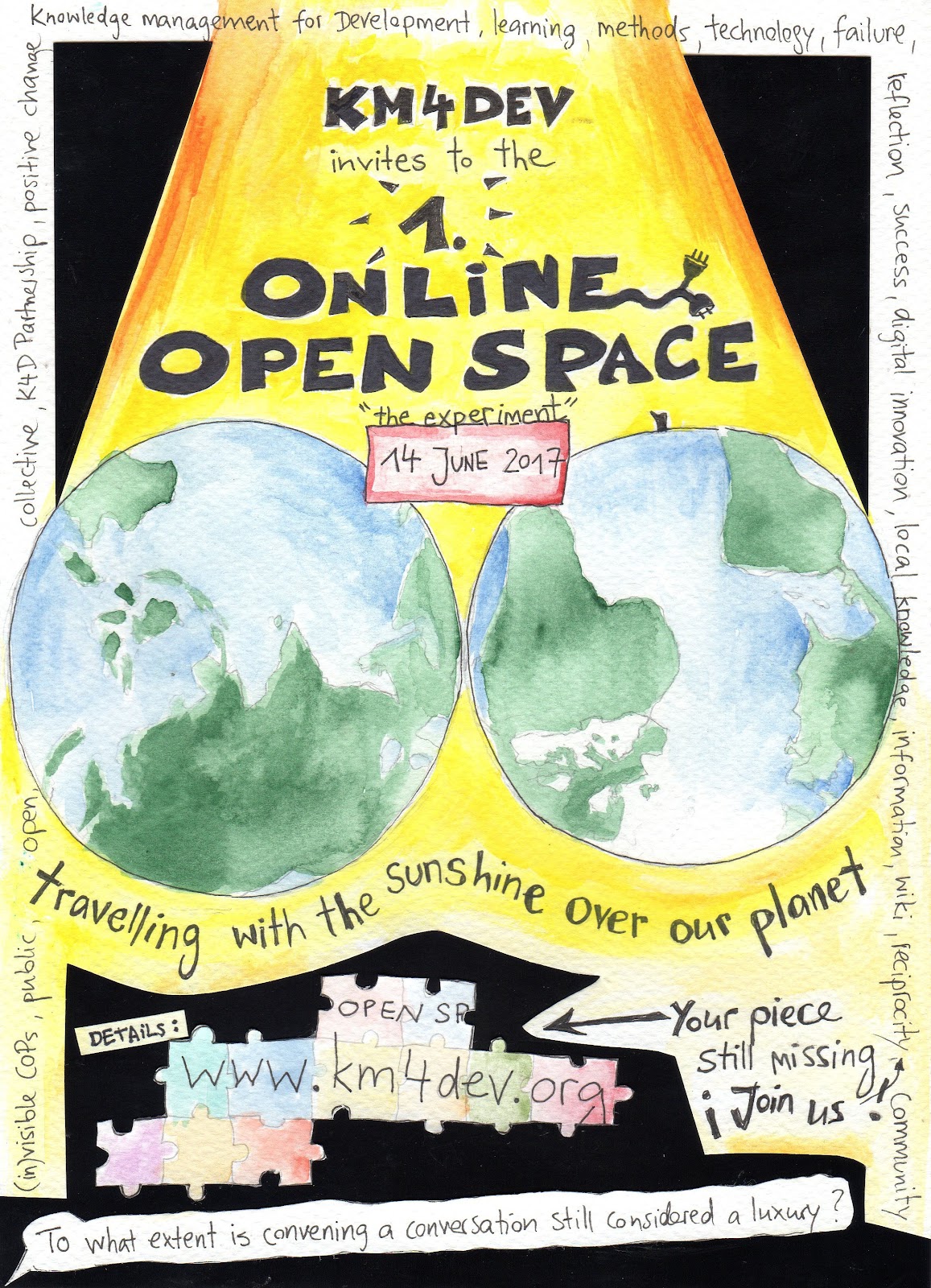
One conversation in particular generated a lot of interest, on the value and constraints of bringing people together to share and learn from each other. Between the need to reduce travel related meetings to limit our carbon footprint, decreasing budgets to organize and attend conferences and events, and a general ‘business’ that doesn’t always allow us to engage, “to what extent is convening a conversation still considered a luxury?

One of the (many) ideas that emerged was to try and organize a KM4Dev online open space - so we offered to facilitate the process to make it happen.

KM4Dev_OOS2017.jpg

So you are invited to join us and experiment in the first KM4Dev Online Open Space on 14th June, from 02:00 London time (01:00 GMT) to 19:30 London time (18:30 GMT). We will be using Adobe Connect for the meetings and Google docs for the Market Place and for notes.

Suggested process

We’re proposing to run approximately two-hour long sessions, with a 30 min break between them. In total, we have up to 8 sessions scheduled, so all timezones should be well covered.
The suggested outline for each session is as below - but of course these are first thoughts and we welcome comments:
  • Hellos, including people logging in, 15m 
  • Introduction to Open Space - principles, how we’ll work, 10m 
  • Marketplace - looking at any suggestions already collected during the registration, inviting new topics, and then the process of agreeing which topics will be led by whom, followed by people selecting which one to join and allocating people to the different online breakout rooms, 30m
  • Conversations of about 30 - 45m 
  • Feedback, about 15m
  • Goodbyes, 5m

Who else is coming?

Some 15 people have already registered, and we’re already covering the whole globe, from Manila in the Philippines to Seattle in the US.


But as you can see in the illustration above by fellow km4dever Tina Hetzel, your piece is still missing. So why not joining us? You can register here and join the list with the other volunteers that have come forward to make this happening.

Come experiment with us, travelling with the sunshine over our planet!

Tuesday, March 24, 2015

Learning - sharing what we know we know

Here's a terrible story whose details we'll hide. It’s from an excellent, well regarded development agency where around 1998 a smart, experienced project manager learned in a country programme that a particular approach didn’t work, it upset people and their lives and was a waste of money. As s/he recounted the experience another equally smart experienced person stood up and said s/he’d learnt the same lesson working in the same organisation in another country around 1989. And I later spoke to someone who works for the same organisation who was too embarrassed to admit in plenary that s/he had learnt the same lesson for the same organisation in another country in 2004!


Stories like this are dismayingly common, and not just in international development cooperation. DfID’s Learning efforts, to take just one, scored Amber/Red 1 in a 2014 assessment by the UK’s Independent Commission for Aid Impact (ICAI). So what can organisations do to learn better? This perennial question is at the centre of a review we’re doing with Water Aid UK on Knowledge Sharing and Learning. It overlaps with the other sanitation work we’re doing, KM in the Building Demand for Sanitation (BDS) programme. Three sub questions are interesting to both projects:
  • Are we too cautious about saying what we know we know
  • How do we record what we know and have learned in ways that people will pay attention to? 
  • How do organisations develop cultures where it is “socially unacceptable not to learn”, as one grantee put it recently? 

Known knowns

On the first point, a conclusion from the terrible story is that the first smart experienced person, who told the story, groaned as he learnt that the same error had repeated, in the same organisation. He suggested we don’t declare loudly and clearly enough what it is we know we know. We are often too tentative and vague, delivering high level bullet point recommendations or simply not sharing our conclusions. As part of the BDS KM programme we're supporting a Learning Exchange where he is going to sit down with two others from two organisations and try to write down what it is they have all learnt, what they know they know (about Sanitation Marketing, in this instance). We're encouraging them to tell the story using a range of media, to try and make their ideas sing and dance.

We'll also be encouraging the group to produce content that makes people think. If there is a document that tells you how to do something, and doesn’t require you to think, then it's probably only a technical fix: important for sure, in specific contexts, but not necessarily generalisable nor stimulating to other people's learning. Meaningful outputs that might enable people to learn across contexts are those that require people to talk together, question and reflect on the basis of what they read/hear/see in the documentation - to learn socially.

But it’s not easy to pronounce on what we know we know. It’s quite a bold thing to do. It’s much easier to ask questions, be tentative. I tried in a long, excellent conversation about knowledge and doledge on the KM4Dev discussion list, and I still feel uneasy about being so definite. A better example is a great blog, "Do we learn enough and does learning lead to improved sector performance?" The authors are two more smart, experienced, WASH specialists and the blog reflects on learning from the recent BDS annual convening meeting in Hanoi. The authors described elsewhere how, when they first re-read what they had come up, with they were startled at how obvious a lot of it seemed. But the blog has been well received, possibly because by stating the obvious, statements about which they were confident, the authors are providing navigational markers by which other people can steer.

But it takes time – and a learning culture - to mainstream that kind of reflection and recording. To quote from the ICAI report on DfID: “DFID is not sufficiently integrating opportunities for continuous learning within day-to-day tasks. In particular, staff do not have enough time to build learning into their core tasks. DFID is not fully ensuring that the lessons from each stage of the delivery chain are captured, particularly in relation to locally employed staff, delivery agents and, most crucially, the beneficiaries. Heads of office do not consistently define a positive culture of learning".

We'll be addressing culture in the next blog.


1. [programme performs relatively poorly overall against ICAI’s criteria for effectiveness and value for money. Significant improvements should be made]

Tuesday, June 03, 2014

Multiple KM4Dev

An extended vocabulary for KM4Dev to describe ourselves now and in the future was one of John Smith's major contributions as part of his consultancy on KM4Dev futures. This vocabulary was introduced along with a framework illustrated below to help envisage different ways that KM4Dev might develop in the future. In the report four scenarios are laid out, one describing the current situation and three describing possible futures.


In his final report John suggests that KM4Dev identity is currently informal and interactionist in nature. Thinking through the implications of being located in another quadrant seemed a good way for a group of KM4Dev members to reflect on the implications of John's report as well as all the other material from KM4Dev that informed his thinking. We recorded in a Google document the process and outputs - including our rich pictures - from that March 2014 meeting.

This blog is a personal reflection on KM4Dev futures - mainly the reality but also the project since we've been in it from the beginning! With Nancy White, we compiled (from years of drafts) the final application to IFAD for a project that focused on KM4Dev, what it can and does contribute, and how it might evolve; with Natalie Campbell, we coordinated the KM4Dev Social Network analysis that was the first product of the project; and then we took on a project coordination role for John's work.

Multiple KM4dev

The notion of multiple knowledges was at the centre of the much missed IKMemergent project. And I think it helps in understanding that KM4Dev operates already in more than than one quadrant, something that became clear to us in the Hague (and online). Jaap Pels did a mapping that illustrates it well, with a page on the wiki to gather ideas
Multiple KM4Dev means to me that the Open Space principle operates: 
people cluster around ideas, usually suggested or led by one or two people; those people stay in the network, report back, engage with the KM4Dev Core Group as necessary, develop short-term (like face to face meetings) or longer projects (like the KM4Dev journal).

Crucially, KM4Dev as a network flexes to accommodate those ideas and projects. If there is energy and some leadership then activity happens, and when it is over, it is over, to borrow from the Open Space principles. This potted history of the Km4Dev journal, lifted from the meeting documentation, illustrates the point.

Case Study - KM4Dev Journal

A group of individual members started the journal because they wanted to. They consulted within the network, and the core group, and have been running it since 2005 as volunteers. In 2009 funds became available from the IKMemergent project to support its becoming a print journal, published by Taylor and Francis (T&F). The decision to move to a printed, published journal, caused controversy within KM4Dev. Some people opposed the move on the grounds that the journal ceased being an Open Access publication, although 200 free print copies were available. Some of the founder members decided to move the journal to T&F, from where it was published between 2009 - 2012. When the funds ceased the journal move back to an Open Access model, from 2013 onwards. 

We suggested the significance of this example is that, firstly, the journal represents a focus on capturing, ‘reifying’ knowledge into collections of articles. The move to T&F was in order to benefit from the more formal status of an academic journal and some argue that the content became more ‘academically rigorous’. In this sense the journal as a whole, and the move to T&F, represent a position where expertise, formally captured, is seen as at least as important as the interactions at the core of KM4Dev. 

The second significant lesson from the history is that it illustrates the benefits - and risks - of a loose structure. A group of individuals started the journal, from within the community. A group of people made a move that other people opposed, yet the material being published largely came from within KM4Dev, which continued to support and promote the journal. It is now back in Open Access format, because the same, dedicated, group of individuals decided to put the time to re-establishing the journal in the Open Journal platform. Km4Dev enabled, supported, and flexed to accommodate the trajectory of the journal. It’s interesting to speculate what would have happened if there had been a more formal structure to which such a set of decisions would be taken. Would a more formal structure have been more rigid, and in consequence taken decisions that resulted in a split - as is so often the case in organisations that are less supple than the loosely organised KM4Dev.

Formal vs Informal - a view of the IFAD funded project

We've also done a case study in the meeting documentation of the IFAD project, to illustrate how KM4Dev operates in the 'Focused Quadrant, where more more formal structures develop but the predominant value is an “interaction” orientation to knowledge production, rather than an “expertise” orientation”.  Formality, in the sense of more detailed and bureaucratic structures for governance and management, is the dimension that worried us the most in our meeting - concern that was reflected in the various conversations that took place online in the KM4Dev network. The IFAD project illustrates both the strengths and weaknesses of the current informal structure.  On the plus side, a lot was achieved in terms of research, useful reports, conversations - both 'directed' and emergent - in the network and the richness of the work that John led, co-created from and with KM4Dev members. However, I think that the absence of any dedicated, paid, coordination made the project inefficient, in the sense that time was wasted in getting things started and delivered, and opportunities to learn with the network weren’t taken as fully as they might have been. The only coordination came from the already over-burdened volunteer KM4Dev Core Group, which has next to no formal structure or processes. That exacerbated the inn efficiency, yet the project delivered, people volunteered and all we know about learning tells us that a lot of people will have been enriched by the exchanges, the materials and their spin offs.

Relax, don't do it

One of the driving forces for the IFAD project was a fear about KM4Dev surviving in the absence of funding. And there were those who argued that KM4Dev should become more of a formal entity, to be able to attract more funding and become more influential, to be able to advocate for KM in Development. Discussions continued over most of the project, with a particularly rich set of exchanges on Nancy White's blog. But the impression from all the exchanges is that probably a majority (of those who contributed): 
  • do not support  KM4Dev  moving to a formal, governed structure, with a constitution and the formation of a legal entity. Indeed there is support for the opposite, staying as organic, emergent, informal and open as we are
  • believe that funded activity can deliver enormous benefits and that funds will be useful for 
    • a paid coordinator
    • Support for KM4Dev face to face meetings, including scholarships for people to attend, especially from the global South.
Probably the most inspiring development is the number of people volunteering to contribute to KM4Dev, via a membership scheme of some kind. It will be interesting to see what emerges, how much money is actually generated.

KM4Dev hasn’t done a review or evaluation of the IFAD project which would be a useful activity. While John Smith’s reports are a rich resource of information and analysis on KM4Dev his final report is deliberately not a set of recommendations or a plan. There is an interesting outstanding question as to whether the outcome of the whole KM4Dev futures process is that one, single community-driven strategy plan cannot be and shouldn’t be a target. That the logic of the report, driven by the network in discussions and in response to surveys, is instead of multiple future states co-existing within a healthy KM4Dev network - a model of one of those complex adaptive systems we are all learning to recognise and love. 

Thursday, September 22, 2011

AgriKnowledge Share Fair 2011

The second AgriKnowledge Share Fair is about to kick off next week, hosted by IFAD in Rome (from 26 to 29 September).
It's going to be packed: "this four-day event will provide a forum to learn and share knowledge, experience and innovations on emerging trends relating to agriculture, food security, price volatility, climate change, changing demographics and other rural development related issues".
Having participated in two previous Share Fairs, in Rome in 2009 and Addis Ababa last year, I know this is going to be a very exciting gathering, with 160 presenters from across the planet, discussing their experiences and innovative ways to share knowledge in the agricultural and rural development sector - see the final agenda here.


We'll be in Rome for the whole week and we have a very exciting agenda ahead. More importantly, we look forward to meeting old and new friends.
To start with, on Day 0, Monday 26 September, we'll be facilitating several modules on knowledge sharing tools and methods:
  • Collaborative writing (1100-12:30, room B400)
  • Microblogging (14:00-1530, room C400)
  • Video production, storing and sharing (14:00-1530, room C200)
  • Open space (16:00-1730, room C500)
  • Dgroups (14:00 to 15:30, room B500)

From Tuesday to Thursday, we will provide support and facilitation to the following sessions:
  • On 27 September, Dgroups annual members meeting (14:00 room B100);
  • On 28 September, Sensemaking: The cognitive map of farms - Experiences of sharing agricultural knowledge in Southern Africa (171) (11:00, room C400);
  • On 29 Septembers, Helping farmers identify fake or genuine agro-inputs using SMS (138) (14:00 room C300)

We'll be also collaborating with the #sfrome social reporting team. We will focus on sourcing and aggregating the content that is produced during the event, so we can deliver it to users into a consolidated information product. Here's the link to the aggregated Share Fair newsfeed and email alerts. You can also take a look at the Netvibes dashboard we've been playing with: it still needs some work but we think it can be useful to keep track of the different "#sfrome" conversations in one single window - feedback and comments are most welcomed!

Finally, the week climaxes - for us at least - with the KM4DEV members meeting!

Follow the event remotely, comment on media and share your reactions with us.

Share Fair news and updates