Google+
Showing posts with label web2share. Show all posts

Thursday, May 19, 2011

Social media masterclass @EADI

On May 12 and 13, 2011, Euforic Services facilitated a social media masterclass organised by EADI in Bonn. This workshop built on previous introductory and basic web2.0 trainings we had co-organized with EADI in 2008 and 2009, as well as on the one day advanced session with the NEDS network in Switzerland in 2010.

The session was designed to be participatory, more of a peer exchange than a formal training. We knew that participants had a lot of experience already in social media, with most of them having using it for several years in their daily lives and work. We wanted to tap into their experiences and make sure they had space to share knowledge amongst themselves as well as hear our ideas.

A pre-workshop survey helped us to assess participants’ level of knowledge and understand more of their expectations. Once we met face to face, we started off with a new (to us) icebreaker, adopting from Beth Kanter the ‘twitter on paper’ exercise.

The main focus of the first day was on what it means to be online today, what has changed in the past two years in terms of the social media toolkit and approaches to using the tools. We brought in examples of how other organisations are leveraging social media to strengthen their online presence, showing which channels they use to communicate and converse online. In particular, we looked at how to set up your social media management centre. We use the term to describe a simple but effective listening dashboard which can be used to tap into conversations on the social web; to select, share and archive relevant content; and to aggregate, curate and republish to reach and engage with your different audiences.


On the second day, we started with a discussion on tools and approaches to measuring online activity, on your website as well as on other social media channels you might use. Among others, we discussed the concept of Crowdmarketeers that our former colleague Chris Addison (now at IFPRI) had presented just one week before during the KM Impact Challenge unConference.

Last but not least, a discussion on social media strategy and policy gave participants all the elements to define their own social media projects. Participants then split into 3 groups and worked on a fictional scenario. Their task was to define a social media strategy to support a specific business process. A plenary discussion of the working groups closed the workshop.

The format, design and content of the workshop worked well. Participants were actively engaged throughout the two days and they all felt they had either learned something new or seen different aspects of using social media that they were not aware of or hadn't paid enough attention to. They all went home with clear, actionable ideas and it will interesting to keep track of how these develop, and what useful lessons can be shared back again with the rest of the group.

From our side, the feedback received was very valuable and we’ll use it in the design of future sessions.
Wednesday, December 08, 2010

Social media masteclass @ NEDS

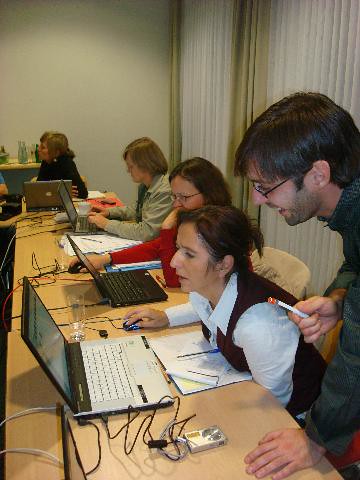
On 29 November, 2010, we facilitated a one-day masterclass on social media for the NEDS network. The session was organised with our colleagues at EADI and was hosted by the Graduate Institute in Geneva.

The Network of Swiss Development Documentation Centres (NEDS) comprises the 20 most important Swiss development cooperation libraries and documentation centres. It's an informal network. Its members meet twice a year to exchange professional and technical information and look for ways to improve development cooperation documentation. They also organise group trainings and awareness sessions on issues realated to information, knowledge sharing and communication.

All the participants already had a basic knowledge of social media and collaborative tools: what they felt they were missing was a wider perspective and knowledge of what others are doing. They wanted to compare notes and get some guidance in thinking about social media from a more strategic perspective.

A pre-workshop survey helped us in profiling the group, so we could tailor the session as well as try to match objectives and expectations in the limited time available.

In terms of session design, we divided the time available in 2 parts:
  • The morning session provided users with background information on what social media means for an organisation, explored how you define a social media strategy and shared examples of success stories and case-studies. We then moved onto the tools, and had a conversation about how different tools have been introduced and are used in different organizational contexts, including small non profit organisations, research institutes, academia and international organisations. While we were providing examples of different business process and activities where social media can add value, participants presented their cases and experiences. Together we started surfacing challenges and opportunities that social media brings, in different organisational contexts.
  • For the second part of the session, we identified different cases, or 'organisational problem examples': participants formed groups around the issue most relevant to them and together defined a social media strategy to tackle these issue. Taking this further, they looked at how to work with social media to reach a specific, defined outcome. The result of the 'think-labs' was then shared back in plenary, for a final round of feedback and discussion.

Even if the time available was limited for such an exercise, having different tables working on pre-defined, fictional but yet realistic scenarios, proved to be very engaging for participants. For us, the design and facilitation of the session was very different from workshops that we have been running for several years as introduction to web2.0 and social media. We'll probably be expanding the programme and developing two day master-classes, to be held in 2011.

Monday, November 23, 2009

Information, knowledge and communication – 3rd training on the social Web in Bonn

In a good tradition Euforic facilitated the third Web2Share Training in Bonn. The event took place from 19-20 November 2009 and was co-organized with EADI, the European Association of Development Research and Training Institutes.

Like in the years before a diverse group of information and communication professionals from several countries, including Switzerland, Norway, Italy and Germany joined the training. Among other things they expected to learn how to work with social webtools such as wikis to cooperate and to share knowledge in open and closed networks. Furthermore they were looking for guidelines for social media usage in NGOs, good monitoring tools and podcasting.

The Euforic trainers provided an up-to-date overview of possibilities and advantages that web 2.0 tools and social media offer for their work. Popular buzzwords included “social bookmarking”, “RSS”, “wikis”, “blogs”, "Googling", and “podcasting”. Besides, we looked at how to connect and integrate these new tools into daily business processes across the organization, for communication, knowledge sharing and campaigning.

Since an increasing number of our participants have already some experience with the new Social Web, we spent more time on storytelling and discussion then in our first trainings. We compared experiences and explained new ways to apply tools strategically for different purposes. To name just a few, discussions touched upon issues like the pros and cons of social networking sites for organizational purposes, privacy and content ownership, or the use of internal micro-blogging tools.

Towards the end of the training participants were fascinated by the different possibilities the new Web provides but also called for more advanced training.

Some interesting quotes from the evaluation:


"I think I can teach the communication crowd how to work with some of the new tools but I'm afraid it won't go that well with the researchers, who are not always keen on sharing."
"I knew most of the tools already, but this workshop confirmed that you really need to look at the target group to know which tool or package to use. I feel that I don't have the time to use all this, but what is worse is that my colleagues think that everything connected to a computer is up to me, because I'm the IT person"

"The Web still very depends on written language but I'm sure that podcasts are the future."

"I heard what is going on on the Web before but now I'm not afraid anymore to try it out and use it for my organization"
Former Euforic associates and staff will look into possibilities to organize a Master Class in the first half of 2010 which will address the challenges participants face when they go back to their organizations.

See some pictures of the workshop

Explore the Euforic Web2Share Wiki

Find more information about Web 2.0 in our newsfeed

Sunday, October 18, 2009

Putting web 2.0 to work - Training on the social web - Bonn, 19-20 November 2009

After the success of the last web 2.0 workshops and the positive feedback received from participants, the European Association of Development Research and Training Institutes (EADI) and Europe’s Forum on International Cooperation (Euforic) organise a new workshop: “Information, Knowledge and Communication - Putting web 2.0 to work: Training on the social web”.

As last year we intend to provide information and communication professionals in the development community with an up-to-date overview of possibilities and advantages that web 2.0 tools and social media offer for their work. Some of the buzzwords include “social bookmarking”, “RSS”, “wikis”, “blogs”, ‘Googling’, “podcasting” - all are free to use and they provide numerous flexible solutions to the challenges we face. Besides, we aim to look at how to connect and integrate them into daily business processes across the whole organisation, for communications, knowledge sharing and campaigning.

The workshop will equip participants with the skills to use and combine these tools into useful information sharing systems. We will be exploring and learning from a typical organisational toolkit 2.0. This might include blogging, the use of multi-media tools, wikis, custom searches and customised feeds for news or knowledge sharing as well as use of online social networks.
This course is designed for individuals and teams who are new to the tools, as well as currently exploring these tools and want to extend their use. It will also include “second wave” adopters, individuals and teams who are not web specialists but who want to extend their use of web 2.0 approaches into areas such as research and policy communications; collaborative working; publications, network and partnership relations and event management – bringing together participants, social reporting and documentation.

The workshop will combine presentations from people who use the web 2.0 in their everyday work, with intensive guided ‘hands-on’ training.

This workshop forms part of the Euforic web2share initiative that supports Euforic members in using the new web tools and services and working collectively.

Cost: 550€ EADI/Euforic members (650€ non-members) including 2 days training, materials, lunches, refreshments.

To register or get more information, please contact heil(AT)eadi.org

See Euforic newsfeed, dossier and wiki on web 2.0.

Monday, April 27, 2009

Putting web 2.0 to work - training on the social web - London, June 1-2, 2009

Facebook and Delicious are five years old; Blogger nearly 10 and Twitter already three! Web 2.0 is no longer new and web teams are active users. The challenge has always been how to connect and integrate them into business processes across the whole organisation process daily business processes, for Communications, Campaigning and Knowledge Sharing.

This course targets primarily the UK based NGOs and is designed for individuals and teams who are currently exploring these tools and want to extend their use. This will include members of smaller organisations, who may be using only one or two of the range of options. It will also include "second wave" adopters, individuals and teams who are not web specialists but who want to extend their using web 2.0 approaches into areas such as policy communications; collaborative working; publications, network and partnership relations and event management – bringing together participants, social reporting and documentation.

Over the past four years Euforic has developed an approach to integrating these tools which has been the basis for its training programmes, as well as for its leading role in the 07 Rome web2fordev conference. This two-day practical course has been adapted to the UK context. It aims to equip you with the skills to use and combine these tools into useful small information sharing and publishing systems. We will be exploring and learning from a typical organisational toolkit 2.0. This might include blogging, the use of multi-media tools, wikis, custom searches and customised feeds for news or knowledge sharing as well as, especially in the UK, use of online Social Networks. The individual tools are easy to use and free.

Participants are encouraged to bring examples and challenges from their own situations as the basis for the practical work and we will look at examples from UK and other European development and social change NGOs. Healthlink Worldwide, a Euforic member and an avid user of new media, is hosting the training.

See more information and registration form at http://practicalweb2.eventbrite.com/

See Euforic newsfeed, dossier and wiki on web 2.0.

Monday, April 06, 2009

Workshop: Introducing Blogs, Wikis, Newsfeeds and RSS - Maastricht, 2 and 3 April, 2009

On April 2 and 3, Euforic organised the fourth two-day workshop on the 'new' or 'social' web. Aimed at people in organizations working in international cooperation, it familiarized participants with new tools and show how to use them to deliver low cost, participatory, and more integrated web presence.

Covering the use of Blogs, Wikis, Newsfeeds and RSS the course combined presentations, hands-on, and lessons from people already using these tools. Participants could see what others have done, how they could use these tools and assess how they can help them and their organization to find relevant - and often hidden – information; also how they can help disseminate their information more widely.

This workshop, hosted as the previous editions by ECDPM, forms part of the Euforic web2share initiative that supports our members use the new web tools and services and find ways to work collectively.

See Euforic newsfeed, dossier and wiki on web 2.0.

Tuesday, February 10, 2009

Euforic web2share events in 2008

In 2008, our web2share activities have been growing and represented a great deal our work.

Since late 2005, Euforic has used a wide rang of 'social' web2 tools to make development cooperation information more accessible. Through internal as well as public web2share training and events, we share our experiences with members and partners.

In April and November, 26 people signed up for our regular two-day workshops - in Maastricht hosted by ECDPM and in Bonn, jointly organised with EADI . They will be run again in 2009 - see the announcement.

During the first half of 2008, together with CTA and the ACP Secretary we ran a series of sessions for ACP embassies in Brussels. Starting with introductory workshops on web2 at the ACP House in February and March, we then delivered a series of training sessions in June. In total, some 22 ACP embassies were involved and about 50 people attended the sessions, run in English and French.

Compared to previous years, in 2008 we ran more sessions within our member organisations, sitting with them, discussing the potential of the social web and exploring ways to put these into practice. In these sessions, we worked with CIDSE in Brussels, DFID,Healthlink Worldwide and the Wellcome Trust in London, IDS in Brighton, Concord and its communication network, and our Nordic members DIIS, DDRN, NORAD and NIAS (read more).

In 2008 we also continued to support ICCO staff and partner organisations in getting familiar with the social web and embedding these new tools and approaches into their 'business processes'. As well as training in different tools and applications, we started a series of 'ComPart surgeries' - regular weekly sessions of two hours where people can drop in, meet experts and champions, get advice and answers and share tips (read more)

In terms of format of the public sessions, we maintained the modular approach that proved to be popular in previous years.

As for the content, we try to match the interests of the participants while introducing new areas and drawing on experiences in the Euforic network. Compared to previous years, we focused more on areas like social networking, video sharing and podcasting, and searching the new web.

Last but not least, an important development of our web2 activities was the launch of a French version of the web2share wiki - jointly developed with ICCO. A Spanish version comes soon. Several people have requested access to these spaces and will contribute to their further development.

To stay up-to-date with these activities, subscribe to our web2 newsfeed, see our web2 dossier, check out the web2share wiki.

Read more related posts on this blog.

by Pier Andrea Pirani

Monday, December 01, 2008

Workshop: Web2.0 in development cooperation - Bonn, 27 and 28 November, 2008

After the success of last year's web 2.0 workshop and the positive feedback received from participants, the European Association of Development Research and Training Institutes (EADI) and Europe’s Forum on International Cooperation (Euforic) organised the second edition of the workshop 'Information, Knowledge and Communication - Web 2.0 in Development Co-operation'.

As last year we provided information and communication professionals in the development community with a up-to-date overview of the possibilities and the advantages that web 2.0 tools offer for their work.

Some of the buzzwords include “social bookmarking”, “RSS”, “wikis”, “blogs”, ‘Googling’ and “vlogging” - all are free to use and they provide numerous flexible solutions to the challenges we face.

This ‘web 2.0’ offers various ways to use these opportunities to improve and enhance the data and information management of your own organisation. Most of these offerings are completely free of charge. Used alone or in combinations, the new tools may revolutionize the way development information is created, accessed, shared, and used.

Our two-days workshop combined presentations from people who use the web 2.0 in their everyday work, with intensive guided ‘hands-on’ training.

Participants included both novices to the subject and more advanced users, who wanted to get more detailed know-how. Very interesting was the composition of the group, with a good mix of people coming from different development organisations, being research institutes like DIE and ZEF, development agencies like SDC, networks such as DDRN, and a various range of NGOs and civil society organisations.

The closing roundtable highlighted some of the lessons learned, and how participants started to think about possible use of different applications:

"Several of the tools we practiced with in the past two days seem ideal for running and supporting campaigning."

"I think that both blogs and wikis can offer a lot in terms of supporting our main website; I still need to figure out how exactly to proceed, but I really see potential."

"This training has been very useful, as it provided a broad overview of what's happening on the web and how development organisations are embracing these new tools. Personally, I'm not fully convinced that bloggging is effecient way to communicate, but all the other things we saw these days are very good for information and communication."

"Even if I was already familiar with some of the tools, this type of event allowed me to raise my level of confidence. It is important in fact to see how others are using the 'new' web in a professional way; in particular, I'm impress with the possibilities offered by wikis and RSS feeds. The difficult part will now be to get back to my organisation, and try to mobilize my colleagues!"

This workshop forms part of the Euforic web2share initiative that supports Euforic members in using the new web tools and services and working collectively.

See Euforic newsfeed, dossier and wiki on web 2.0.

Monday, October 20, 2008

Introducing web2 at IDS

In October 2008, Euforic's Chris Addison and Pier Andrea Pirani joined the colleagues at IDS in Brighton to run a series of sessions on web2 and how this is used among development organisations.

For four days we met with different groups and, between presentations, practical examples and discussions, we went through different aspect of the new web and how this can be used for marketing, sourcing content, disseminating information, and networking.

In this video, we asked Adrian Bannister, working for BRIDGE in the IDS Information and Communication Team, to share some impressions about the different sessions he attended.


Video thumbnail. Click to play
Click To Play

This workshop forms part of the Euforic web2share initiative that supports Euforic members in using the new web tools and services and working collectively.

See Euforic newsfeed, dossier and wiki on web 2.0.

See also the newsfeed from IDS.

Sunday, October 19, 2008

Web2 at the CONCORD Communication Network

On 15 October, participants in the CONCORD Communication Network met in Brussels for a two day workshop on information, knowledge and communication. The purpose was to share and discuss the results of the 2008 media work, to define actions and opportunities for 2009, and to address the issue of communicating better as a group and with the members of the different national platforms and networks.

As part of this effort, Euforic has been invited to present the possibilities offered by the social web and to share with participants some of the lessons learned from 'doing' web2 for more than 3 years now.

Peter Ballantyne updated participants on ways that emerging ‘social media’ are empowering citizen to citizen communication: what's the social web and how are people using it, to communicate, collaborate, exchange information and knowledge?

A practical hands on session followed, and participants have been introduced to the basics of the 'new' web. Working in pairs or small groups, they created a personal home page and started working with feeds, seeing and understanding how content can 'travel' and how it is now possible to 'read' the web in a different way.

Further, they also saw how to easy it is to 'write' the new web, by publishing content in a blog. A short intro on videos, pictures and presentation sharing concluded the day.

At the end of the day, we asked Laura Sullivan from ActionAid some reflections on what she saw and practiced with. This is what she had to say:


This workshop forms part of the Euforic web2share initiative that supports Euforic members in using the new web tools and services and working collectively.

See Euforic newsfeed, dossier and wiki on web 2.0.

Friday, September 26, 2008

Social web awareness and training at Healthlink Worldwide


In September 2008, Euforic hold a three-day awareness and training session on web2 with new member Healthlink Worldwide, In London.

A preparatory day gave us the opportunity to discuss Healthlink’s expectations from the training, understanding their needs and see which specific needs could be addressed by the introduction of web2 tools.

With this picture in mind, the first day of the training focused on a general introduction to the social web, and how development organization are embracing it to run their back office, collaborate with different partners and communicate with the wider public. Two hands on session gave Healthlink staff the opportunity to set up their own ‘gourmet’ dish of information, using Google personal page, start publishing their news and reflections on a blog, and set up wiki pages to organize events and coordinate projects.

A roundtable discussion closed the day, giving us important feedback to arrange the agenda for the second day, so to accommodate the growing interest of the team.

On the second training day, we kicked off again in plenary by looking at the different ‘forks’ we need to navigate the ‘spaghetti’ junction of information now available on the net: different Google commands to make the most out of our web queries; specialized Google services like blogs and news searches; thematic portals such as R4D and AiDA; multimedia content with iTunes and Podscope.

Introducing Delicious provided a way start making sense of this wealth of content, using tags to organize it and creating new lists of items to be republished on different websites.

The last part of the plenary explored tools for remote collaboration, using applications such as Google Calendar and Google Docs; and understanding how and why development organizations are increasing their presence in spaces such as Facebook and Linkedin.

A final intensive hands-on session encouraged Healthlink staff to practice with their preferred applications: Often working in pairs, different people mastered the use of different applications, some working with blogs, others editing videos, others uploading presentations in Slideshare and pictures in Flickr. Allowing time for each person to work on what they preferred proved to be quite beneficial, as the team, together, has experience on a wide range of tools and can more easily support each other in using them.

The closing roundtable highlighted some of the lessons learned:

“It’s important for Heathlink to stay in the loop and see what’s going on in terms of using the web. This type of exercise has to become part of an ongoing learning process.”

“All the different things we’ve been experimenting with these couple of days are extremely useful and have huge potential; we now have to discuss and see how we go about it.”

“Now it’s all about practice: we have to see what the different team members are interested in mastering and try to combine our skills and expertise.”

“We could benefit a lot from the social web, in particular as far as coordination among the team is concerned.”

“We could think about linking this type of awareness and training session about the social web to our quarterly reviews, to reinforce our learning processes.”

“The most amazing thing is how user friendly all these applications are. Even more, they’re almost all free of charge!”


by Pier Andrea Pirani

See Euforic newsfeeds on Healthlink Worldwide, and on information, knowledge sharing and communication

Tuesday, June 10, 2008

Web2share training sessions with ACP embassies

Following up some earlier awareness sessions, twenty-two embassies (see map on the right) were involved last week in a series of web2share training sessions organized by CTA and the ACP Secretariat and delivered by Euforic at the ACP House in Brussels.

In total, 50 people attended sessions in English and French.

Participants started with remote collaboration tools such as wikis, worked through 'virtual office' services and tried out some newer search options on the web. They finished the day working with blogs and integrating information from various sources using newsfeeds.

Preliminary feedback suggested that many of the participants will use some of the new skills they had learned, particularly for remote collaboration and information retrieval.

CTA Giacomo Rambaldi introduces the project


Several new training materials were developed for the training, including French language versions of explanatory videos and the first version of a web2 matrix. The matrix, developed by CTA, explains some of the uses of web2 tools in development and follows up on the work of the Web2forDev initiative.

We also welcomed Robin Ruquet to the team and thank him for his assistance in the French language training.

by Chris Addison
See Euforic newsfeed, dossier and wiki on web 2.0.

See also Euforic newsfeeds on ACP-EU cooperation and ACP-EU trade; and from the ACP Secretariat and CTA.

Monday, April 14, 2008

Workshop: Introducing Blogs, Wikis, Newsfeeds and RSS - Maastricht, 10 and 11 April, 2008

On April 10 and 11, Euforic organised its third two-day workshop on the 'new' or 'social' web. Aimed at people in organizations working in international cooperation, it familiarized participants with new tools and showed how to use them to deliver low cost, participatory, and more integrated web presence.

Covering the use of Blogs, Wikis, Newsfeeds and RSS the course combined presentations, hands-on, and lessons from people already using these tools. Participants could see what others have done, how they could use these tools and assess how they can help them and their organization to find relevant - and often hidden – information; also how they can help disseminate their information more widely.

The closing roundtable highlighted some of the lessons learned and the issues emerged during the two days:

"I'm very interested in wikis and in the possibility to disseminate the conte we produce via services such as iTunes; I think we have a lot to do to improve our services! I'll try to keep my blog going, also to document the process of writing an annual report with a wiki."

"First of all, I had a lot of fun in the past two days! I'll be using several of the tools I've seen these days. For example, I'm thinking that we could use wikis for developing educational booklets. Further, social bookmarking seems to be ideal for working with colleagues."

"I think it's important to see how these tools can find practical application in my day-to-day work, attaching the tools to concrete issues. Wikis for example seem to be ideal for conference setup and follow up, while a blog can be used for creating discussion spaces. For sure I intend to make a more intense use of Delicious to feed and update the documentation center of my organisation."

"I also had really a lot of fun! It's very good to have so many hands on session and to be have enough space to discuss with colleagues which tools could be used, for what. I think I'll be using delicious for personal use first, then I'll see how to introduce it in the office. And I've already started to read feeds to keep track of what's happening."

"The tools are easy to learn and to use. I see lot of opportunities in the 'new' web: I work with networks, and members need to communicate with each others, but this is sometimes difficult to get. These new tools may help out in that, and people need not to be afraid of the technology. Further, I also had a lot of fun!

"I need to dive more into these things and overcome the fear of exposing myself. But I believe that once you get the things rolling, you'll have better impact and dissemination and save yourself a lot of work!"

This workshop is part of Euforic's 'web2share initiative' that supports our members and others in the use the new web tools and services and finding ways to work collectively.

See Euforic newsfeed, dossier and wiki on web 2.0.

Monday, April 07, 2008

TRIALOG 2.0: using a blog to disseminate news

The Trialog Project aims to strengthen development cooperation through the full integration of development NGOs from New EU Member States and EU Accession Countries into CONCORD and other European networks.

Trialog activities include capacity building and training for members of NGDOs, support for the creation and strengthening of national platforms and their integration into CONCORD, and networking to strengthen cooperation between key actors in the field as well as policy and advocacy activities.

After participating in several CONCORD/Euforic web2share events in the course of 2007, TRIALOG staff embraced web2.0 tools, turning its newsletter, the Trialog Information Service, into a blog.

This way, not only the content is more accessible, it is also easier to share and disseminate.

Anita Bister, Trialog's Communication Officer reflects on their experiences:


Subscribe to the Trialog blog; See Euforic newsfeed, dossier and wiki on web 2.0.

Saturday, February 23, 2008

Web2share sessions with ACP Ambassadors

On February 4th and 5th Euforic, CTA and the ACP Secretariat organized an introductory workshop on 'web2' at the ACP House.

Attended by representatives of 27 African, Caribbean and Pacific embassies in Brussels, the presentations introduced web2, discussed remote collaboration tools, and explored new ways to retrieve information across the web.

Euforic looks forward to working with CTA, the ACP secretariat and the embassies on further development of web2 use in the ACP community in Brussels. Follow up sessions are planned later in the year.

See Euforic newsfeed, dossier and wiki on web 2.0.

See also Euforic newsfeeds on ACP-EU cooperation and ACP-EU trade; and from the ACP Secretariat.

Monday, February 11, 2008

Introducing web2 at CIDSE

cidse
On 8 February, Euforic organized a one day web2share awareness session for CIDSE staff on the 'new' web.

Participants created personal home pages and got to grips with newsfeeds to track the content of their favorite sites. They explored how to create their own newsfeeds, from their own blog and by tagging content with social bookmarking applications. They finished by editing their own wiki pages and learning ten ways to search the new web, using different 'spaghetti forks' to unravel the web's content spaghetti.

Discussion at the end of the day showed that most participants had some clear ideas how they could put their new skills into practice.

See Euforic newsfeed, dossier and wiki on web 2.0. See also Euforic's newsfeed on CIDSE

Monday, January 07, 2008

Euforic web2share events in 2007

During 2007, Euforic greatly increased its 'web2share' training and awarenes activities. As well as the annual two-day event in Maastricht (with ECDPM), we held joint workshops with several of our members: CONCORD and CIDSE in Brussels, and a two day session with EADI in Bonn. We also provided a series of training sessions within organizations including NORAD (Norway), DCISM and the Nordic Institute of Asian Studies in Denmark, ISS, ICCO, the Bernard van Leer Foundation and ECDPM in the Netherlands, and CIDSE in Belgium.

The modular approach continued to be popular; we generally offer 3 modules:
  • A lunchtime awareness session (normally 1-1hr 30mins), covering the key elements of web2 and examples of its use in the international development sector;

  • A one day session (10am - 4pm), popular for NGO information managers wanting to get a complete overview with some hands-on;

  • Two days training course; in depth practical exploration of blogs, feeds, calendars, social bookmarking and wikis. Feed management, publishing and statistics are also covered.
Stay up-to-date with these activities! Subscribe to our web2 newsfeed, see our web2 dossier, check out the web2share wiki.

Read more related posts on this blog.

Friday, December 28, 2007

Euforic web2share reaches into Scandinavia

During December 2007, Euforic run several web2 training sessions in Denmark and Norway.

At NORAD, we introduced staff and management to various web2tools. Feeds were particularly interesting as ways to keep up to date.

At the Danish Centre of International Studies and the Nordic Institute of Asian Studies, the focus was on both information managers and researchers. The hands on sessions included blogs, wikis, tagging, feeds and mashups. Exercises with researchers highlighted the value of some of the translated search approaches available.

See Euforic newsfeed, dossier and wiki on web 2.0.

See also Euforic newsfeeds on Norway and Denmark

Saturday, December 22, 2007

ISS library explores web2

In October and December 2007, Euforic introduced the basics of the 'new' web to library staff of ISS, in The Hague.

The objective was to 'expose' people working in the Library services to the new web, in particular making them familiar with newsfeeds to 'read' the web; sharing and archiving interesting links using social bookmarking applications; uploading content by publishing news in a blog, and working together on a wiki.

Participants enjoyed the different tools presented, and showed a genuine interest in the potentialities that these can open to ISS in making its services a 2.0 library.

See Euforic newsfeed and dossier on web2; web2share wiki on web 2.0; and Euforic newsfeed from ISS

Sunday, November 25, 2007

EADI, Euforic hold Web2.0 for Development Workshop in Bonn

In a workshop organized with EADI, Euforic introduced members of German development cooperation organizations, including GTZ, Inwent and the UN Volunteers, to the 'new web'.

The training course from 22-23 November provided the 16 participants with basic knowledge about Web2.0 tools such as blogs, rss-feeds, wikis and social bookmarking as well as new features in the web which are relevant for knowledge and information management or research.

After short introductions by the trainers, time was given to the participants to test the tools themselves and create their own blogs, wikis or social bookmarking accounts.

Particularly popular was the 'googology' session where the full text of books was searched online, web pages were searched in arabic and chinese and displayed in english, and project databases were searched for research contacts.

The closing roundtable showed a great enthusiasm about the new possibilities spread and a lively discussion on how to incorporate these new tools into more or less static knowledge management systems started among the participants.

See some pictures of the workshop on the Euforic flickr account; learn more about our other training and learning activities.

See Euforic newsfeed, dossier and wiki on web 2.0.

Story by Martin Behrens