Google+
Showing posts with label social reporting. Show all posts

Monday, December 02, 2013

Do more with your tweets - Social reporting at ICT4Ag

In my previous post about tracking the online buzz generated around the ICT4Ag conference I’ve mentioned a couple of the tools that we used in the social reporting of the event. At the ICT4Ag conference, blogs, workspaces, Twitter and the other ‘usual suspects’ formed the backbone of our technology infrastructure.

However, besides these tested and tried solutions, this time around I wanted to experiment with some new applications around the edges of the process.

In this and the following posts I’m going to zoom in and focus on technology, presenting some new (to me at least) applications that I’ve used and what I’ve learnt - and what I would do different next time to further develop my own practice.

Specifically, this post looks at different tools to do (much) more with Twitter.

Conference structure, KM and Twitter #tags

The conference programme was organized around 3 main conference streams, a Plug and Play day and a Hackathon running in parallel to the main event. While it was a no brainer to decide the conference tag and the tags for Plug and Play and Hackathon, the design of the conference in streams and sessions presented some challenges in terms of effective use of #tags in Twitter.

On the one hand, we were expecting (as it indeed happened) quite some buzz on Twitter - and we needed to have ways to aggregate and disaggregate tweets around different conversations. On the other hand, CTA KM team was also interested in finding ways to archive and search the different tweets - around the conference #tag and specifically according to the different conference streams. Finally, we wanted to have the possibility to display specific twitter feeds on each tabs of our social dashboard.

So once we had decided a basic #tag vocabulary, with specific #tags for each session, I was faced with the challenge to find ways to:
  • Extract information from Twitter a Search - possibly a feed search results for each session #tag; 
  • Aggregate this info to display twitter feeds around each of the three conference streams; 
  • Find a way to archive and search these Tweets.

Display and aggregate Twitter search RSS feeds

This sounded complicated to achieve when I first looked at it. With the recent changes in Twitter API policy, users are no longer able to obtain any of the Twitter streams – search results, timelines of users, users’ favorites etc – in an RSS feed.

After spending some time researching and testing online what tools I could use to get a Twitter RSS feed, I found that some smart folks out there had the answer I was looking for and I was able to use some simple Google Scripts to set up a Twitter RSS feed for each session #tag search result.

Once I had created these 25 odd Twitter search feeds (one for each session #tag), I was then able to aggregate them into consolidated feeds for each of the 3 conference streams, using Yahoo Pipes. So for example, out of the Twitter search feeds for each of the 12 sessions in the Emerging Innovation stream, I was able to produce a single, aggregated Twitter feed.

Never miss a Tweet!

Once I’d solved this challenge, I was still presented with the need to find ways to archive tweets - as after a while they disappear from the search results. Plus, this Twitter archive had to be searchable, to meet the needs of the CTA team to browse and use this content in the future.

The solution here came from a brilliant post by Martin Hawksey, where he presents TAGS5.0 - a way to archive AND visualize tweets, automatically pulling results from a Twitter Search into a Google Spreadsheet.

This was indeed a great discovery and using it has proved to be of great interest and value

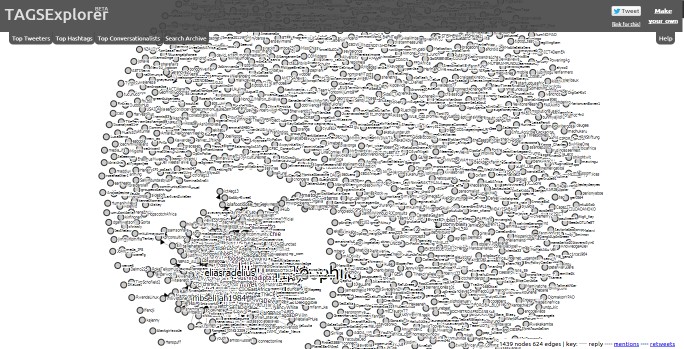
The full Twitter archive for the conference hashtag #ict4ag13 is available as a public Spreadsheet on Google Drive. You can also explore the interactive visualization of the conversations on Twitter, mapping replies, retweets and mentions, and the relations between different users. Finally, it gives you a complete Twitter archive that can be easily browsed and searched by keyword or by username.

Together with one main Spreadsheet for the conference hashtag, I’ve also repeated the process and created different Spreadsheets for:
For each of them, you can visualize the interaction and search the online archive of tweets (see on Summary tab, then Public web views).

Back up if you can

While the whole setup was quite easy, I did encounter one main technical problem. The script failed to archive several tweets for two days of the conference - maybe due to the very high volume of tweets that were generated.

Luckily I had also set up a backup for the #tag search in Hootsuite and I was the able to reconstruct the full database in the days after the event. But of course this is not ideal, as it require quite some time in moving data from one spreadsheet to the other.

Despite this, the end result is quite useful I believe, especially as it enables the preservation of the tweets for future reference and research, and to compare different events in terms of online conversation and engagement on Twitter.

I’d also like to see if the visualization of the Twitter conversation can be improved and provide a clear picture of the connections.

Any expert out there that would like to give it a try and improve the visualizations from the complete dataset?

 - 

Thursday, November 28, 2013

Tracking reach, understanding engagement - Social reporting at ICT4Ag

Over the past few weeks, I’ve been busy with the preparation and the coordination of the social reporting team for the ICT4Ag conference in Kigali. I'll blog separately about the process and learnings (actually, a lot!) in terms of both technology and people for a successful social reporting effort.

But if you are interested in discussing Twitter reach and online engagement around the event, please stay with me for a few minutes and keep reading.

The starting point for this conversation is the post that my friend and colleague Pete Cranston published few days back. I’m grateful for the questions he poses, as they couldn't provide a better framework for my reflection.

It’s two million, actually...

On one thing Pete is not not correct though. According to Keyhole, the tool we used to track the conversations around the conference hashtag #ict4ag13 (on Twitter, Facebook and Instagram) the total reach is over 2 million!

Together with the reach (defined as "the number of unique followers that a users has - and so the unique number of people that a tweet could potentially get to"), Keyhole also tracks impressions, number of posts and number of users that have contributed content around #ict4ag13. So if we look at this full picture, the headline figures are even more impressive, with over 12 million impressions, from 11,900 posts contributed by 1,272 users.

(click to enlarge image)
#ict4ag13 real-time tracker with Keyhole - 12 Oct-11 Nov. 2013
So what does it mean to reach these people? And do these numbers really matter?

On the one hand, if I look only at these figures, I am very pleased with the results - and I am indeed including these figures in my report back to CTA! And not just because I believe in ‘vanity metrics’ (in fact I don’t, as you’ll read) but for the reason that these numbers could be enough for me to say that the objective of the social reporting project - in terms of raising online awareness on the topics/sessions of the conference, update the online audience on the conference proceedings and engage them in the discussion - were met.

But I want to move beyond the numbers or - as Pete put it - "avoid the risk posed by pure, refined white sugar."

Keyhole itself provides some useful indicators that go in this direction. Indeed, it gives you insights on the contents that are shared (at the level of domains and individual links). It also provides a useful map that show where the conversation around the hashtag are happening, the demographics of contributors and the share of posts between original posts, retweets and replies.

To me these are already very interesting analytics and they provide a much richer picture of the online conversation around an event - and how users engage with it.

However, if you want to understand more about the value of social media for events and where different users position themselves on the ladder of engagement, especially when we look at Twitter conversations, I think different approaches are needed.

Tracking engagement, mapping conversations

While preparing for the event, I spent quite some time researching online for tools that could allow me to archive all the tweets around #ict4ag13, and to do some more analysis beyond the usual suspect metrics. I was looking for a free tool, and after several searches - and testing some applications - the right query string finally landed me to this post by Martin Hawksey, where he presents a way to archive AND visualize tweets, automatically pulling results from a Twitter Search into a Google Spreadsheet.

I am not going into the technical details of how this works (Martin does a pretty good job himself in explaining how to setup and use this script). As for the technical problems I have encountered, this will be in follow-up posts.

Again, I’d like to focus here on the results, and show you how different the picture looks like if you add another layer of analysis to the data available.

(click to enlarge image)


(Note - An interactive version of this visualization is available online but sometimes it may take long to load. You can hover over a node to see a summary of the data recorded in the archive. By clicking on the node you can see the conversations that person had condensed into 30 seconds)

As you can see in the image above, this visualizations shows the conversations between Twitter users around #ict4ag13 - producing a network analysis where the different nodes represent users and the connections between them is determined by the replies and conversations between them - instead of just retweets.

While this is probably not perfect - the visualization for example could be improved to have a more clear picture - I think this is very useful to evaluate the conversation around Twitter. In the case of the ICT4Ag conference, while many users contributed content, not all of them had been engaging in conversations - rather this happens amongst a core, central group of users, while many more remain at the periphery, broadcasting, engaging with the content of the conference but not really exchanging with one another.

Show off but connect the dots!

So while I am definitely using some ‘vanity metrics’ in my report back to CTA I think that a fair assessment of social media engagement around an event like in the case of ICT4Ag needs to look beyond just these numbers. It needs to map the conversations and the contents that are shared. Most important, once you have these information, it is critical to act on it and spend more attention into enlarging the conversation, to making sure that each contributor does not talk to himself but engage with others - or to put it another way, that each dot has at least a line that connects to it.

 - 

Thursday, March 07, 2013

Social reporting at ERF2013 annual conference

Image credits: GDNet on Flickr
I've just returned yesterday for Kuwait City where, together with colleagues from GDNet, I've supported the social reporting at the 2013 ERF Annual Conference.

This is the third year I have attended this conference which have always found to be extremely interesting events, in terms of topics discussed and quality of speakers invited. This year event focused on the rise of Islamist parties following the Arab uprising, and what this means for the economic development of the region.

The plenary sessions looked at the causes of the Arab uprising and the rise of Islamist parties to power in Tunisia and Egypt; a comparison between these countries in terms of economic development policy since Islamist governments came to power; and finally a look at some future scenarios for the region.

With a small team of just three people we had to be selective in terms of what social reporting we could realistically do. We chose the usual suspects but we also tried something new.

Even if the crowd was not particularly Twitter-savvy - and unfortunately participants were not provided with Internet access till the third and last day of the conference (no need to comment on this...) - we covered the plenary sessions with live tweets using the hashtag #erf2013 - several tweeps from outside the event re-tweeted and joined in the conversation.

We also recorded several short video-blips with most of the speakers at the event. The videos are available on YouTube on this playlist. Most - if not all of them are - are also published on the ERF blog, together with short write-ups of the plenary sessions.

Further, we collected all social media outputs into a daily curated summary using Storify - see here the social stories for day one, two and three.

Last but definitely not least, we had done a bit of R&D (as in "robbing and duplicating") and got inspired by the multimedia coverage of the recent TED Global 2013 and their TED Quotables. We created a series of images with the most relevant quotes from speakers and participants at the ERF conference. While a bit more time consuming than we'd expected, these images worked well as we were displaying them on the big screen in the plenary room before each sessions started, alternating with pictures form the event. This attracted the attention of the participants who could view them as they were entering to attend the sessions. It was a nice experiment, and I think one I'll repeat in future social reporting of events.

Besides blogging, tweeting, blipping, photo-sharing and slide-sharing, what do you use when you do social reporting?

 - 

Sunday, October 21, 2012

WBI social reporting apprenticeship programme on innovative procurement reforms

We're in South Africa this week for a new, exciting collaboration we have started with the World Bank Institute (WBI). It's about social media, ça va sans dire, but this time we'll be working with quite different types of development professionals and on a very specific topic.

Indeed, for the next four months we will be working with the WBI to facilitate an apprenticeship programme in Social Reporting on Innovative Procurement Reforms.

The rationale for this apprenticeship program is that innovative procurement reform initiatives are happening around the world, including in Fragile States. These efforts can offer powerful insights about what drives procurement reform. However, they are infrequently well documented and shared as practitioners don’t have tools or the support to document their work, leading to a missed opportunity to bring visibility to their work and share with peers.

The programme seeks to address this knowledge and capacity-building gap.

The WBI has identified innovative procurement champions committed to advancing public procurement reform, transparency and efficiency and we'll be kicking off the programme with a 3 days face-to-face workshop in South Africa. In the workshop, we'll train participants in the use of web 2.0  and social media  tools to capture and share their experiences.

One of the excellent features of this programme is that it goes well beyond the more usual social reporting training events. At the workshop, participants will agree the activity(ies) that they will explore and the colleague(s) with whom they will collaborate for the remaining months of the apprenticeship following the workshop.  It will be up to participants to identify and agree upon activities. These could include examples such as:
  • documenting their own experiences of what works, 
  • identifying  and documenting common good practices across countries or regions, 
  • developing training materials which describe the stages of a process or 
  • reporting on a deeper follow-through on the implementation of a specific activity.  
We'll support the apprentices with coaching throughout the duration of the programme, through online webinars, email discussions and virtual conferences.

All knowledge generated will be shared with a global community of practitioners for further learning and uptake - mainly through the Pro-Act platform.

In the video below, Marcela Rozo (WBI) introduces the Apprenticeship Program, its objectives and process.


 - 

Wednesday, September 05, 2012

Social reporting at KM Singapore 2012

I've arrived today in Singapore where I'll be doing social reporting at the KM Singapore Annual Conference. This is the second year that I have attended this event and I very much look forward to the conference starting tomorrow.

Organized by the Information & Knowledge Management Society of Singapore (iKMS) - a non-profit organisation aimed at serving information and knowledge management (KM) professionals - the 2012 KM Singapore Conference is the 9th Conference organised by the Society. For this year, the theme of the event is "Exploring the Frontiers of KM". To quote from the conference brief:
We want to look at emerging trends and reflect on implications for information and knowledge managers. Such trends may be in the realms of business management, IT, science, economy or society. The conference aims to bring together the IKM Community in Singapore, both IKM practitioners and partners from the public and private sectors to share and learn about the latest development in KM in Singapore and beyond.
Though the target audience is mainly from Singapore, several international speakers who'll take the floor over the next two days. And the programme looks *really* good! Check the conference website and judge for yourself.

So you are not in Singapore and you are interested in following the event remotely? No problem, we've got that covered!

The crowd here is very Twitter savvy so you can follow the hastag #kmsg for live tweets, quotes and twitpics from the event. Event better, you can check the awsome Twitter wall provided by JamiQ (@kelvinq) and see the different Tweets visualized in a great way.

In addition, the KMSG website will feature daily updates, including blogs and video interviews with speakers and participants, as well as pictures and presentations.

Join in and participate from wherever you are!
 - 

Tuesday, April 10, 2012

Participative Video & learning participatively

I spent a week with InsightShare learning how they facilitate participative video projects. The programme itself was a model in participative learning and facilitation. As well as learning a lot about using and editing video films the excellent programme made me reflect as much on participative learning and appraisal as on using video in our work.

InsightShare is an acknowledged leader in this small, specialist but influential field. Over their 15 years they have developed a robust methodology for people with any level of skills, including no previous experience of ICT, to be able to appropriate video story telling. In this context that means finding ways to ensure the people involved in a programme not only know how to use technology but packing a lot into a small number of weeks. For example, understanding and learning tools to develop storylines collaboratively with other people – members of a community or a team – is as important as learning how to use the technology. Transcribing and translating interviews accurately for subtitling is as important as learning to tell stories in images. And, as InsightShare emphasise in their introductory video, "it is about more than video, it is about getting people to unite and plan together to make change in their communities."

The emphasis on collaborative development of the story and the film is one of the things that sets it apart from social reporting and citizen journalism, two developments in which we’ve been very involved. The other touchstone issue is control of the editing process, and the amount of editing that is involved. For the kind of rapid-fire, low tech, mobile phone or digi-camera style approach that we have promoted simple editing packages such as Windows Moviemaker (found on any Windows PC), and iMovie (the Mac default editor), are quick to use for basic web publishing. InsightShare have generally aimed to produce higher quality video, better suited for displaying at conferences or events, or indeed broadcast. That means they use better quality cameras which have connections for external microphones. That opens up the process massively, since shotgun, boom or handheld mikes make possible the development of storylines involving multiple people, groups and locations (though attaching mikes to phones is also possible as I was taught at MobileActive 08) For editing, InsightShare encourage the use of packages such Final Cut Pro (for the Mac) or a package of a similar quality for the PC, starting with software like Sony Vegas going up to the achingly expensive Adobe suite.

InsightShare started before the term citizen journalism appeared, indeed before the mobile-phone explosion, and their approach is based on the idea that good quality video films enable people to tell their own stories effectively. Their innovation was to integrate long-standing good practice in participative facilitation, exemplified in resources such as the excellent Participative Learning and Action publications, with grassroots documentary making. They have developed tools that help people not only take good quality video but to structure stories meaningfully and take control of editing. And they have demonstrated how this can work with the complete range of development actors, as can be seen from the many superb examples on their site.

Participative Video (PV) has its drawbacks and critics, of course. The approach maximises the likelihood that there will be a genuine handover of control from the facilitators to the participants, and that they will have the skills and resources to appropriate the media properly. However, as in all participative processes, external facilitators and projects are presented with a power structure and culture to which they react. Increased ownership and control is at the core of PV but we have to ask by whom and how widely. And PV is a large investment for the institutions and people involved, not only in equipment but in the time involved. InsightShare’s introductory courses range from two to four weeks, and they support the groups they have worked with over a much longer period of time, trying to develop hubs to support programmes in other parts of the world. But sustainability is nonetheless a major issue. Maintenance and replacement of expensive equipment is a standard constraint for any ICT4D project, while the process itself, the collaborative story creation and film development, is a hard ask for small NGOs or busy communities. But then neither of those is a reason not to provide opportunities for people to learn new skills and stretch their understanding of how they can communicate what is important to them.

I am particularly interested in the space between citizen journalism or social reporting and PV. The approach and tools for engaging people in a longer-term, deeper communication or KS process which InsightShare  have fire-tested over the years are applicable in a wider set of contexts, using a mix of technologies. That is the area I shall be exploring in a second post. Meanwhile, sit back and enjoy.

Thursday, September 22, 2011

AgriKnowledge Share Fair 2011

The second AgriKnowledge Share Fair is about to kick off next week, hosted by IFAD in Rome (from 26 to 29 September).
It's going to be packed: "this four-day event will provide a forum to learn and share knowledge, experience and innovations on emerging trends relating to agriculture, food security, price volatility, climate change, changing demographics and other rural development related issues".
Having participated in two previous Share Fairs, in Rome in 2009 and Addis Ababa last year, I know this is going to be a very exciting gathering, with 160 presenters from across the planet, discussing their experiences and innovative ways to share knowledge in the agricultural and rural development sector - see the final agenda here.


We'll be in Rome for the whole week and we have a very exciting agenda ahead. More importantly, we look forward to meeting old and new friends.
To start with, on Day 0, Monday 26 September, we'll be facilitating several modules on knowledge sharing tools and methods:
  • Collaborative writing (1100-12:30, room B400)
  • Microblogging (14:00-1530, room C400)
  • Video production, storing and sharing (14:00-1530, room C200)
  • Open space (16:00-1730, room C500)
  • Dgroups (14:00 to 15:30, room B500)

From Tuesday to Thursday, we will provide support and facilitation to the following sessions:
  • On 27 September, Dgroups annual members meeting (14:00 room B100);
  • On 28 September, Sensemaking: The cognitive map of farms - Experiences of sharing agricultural knowledge in Southern Africa (171) (11:00, room C400);
  • On 29 Septembers, Helping farmers identify fake or genuine agro-inputs using SMS (138) (14:00 room C300)

We'll be also collaborating with the #sfrome social reporting team. We will focus on sourcing and aggregating the content that is produced during the event, so we can deliver it to users into a consolidated information product. Here's the link to the aggregated Share Fair newsfeed and email alerts. You can also take a look at the Netvibes dashboard we've been playing with: it still needs some work but we think it can be useful to keep track of the different "#sfrome" conversations in one single window - feedback and comments are most welcomed!

Finally, the week climaxes - for us at least - with the KM4DEV members meeting!

Follow the event remotely, comment on media and share your reactions with us.

Share Fair news and updates

Tuesday, September 20, 2011

Cotton Dialogues 2011 - The face-to-face meeting of the Global Organic Cotton Platform


After having supported the 2009 World Congress on Organic Cotton, we've recently collaborated with Helvetas for social reporting the Cotton Dialogues 2011, held in the context of the 2011 Sustainable Textiles Conference in Barcelona.

The meeting served as an opportunity for the Global Organic Cotton Platform to meet face-to-face and help improve the future sustainability of organic cotton production and trade through dynamic discussion. Three 'roundtable discussions' took place during the day, addressing the key topics: shaping the future of non-GM seed supply; Developing guidelines for responsible business practice and trade; Supporting sustainable growth.


Each session, featuring world experts from a diverse background and different sectors, saw a rich dialogue and constructive ideas to move from discussion to action.

We supported the event through blipping most of the event speakers and facilitators. After each session we shot short, unscripted video interviews capturing first hand ideas and comments from participants. We edited the clips on the spot and shared them with the broader audience on Blip TV and through Twitter. Ultimately the final product is also shared online with the organic cotton community members by archiving it in the platform library.

The following content is available:

Tuesday, June 07, 2011

Social reporting at ABCDE 2011 in Paris

The 2011 Annual Bank Conference on Development Economics (ABCDE) took place in Paris from 30 May to 1 June 2011, co-hosted by the Organisation for Economic Co-operation and Development (OECD), the French Ministry of Foreign and European Affairs, the French Ministry of Economy, Finance, and Industry, and the World Bank.

ABCDE is the world’s best-known conference for the presentation and discussion of new knowledge on development economics. The conference aims at promoting the exchange of ideas among researchers, policymakers, and students interested in development issues. The theme of this year’s conference is Broadening Opportunities for Development and the specific sub-themes are inequity, job creation, youth, social protection and gender equity. 

Euforic Service, with GDNet, collaborated to the social reporting of the event, working with colleagues from the OECD and the World Bank to capture the conversations and shared them across the social web. 

Tuesday, May 10, 2011

Social reporting at the KM Impact Challenge


The KM Impact Challenge is a collaborative learning process that has brought together practitioners to describe and share their experiences in assessing their knowledge and learning initiatives. Over 70 practitioners from different fields of expertise attended the unConference that took place in Washington, DC, on May 5 and 6, 2011, to discuss these experiences and debate tools and approaches to measure the impact of KM activities.

Euforic Services worked with GDNet to provide coordination and support for the social reporting during the face-to-face event.

We started with a core team of 3 to 4 social reporters, but soon after the event started, many more joined in the effort by sharing their impressions, particularly via Twitter, and contributing to the digital footprint of the event #tag #kmimpact.

During the two days, we recorded some 30 video interviews with speakers and participants, capturing their stories, impressions and what they had been learning at the event. We also posted several updates on the KMIC blog, featuring some of the stories emerging from the different sessions and embedding videos and presentations shared. Lastly, we produced a daily summary of the highlights from the unConference, aggregating and curating the best of the social content produced by us and others around the event and publishing it online.

You can see more about the event on the KM Impact Challenge blog and read this post from Sophie Alvarez from CIAT where she reflects on the event and share her main takeaways.

You can stay connected with the KM Impact Challenge by joining the online community, conversing on Twitter (#KMImpact) and Facebook, and subscribing to the RSS Feed and email alert.

Friday, March 25, 2011

Social reporting at 2011 ERF Annual Conference

The Economic Research Forum (ERF) Annual Conference has become a leading platform for the discussion on economic development in the Arab Region. It draws together ERF affiliates, international scholars and guests, all interacting and learning from each other. The 2011 ERF Annual Conference took place in Antalya, Turkey, on 20-22 May 2011. On the agenda, issues such as : “Democracy and Economic Development: the Politics of Policymaking”; “Do Institutional Constraints on Policymakers Work?” and “Political and Economic Transformation.”.

Euforic Services worked with GDNet to support ERF colleagues with the social reporting of the event on the ERF blog and other social media channels

Saturday, January 15, 2011

Social reporting at the Global Development Network conference

We have been working with CommsConsult to support GDNet at their 12th Annual Conference in Bogota. Together we provided training for GDNet Awards and Medals Finalists in presentation skills and the use of social media before the event so they were among the contributors to the conference reporting blog.

This followed our collaboration at the AgKnowledge Africa ShareFair in October 2010. We are plan to use that experience to review approaches to evaluating the impact of social reporting at events as well as their longer term impact in supporting communication programmes such as R4D, on which we also collaborate.

Monday, June 14, 2010

Social Reporting at IAALD Congress 2010

Euforic has been closely associated with IAALD for over ten years, and their blog is a great example of how small, voluntary organisations can use web 2.0 tools to create a professional and dynamic online space.

The 2010 IAALD congress was held in Montpelier and we were there to support and facilitate the event with social reporting. We also participated and covered with blogs and blips some specific sessions

m-agriculture & CTA
We also supported the m-agriculture workshop organised by CTA, as a follow up to the Observatory held earlier in the year. A report from the Knowledge Cafe at IAALD was published on the ICT/KM blog and there are three posts on the IAALD blog featuring a range of ICT4D specialists reflecting on the impact and role of mobile devices:

Interviewed at the IAALD Congress 2010, Michael Riggs of FAO gives some background to the work of FAO, CTA, IICD and others in developing a new conceptual framework for ICT4D. He also gives a measured view of what he sees as the role and importance of mobile devices.


Interviewed at the IAALD Congress 2010, Anriette Esterhuysen, Executive Director of APC (Association of Progressive Communications) reflects on the characteristics of mobile devices, their impact and the need to maintain a balanced view of their potential.
For both the CTA events we helped in the planning, facilitation, social and final reporting. CTA is organising a second m-agriculture observatory later this year, probably in Southern Africa.