Google+
Showing posts with label netherlands. Show all posts

Wednesday, July 29, 2009

Debates about the new Dutch development cooperation policy

This autumn there are a number of meetings organised by MDF Training & Consultancy, the Institute of Social Studies (ISS) and Vice Versa to contribute to the discussions for the formulation of new policies for Dutch development policy from 2010 onwards. It is a continuation of the conference 'Understanding Development Better' of last August and related to the DPRN process on the future architecture of the Dutch development cooperation.

On Thursday 1 and Friday, 2 October, 2009, a public meeting, the Kick-off conference will be held in Hotel de Bosrand, Ede. On the agenda of this public meeting are discussions with experts from science, policy and practice. We will talk about what policy is actually or what should it be; on sources, foundations and axioms in the current policy, the implications of the shift from Development Cooperation to a much wider agenda and the applicability of policies in a rapidly changing complex world.

Language of the meeting is Dutch.

Costs for the two-day conference is € 200 and € 280 (incl. 1 night). More information and registration? From 29 July onwards, the website will be on air.

Check also the Euforic newsfeeds on MDF and on Dutch development cooperation

Thursday, May 14, 2009

Partijen debatteren over ontwikkelingssamenwerking in de aanloop naar de Europese verkiezingen

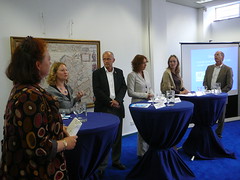
Onder aanwezigheid van een veertigtal belangstellenden, met name vertegenwoordigers van NGO’s en politieke partijen, gingen een vijftal politici (van Groen Links, Partij voor de Dieren, D66, CU /SGP en PvdA) op woensdag 13 mei het debat aan.

NCDO, Partos, en de EEN campagne lanceerden met dit debat de Wereldstemwijzer. Deze stemwijzer geeft een stemadvies gericht op de komende Europese verkiezingen. Evelijne Bruning, hoofdredactrice van Vice Versa, leidde het debat: "Ik hoop dat de diverse politici tijdens dit debat van elkaar kunnen proeven". (zie haar samenvatting van het debat)

Marie-Trees Meereboer, directrice van Partos, opende het debat. Volgens haar is het belangrijk dat internationale samenwerking hoog op de agenda blijft, middels actief debat; “Het gaat erom dat we samen oplossingen vinden voor de huidige financiële, klimaat- en voedselcrisis”.

Stelling 1: Hulp aan arme landen moet een zaak van de EU als geheel worden.

Natasja Oerlemans (Partij voor de Dieren - video) en Louis Meuleman (PvdA - video) lichten toe waarom hun partij tegen deze stelling is. Beide partijen dragen als argument aan dat Europa in enkele gevallen als een schuilplek fungeert voor problemen waar we geen oplossingen voor kunnen of willen vinden. Het gevaar van het verschuiven van deze problemen naar Europees niveau is dat budgetten van deelnemende landen naar beneden gaan. Als concreet voorbeeld noemt Natasja Oerlemans het landbouw- en dierenwelzijnsbeleid wat achteruit is gegaan nu het op internationaal niveau geregeld wordt. Iemand uit het publiek reageert teleurgesteld: "De wereld heeft Europa nodig". Waarop beiden aangeven dat we in enkele gevallen zeker vanuit één stem moeten spreken, maar dat hoeft nog niet een overdracht van bevoegdheden te betekenen. Het is niet geheel duidelijk onder de panelleden of deze stelling dat suggereert.

Ruud van Eijlen (CU/SGP - video) beargumenteert waarom zijn partij neutraal tegenover deze stelling staat. Volgens hem is het belangrijk dat er op Europees niveau meer aandacht komt voor dit onderwerp, maar dat we het wel nationaal moeten blijven coördineren. NGO’s, die hier vandaag zitten moeten er niet aan denken dat alles vanuit Brussel gecoördineerd zou worden: "Samenwerken: ja, een superstaat: nee".

Marietje Schaake (D66 - video) is voorstander van dit standpunt omdat we in een globaliserende wereld leven, waarbij dit onderwerp meer aandacht op Europees niveau vraagt. Ze draagt het voorbeeld aan van de landbouwsubsidies, die volgens haar partij in Europa afgeschaft moeten worden. Evelijne Bruning vraagt of de aanwezige panelleden het allen eens zijn dat de landbouwsubsidies in Europa afgeschaft mogen worden, dit wordt beaamd. Ook Judith Sargentini (Groen Links - video) stemt voor de stelling, ondanks teleurstellende resultaten van het ontwikkelingsbeleid van de afgelopen jaren. Ook met Louis Michel is ze niet echt gelukkig, maar het streven is er wel. En dit moet er volgens haar ook blijven: “We doen het niet goed, maar wel beter dan anderen; hoe zorgen we ervoor dat Europa ‘leading’is?”

Stelling 2: De EU moet stoppen met de werving van kennismigranten uit arme landen.

D66 is tegen deze stelling omdat, aldus Marietje Schaake, kennismigranten wel de kans moeten krijgen om in Europa te werken. Dit moet wel goed geregeld worden met een ‘blue card systeem’. Migranten kunnen ook kennis terug brengen naar de landen van herkomst, waardoor niet per definitie sprake hoeft te zijn van een ‘braindrain’.

Judith Sargentini (Groen Links) is ook tegen deze stelling. Ze geeft aan dat we werknemers nodig hebben. Dit blijkt alleen al uit het grote aantal illegale werknemers in Nederland. Door deze werknemers een legale status te geven zouden ze beter in staat kunnen zijn om hun werk beter te doen. We moeten wel goed in de gaten houden of de beroepsgroep wel te missen is in het land van herkomst. In het geval van Zuid-Afrikaanse doktoren, zijn ze van meer betekenis in Zuid-Afrika en moeten we ze hier dus weigeren.

Louis Meulemaan (PvdA), tevens tegen deze stelling, beaamt dat we niet daar de kennis moeten weghalen, die er het hardst nodig is. Maar hij benadrukt dat we lager opgeleiden niet zomaar binnen moeten laten komen, daar is een grote werkloosheid, deze dreigt groter te worden.

Natasja Oerlemans (Partij voor de Dieren) is voor de stelling. Ze vindt het belangrijk dat gekeken wordt naar de achtergrond van de migranten en hun motivatie om naar het westen te willen migreren; de situatie in eigen land is voor een groot deel tot stand gekomen door het ‘westen’. Onderscheid maken naar groep of kennis klinkt haar neokolonisalistisch in de oren; "waar trek je de grens?". Ze is voorstander van een structurele herverdeling van kennis, rijkdom en macht en het creëren van werkgelegenheid daar.

Ruud van Eijle (CU/SGP) is ook voor deze stelling en benadrukt het belang van het ter plaatse organiseren van ontwikkeling: "kijk ook naar de sociale en gezinsstructuren".

De overige panelleden zijn het erover eens dat het ideaal zou zijn wanneer migranten niet meer zouden migreren, dankzij een verbeterde leefsituatie ter plekke. Louis Meuleman (PvdA) geeft echter aan dat het erop lijkt alsof ontwikkelingshulp pure liefdadigheid is. Maar hulp is geen éénrichtingsverkeer, je mag best aan jezelf denken: "je kunt het beste anderen helpen als je een beetje zorg draagt voor jezelf".

Stelling 3: De EU moet bindende regels opstellen om wapenhandel te beperken.

Aangezien er al bindende gedragsregels bestaan op het gebied van wapenhandel, had het uitgebreid ingaan op deze stelling weinig meerwaarde. Toch werd de CU/SGP gevraagd waarom zijn partij, ondanks bestaande gedragsregels, tegen deze stelling is. Ruud van Eijle licht toe dat zijn partij tegen illegale wapenhandel is, maar dat zij willen dat regelgeving vanuit Nederland geregeld wordt en niet vanuit Brussel. De overige partijen waren voor deze stelling.

Stelling 4: ‘Europa mag alleen in de eigen wateren vissen.

Ruud van Eijle (CU) is voor deze stelling. Hij spreekt over de ongelijkheid tussen de vissers, enkele beschikken over geavanceerde technologieën, maar niet iedereen. Hij is voorstander van een quota en wil vissers betrekken bij een goede en eerlijke manier van visserij bedrijven.

Ook Judith Sargentini (Groen Links) is voor deze stelling: ‘Zoals ’t nu gaat, loopt het de spuigaten uit; grote bedrijven maken de kleine visserij kapot’. Het is volgens haar belangrijk om streng op te treden als overheid en niet alles aan de vissers zelf over te laten.

Natasja Oerlemans (PvdD) is voor de stelling. Door de visserij wordt ieder jaar een te hoge quota vastgesteld. Er wordt in Europa niet duurzaam omgegaan met onze natuurlijke bronnen, eigenlijk doet Nederland dit niet eens. ‘Europa mag alleen in eigen wateren vissen, maar eigenlijk daar niet eens meer’. Natasja Oerlemans reageert fel op deze stelling en vergelijkt de kracht van Europa op dit moment met de kracht van een ‘tandeloze tijger’.

Marietje Schaake (D66) is tegen deze stelling. Ze vindt dat er naar toekomstgerichte vormen van visserij gezocht moet worden: ‘Er moeten strenge en goede regels komen om schade te beperken’.

Stelling 5: De EU mag alleen producten uit arme landen invoeren als ze volgens EU-normen zijn gemaakt.

Judith Sargentini (Groen Links) staat neutraal ten aanzien van deze stelling. Groen Links vindt het belangrijk dat mensen veilig voedsel eten. Tegelijkertijd wil ze ook zeker dat producten niet onnodig van de Europese markt geweerd worden. Groen Links heeft een voorstel ingediend om de gehele productieketen beter op te volgen, inclusief de arbeidsomstandigheden waaronder producten geproduceerd worden.

Marietje Schaake (D66)is tegen deze stelling. Het op de markt brengen van producten brengt kansen met zich mee op een afzetmarkt in ontwikkelingslanden. Het volledig blokkeren van producten is niet de oplossing. Er moet per geval gekeken worden naar de beste oplossing. Hierbij kan ook streng worden opgetreden wanneer er bijvoorbeeld sprake is van kinderarbeid.

Ruud van Eijle (CU/SGP) is voor deze stelling. Belangrijke overwegingen zijn het belang dat gehecht wordt aan de veiligheid waaronder producten worden geproduceerd. Zijn partij is er voorstander van om ervoor te zorgen dat arme landen aan de norm kunnen voldoen.

Natasja Oerlemans (PvdD) is voor deze stelling; ‘kwetsbare waarden worden niet in marktwaarde betaald’. De overheid moet kaders stellen waarbinnen producten worden geproduceerd. Regels moeten ontwikkeld worden gericht op duurzaamheid, maar de regels moeten ook opgevolgd worden.

De deelnemende politici hebben hun standpunten verdedigd. In onderstaande korte ‘blips’, vertellen de vier politici hun belangrijkste speerpunten.

Dat er behoefte is aan een daadkrachtige internationale politiek met aandacht voor mensenrechten en voedselzekerheid blijkt zodra we de zaal verlaten. Op de stoep in Den Haag treffen we twee hongerstakers en een groep protestanten. Zij vragen aandacht voor de mensenrechten- en voedselsituatie van Tamil burgers in Sri Lanka. Een spoeddebat is door Bert Koenders hierover aangevraagd, aldus de demonstranten. Een solidaire en duurzame internationale politiek, beslis mee welke weg we nemen. Stem bij de Europese Parlementsverkiezingen op 4 juni 2009!

WereldStemWijzer


door Stephanie Zwier

Zie ook de Euforic newsfeed over de Europese verkiezingen 2009 en de Ten Days For Development campagne website van Concord

Friday, May 08, 2009

Lancering Wereldstemwijzer: Kandidaat Europarlementariërs in debat

Met medewerking van het Europees Parlement Bureau Nederland, organiseren de NCDO, de EEN-campagne en Partos een debat rond de lancering van de Wereldstemwijzer voor de komende Europese Parlementsverkiezingen op 4 juni 2009. Wij nodigen u bij deze van harte uit aanwezig te zijn.

Wie: Ruud van Eijle (Christen Unie), Judith Sargentini (Groen Links), Barry Madlener (PVV) ovb Jan Mulder (VVD) ovb, Sophie in’t Veld (D66) ovb, Maria Martens (CDA) ovb. Debatleidster: Evelijne Bruning, hoofdredacteur Vice Versa.

Waar: Bureau Europees Parlement Nederland, Korte Vijverberg 6, Den Haag.

Wanneer: woensdag 13 mei van 15:00-17:00 uur (met een borrel na afloop).

Waarom: In Nederland is momenteel een fel debat gaande over de effectiviteit van ontwikkelingssamenwerking. Maar onze internationale rol en die van Europa strekt verder dan alleen ontwikkelingssamenwerking. De huidige financiële crisis, voedselcrisis en klimaatcrisis vragen om een internationale aanpak. Wat is de rol van ons 'kleine' Nederland hierin en wat kan of moet 'Europa' doen? Welke effecten hebben onze beslissingen hier, in Nederland en Europa, op landen buiten Europa? Daar zijn de meningen over verdeeld.

Om bekend te maken hoe de Nederlandse deelnemende partijen denken over mondiale vraagstukken zoals ontwikkelingshulp, wereldhandel en het landbouwbeleid hebben de NCDO, Partos en de EEN-campagne de Wereldstemwijzer laten ontwikkelen. De Wereldstemwijzer is uw eerste hulp bij stemmen in aanloop naar de Europese verkiezingen van 4 juni aanstaande. U zult een stemadvies ontvangen met een accent op de rol van Europa in de Wereld. Moet de Europese Unie stoppen met het werven van kennismigranten? Mag Europa alleen in eigen wateren vissen? Slechts voorbeelden van de stellingen die zullen worden gebruikt als basis van dit debat. Het debat zal tevens de officiële lancering zijn van de Wereldstemwijzer.

Aanmeldingen via info@partos.nl. Toegang is gratis, maximaal 60 mensen, dus meldt u snel aan!

Voor meer informatie zie de Euforic RSS feed over de Europese verkiezingen 2009

Tuesday, July 15, 2008

Policy dialogue about Dutch development cooperation

Source: MDF Newsletter, July 2008


MDF is facilitating the policy dialogue between partners in Dutch development cooperation (DC). On request of the Minister, representatives of all stakeholders in Dutch development cooperation participate in a number of meetings and in an on line discussion. Stakeholders include civil society organisations (big and small), government agencies, private enterprise, academics, migrant organisations, etc. A website has been opened where information about this Policy Dialogue can be found: www.ontwikkelingisverandering.nl.

On this website you will find the reports and proceedings of a Starter-meeting (May 22) and of the Conference of June 24 - 25. You will also find six state-of-the-art papers which were written by academics from outside the direct sphere of Dutch DC, and comments on these papers by people from within the sector. All papers, comments and other discussion documents are arranged according to six leading themes of the dialogue: Enabling environment, Complementary roles, Accountability, Learning capacity, Tasks 'North' and 'South', and Public support for DC.

The dialogue will be rounded off with a report about all outcomes of the process. This report will be used by the Minister as inspiration for a new Policy Paper that is due in autumn of this year. Four MDF-staff members are working on this dialogue - under the guidance of a Steering Committee.

For more information contact Sjoerd Zanen via mdf@mdf.nl

Check also the Euforic newsfeeds on Dutch development cooperation and on MDF

Sunday, April 20, 2008

Afrikadag 2008: Why we need development cooperation

On 19 April, the Afrikadag 2008 took place in The Hague. With debates, workshops, lectures and a cultural programme on Africa and development cooperation, the Evert Vermeer Stichting (EVS) and partner organisations aim each year to raise awareness and change European policies.

Bert Koenders, the Dutch minister of Development Cooperation, was a keynote speaker. He argued strongly for a modern development cooperation, which observes human rights and also embraces military peacekeeping operations. According to Koenders, it is nonsense to abolish development aid, as some Dutch parliamentarians are demanding. Those politicians are only "anxiously closing their eyes" to the global challenges. "Development cooperation makes sense and is effective, but it can still be better", Koenders said. "What we really have to do is to take risks", he added, "and we should not be afraid of accusations of ancient neocolonialism". What we need is objectivity, soberness and humility to build up a strong political cooperation with the Southern partners.

During the lunch break, Paul Collier presented his book "The Bottom Billion." A Professor at Oxford University, it was Collier's first book that "anybody can read". He decided to write a popular science book because he wanted to inform citizens. He argued that "only an informed citizenship can help to escape from gesture politics".

While we may think that the aim of development has always been the reduction of global poverty, Collier revealed that it was a World Bank report in the 1990s that led to this focus. Precisely because it neatly fitted their interests: the political left could understand global poverty reduction in the sense of redistribution, and the political right could interpret it as the need for economic growth.

For Collier, the real challenge of development is to ensure that the one billion people living without any hope in the poorest countries on earth can join the four billion people living in emerging economies like China and India, who do have hope for a better future.

In his book, Collier explains that Africa combines several characteristics which make development harder. On in particular is the 'trap' of being resource-rich. Studies show that five years after the beginning of exploitation of resources, national income goes up, while 25 years later, it has dramatically gone down again. Research has also revealed that democracy seems to make this downward cycle of resource-rich countries even worse. The ideal form of democracy for resource-rich countries seems to be a democracy with very strong checks and balances, and not only democratic elections.

Although Collier stressed that he is not negative towards development aid, he reasoned that there is much more we can do. Europe could assist in developing commodity guidelines for resource-rich countries on how to manage resource extraction and the resulting financial flows. “And I know at least five African countries at the top of my head who would be willing to sign those guidelines”, Collier concluded.

See also Euforic newsfeeds for the Evert Vermeer Foundation, on Africa, on Dutch cooperation policy, and in Dutch.

Story by Birthe Paul

Wednesday, February 20, 2008

Dutch Africa Policy - On the Right Track?

In 2007, for the second year running, the Netherlands was ranked top of the Commitment to Development Index. How good are the policies in practice?

In February 2008, the Policy and Operations Evaluation Department (IOB) of the Netherlands Ministry of Foreign Affairs reported on its evaluation of Dutch Africa policy between 1998 and 2006. Download the report (PDF, in Dutch).

The February issue of The Broker featured some of the findings and several reactions to them:

Nils Boesen: ‘The point is not whether what the Netherlands did was partly good, partly less good – the point is that the donor community tends to move in the same direction until they discover that this was not exactly working as expected, whereafter they run collectively into a new direction. Herd behaviour, frankly’.

Stephen Ellis: ‘A point often overlooked is the degree to which the development policy of a rich country like the Netherlands has, in the end, to satisfy a domestic constituency. This is the main reason for some of the twists and turns of Dutch policy, such as the decline in support for rural development in favour of other policy areas that appeal more to the development lobby in the Netherlands itself or even to the broader public’.

Read more reactions in the special issue; sign up to submit your comments and reactions.

Euforic newsfeed on Dutch cooperation policy

More news from The Broker

Saturday, February 02, 2008

Reviewing the Dutch Africa Policy

In February, the Policy and Operations Evaluation Department (IOB) of the Netherlands Ministry of Foreign Affairs published the report of its evaluation of Dutch Africa policy between 1998 and 2006. The report contains several hard-hitting conclusions on the direction of Dutch development policy.

The February issue of The Broker features an exclusive report on this IOB evaluation and the first external reactions to its findings.

The issue highlights the good policy intentions, points to the mixed results, and examines results in areas including budget support, sectoral approaches, education, agriculture-urban, governance, ownership, coherence, conflict management, debt, and knowledge and research.

Register online to obtain a print version of this special edition of The Broker.

As lead-in to an online discussion, the issue presents comments on the report from Africa development specialists including: Ernest Aryeetey (ISSER, Ghana), George Ayittey (American University), Joan Boer (OECD), Nils Boesen (Denmark), Solveig Buhl (OECD), Anders Danielson (Sweden), Han van Dijk (Wageningen University), Stephen Ellis (ASC), Leo de Haan (ASC), Paul Hoebink (CIDIN), Wil Hout (ISS), Simon Maxwell (ODI), Nadia Molenaers (University of Antwerp), Oliver Morrissey (University of Nottingham), Steven Ndegwa (World Bank), Francis Nyamnjoh (CODESRIA), Brian Pratt (INTRAC), Joseph Semboja (REPOA, Tanzania), David Sogge (Netherlands), Marian Tupy (Cato Institute), and Doris Voorbraak (World Bank).

At The Broker, you can also sign up for the online discussion on the Dutch Africa policy.

Read the evaluation report (PDF, in Dutch)

More
news from The Broker

More about Dutch cooperation policy

Euforic dossier on the Netherlands; also our news in Dutch

Monday, November 05, 2007

How good is Dutch development cooperation?

The Hague, 2 November. In a briefing at the Dutch Ministry of Foreign Affairs, David Roodman of the Center for Global Development shared the results of this year’s Commitment to Development Index, providing some assessments for the mainly Dutch audience to debate.


The tone of the session was set by the chair when he opened the session saying that “we are number 1 again, but there’s no room for complacency.”

Roodman explained that the Index seeks to track and assess the many different ways in which ‘rich’ countries are linked with ‘poor’ countries. Its underlying precept is that greater engagement of a government with developing countries is positive and can be ranked and rewarded in different policy areas.

The aim is to get beyond foreign aid, looking at areas like trade, security, investment, and migration. The Index does not strictly speaking ‘measure’ different policies – it helps people asks questions about their country’s – and especially their government’s – position in the Index.

The 2007 results give the Netherlands a 6.7 (out of 10) score – a slight decrease from 2006 but still enough to top the rankings. According to Roodman: “The Netherlands is about average in four areas, so if the best can do better, all of them can.”

Three of the key ‘take away’ messages of Roodman: That aid is much more than just quantity; that development is much more than just aid; and that even the top ranked countries have average scores on several of the measures.


Paul Hoebink (CIDIN) kicked off the panel reactions, questioning whether his country deserves the gold medal. He queried some of the methodological assumptions and asked whether the data used actually measure the ‘development friendliness’ of Dutch policies. Is high foreign private investment by Dutch companies necessarily development friendly? Perhaps it is a sort of tied aid?

Peter Konijn (Cordaid) took a different perspective, looking more into the usefulness of the the Index as a tool for change. He suggested that it might be a good tool to put ‘peer pressure’ on different governments and he wondered whether it might actually be a basis for governments to commit themselves to better scores in the various policy areas. He concluded by pointing out that a good result for the Netherlands does not help a civil society organization like Cordaid in its campaigning – the government can point to their high CDI rankings!

Questions from the floor ranged across various issues. What is the ‘development’ that the countries are ranked towards? What is the overall purpose of the Index? How can different elements be improved? What effects does it have in different countries, in terms of changing the behaviors of governments? The session clearly stimulated discussion on the relations among the policies, the degree they are –or are intended to be – development friendly, and the data and measures used. Roodman made it clear in one of his responses that the Index seeks to ‘measure’ policies, not the motives behind policies.

Following the presentations in The Hague and Brussels, there remain a lot of tantalizing notions: Countries where governments are closer to the people seem to achieve a higher rank. Taking action on climate change and the environment requires that the rich take the lead. Does the security ranking give undue emphasis to military measures at the expense of ‘softer’ conflict resolution and prevention actions? Measures of some policies, such as migration, are evolving with, for example, ‘brain-drain’ not as negative as was initially thought. Since data on support for research in tropical medicine and agriculture and other ‘development’ areas don’t seem to be accessible, the ‘technology’ scores generally reflect the ‘domestic’ R&D spend.

In some areas, the development-friendliness ‘performance’ of a government in a negotiation process – such as fisheries agreements – might be more important as a measure than whether or not it gives subsidies to a fishing fleet. Beyond the policies of a government, its ability to influence the processes by which policies are adopted by others – in European, OECD or UN forums – can also be more or less development friendly.

On further reflection, one wonders whether and how such an index of government commitment and policies might also reflect the wider commitment of different societies to development – in terms of public support. And what about the fast-growing small-scale ‘private’ cooperation projects by individuals and small citizen groups and perhaps the most widespread foreign experience of many individuals – tourism? Can these also be assessed on their development friendliness?

Story by Peter Ballantyne

The Commitment to Development Index ranks 21 high-income industrialized countries on how well their policies and actions support poor countries' efforts to build prosperity, good government, and security.


In 2007, for the second year running, the Netherlands comes in first on the strength of ample aid-giving, falling greenhouse gas emissions, and support for investment in developing countries..

The powerpoint presentations of David Roodman and Paul Hoebink are available on Slideshare.

The meeting was organized by CGD, Euforic, the Dutch Ministry of Foreign Affairs, and SID Netherlands. It was part of a series in different European cities.

More information on the CDI is on the CGD web site; The Dutch country paper is also available in English and Dutch [pdf format]

See also Euforic dossiers on aid effectiveness, coherence, Dutch development cooperation.

Thursday, September 20, 2007

European Development Cooperation: Does more mean better?

Since 2005, various political agreements have called for more 'Europeanisation' of the Netherlands Development Cooperation. But how ambitious are these agreements? Is The Hague really prepared to work through Brussels? Is the Netherlands willing to delegate some of its sectors to the Commission and other European Member States, including those which are not so like-minded? Will the Netherlands continue its active stance in the Economic Partnership Agreement (EPA) negotiation process?

In the process towards an increased division of labour and greater policy coherence as regards development, will the Netherlands choose to foster or delay further European integration?

In the context of the activities of the Dutch/Flemmish Development Policy Research Network (DPRN), ECDPM and the Centre for International Development Issues Nijmegen (CIDIN) organise a meeting to take an in-depth and critical look at the present state of affairs of European development cooperation, with a specific focus on the possible role(s) of research in further refining and implementing the commitments that have recently been made. It will be held in Maastricht on September 28th.

The meeting's objective is two folded: sharing information among Dutch academic institutions, development experts, private sector representatives, NGOs and policy makers about the most important progress in vision, implementation and changes of the EU Development Cooperation since 2005; debating some of the current 'hot topics': EPAs, policy coherence for development, the implementation of the Paris Declaration, and the voluntary Code of Conduct on division of labour.

For more information, visit DPRN website.

See also Euforic dossier on Europe's cooperation.

Thursday, July 05, 2007

Setting new priorities for Dutch development cooperation

The Hague, 5 July. In an inspiring and forward looking speech to the SID Conference starting today, Bert Koenders, the new Dutch Minister for Development Cooperation outlined the new priorities of his Ministry.

First, his work will focus on equal opportunities for women, who are the sector of population least likely to be reached by development assistance.

Second, he will address the issue of fragile states. If it's true that these countries account for only one third of the world poor, it's also clear that they recieve a very small percentage of aid. The Dutch goal is to think and develop a new approach focussing on the ‘3 Ds’ - linking development, diplomacy and defense in a coherent way. This is not only in the interests of the poor. It is in the “self interest of western countries to secure fragile and failing states and avoid the spread of trans-national conflicts and terrorism.”

Recognising that growth by itself is not enough for poverty eradication, another priority is the wider distribution of this growth. Again, this requires coherence among different policies, in this case closer cooperation with the External Trade Ministry to assure market access for third world countries.

Last but not least is to address the effects of climate change. Unless this is addressed, all efforts to meet the MDGs will be “either washed away or dried up. Action in this area is needed right now”; the outcome of the recent G8 summit can be seen as a first positive step in this direction. Again, a more coherent approach is needed, and cooperation with Environment and the Transportation ministries will be improved, to promote sustainable energy plans for developing countries.

More on Dutch development cooperation and in Dutch

story by Pier Andrea Pirani

Saturday, March 31, 2007

Knowledge and Information Sharing Strategies in Dutch Development

On 21 March 2007, Euforic with WOTRO organized a half-day workshop on Knowledge and Information Sharing Strategies in Dutch development organizations.

For the host organization, Cora Govers introduced the work of WOTRO - Mobilizing knowledge at the interface of science, policy and practice; Sarah Cummings talked about the KM4D Journal, the IKM Emergent research proposal, and Dgroups as examples of a development 'polder model' bringing policymakers, researchers and practitioners together in knoweldge sharing partnerships.

Thereafter, four major actors in Dutch development shared some perspectives on their knowledge and information plans.

Julie Ferguson talked about the knowledge-based programming of Hivos, 2007-2010. Under the banner 'knowledge entrepreneurship', Hivos has developed a knowledge 'integrating' strategy that will prioritize knowledge development through research, knowledge sharing through linking and sharing, knowledge leveraging for lobby and advocacy, and knowledge application through spaces for reflection and learning. These activities will be focused on in-depth programmes focused on themes like civil society building in closed societies, freedom of expression, fundamentalism and democratic pluralism, and civil society building strategies.

Maarten Boers introduced the plans for knowledge sharing and learning of the ICCO Alliance capacity building programme. The plans are based around learning networks on different themes - such as peacebuilding, religion and development, food security - in which the knowledge of different partners will be mobilized and applied to development problems.

Kathelijn Hendrikse updated participants on Cordaid's new partner-oriented information sharing portal. This has multiple objectives, such as: To strengthen relationships between Cordaid partners and to create new ones, to exchange knowledge, lessons learned and practices, to keep Cordaid partners well informed about conferences, events, workshops, and news, and to create a platform for Cordaid related initiatives and information. The first testing phase is now almost complete and 75 partner organizations will soon be invited to test the platform. Some challenges identified by Kathelijn included: initiating thematic discussions, dealing with delicate subjects, getting partner organisations enthusiastic about the tool, and the complexity of the target group.

Finally, Ingeborg Denissen introduced efforts by the Dutch Ministry of Foreign Affairs to use knowledge and research effectively in efforts to combat poverty and bring about sustainable development. The issues are seen in a 'systems approach' that considers that knowledge relevant to poverty reduction (PR) and sustainable development (SD) is "not automatically generated and applied"; that PR and SD are promoted by "knowledge development and interactive learning within networks"; and that research is seen in "combination with other forms of knowledge acquisition." Two important instruments are the 'IS Academy' that promotes relations between research and policy makers; and the Ministry's 'Chief Scientist' who acts as an overall champion for knowledge management activities in the ministry.

After the plenary session, participants gathered in participatory 'world cafe' style groups - facilitated by Lucie Lamoureux - to discuss issues raised by colleagues attending from Stop AIDS Now (Adolfo Lopez), IICD (Joitske Hulsebosch), Bernard van Leer Foundation (Reinhard Skinner and Vera van der Grift), PSO (Bram Langen), and ECDPM (Niels Keijzer).

See also the Euforic dossier on information, knowledge, communication.

by Peter Ballantyne