Google+
Showing posts with label text. Show all posts

Wednesday, December 02, 2009

Members vote to dissolve the Euforic Cooperative

After nearly 15 years the Euforic Cooperative will disappear. Twenty-four members (out of 34) represented at the special general meeting of members, held on 26 November 2009 in Brussels, voted for the dissolution of the Cooperative.

Fifteen years ago, when the Internet started to become a key tool in information and communication, a diverse group of organizations in development cooperation acknowledged its importance for communication and collaboration and constituted Europe's Forum on International Cooperation (Euforic). Euforic was founded by ECDPM - independent, funded by governmental donors -, Clong, Eurostep, CIDSE and APRODEV - all NGOnetworks - and the ACP Secretariat - representing southern governments. The current group of members remains very diverse, including also a number of research networks and institutions.

In a joint effort the Web was used to communicate and to collaborate. Initially the focus was on sharing and disseminating information, over the last years Euforic supported members in using Internet interactively (Web 2.0) in support of networking and collaboration. Euforic always remained on the forefront in working with members on innovative projects and supporting them through training and consulting.

More recently, Euforic supported ICCO’s Compart project that uses Web 2.0 for collaboration and learning within ICCO and with its partners. With ILEIA a similar project was undertaken on a smaller scale. Euforic was also involved with CABI in setting up a repository storing products of all DFID funded research – Research for Development (R4D). In the process of transforming D-Groups, Euforic associates played a critical role. Similarly Euforic has been a partner in support of CTA’s Brussels Briefings since 2007. With NIAS and DDRN Euforic worked in 2009 on using Web 2.0 for communication of research. Campaigns and events were promoted through social reporting, working with FAO, GDN, Concord, IDS, Helvetas and CTA. In training sessions - either open, or targeted for specific clients – Euforic has been building capacities among a diverse groups of staff of member organizations. Euforic staff will work until mid December to transfer outputs of projects and completing work on the IKM-Vines project and the Brussels Briefings.

Funding Euforic has always been a complex issue. As a Cooperative it had limited income from membership fees which were always kept low as the Cooperative was supposed to earn its keep. The combination of a first class, independent public information service on Europe’s development cooperation while at the same time servicing the diverse membership as well as working with individual members on a project basis was not always easy to manage. Over a period of years deficits accumulated, a loan from one of the members allowed a re-start in 2006 but eventually the members agreed that there was no structural viability to the organization, at least not in this form.

To enable the Cooperative to pay all its outstanding debts and close with a zero balance, ICCO, ECDPM and EADI committed ad hoc contributions, at the same time APRODEV, CIDSE, Bernard van Leer Foundation and ISS doubled their membership contribution over 2009.

While the Cooperative is dissolved, there are also indications that – besides project outcomes and capacity development activities over the years - Euforic's heritage will live on: EADI has agreed to host the public information services that are provided through www.euforic.org. Also former Euforic staff and associates will continue to provide training and consulting services under the name 'Euforic Services' communicating through this blog euforic.blogspot.com.

Note: the liquidation also includes the sale of office furniture. For those interested, please click here.

Sunday, October 26, 2008

Innovation, information, communication - maximising research impact

An important change in the discourse on agricultural and rural development is the emergence of an ‘innovation systems perspective’ that focuses on interactions among different actors working to bring change. According to Hall, the innovation systems perspective fundamentally recognizes that the determinants of innovation, as a process of generating, accessing and putting knowledge into use, are the interactions of different people and their ideas, and the social setting of these interactions and relationships.

At last week’s workshop to discuss how improved communication can help maximize the impact of agricultural research in Africa, we caught up with David Spielman of IFPRI and Patti Kristjanson of ILRI - both of whom work in this area.

We asked David to explain what such innovation systems entails:


We also spoke to Patti Kristjanson, Leader of the ‘Innovation Works’ Initiative at the International Livestock Research Institute in Kenya for an example of such thinking, in action, so to speak. The 'Innovation Works' initiative is about "how we do the research, more innovatively, with partners, to have more impact on sustainable poverty reduction." According to Kristjanson, how the research is done "absolutely matters" - she and her colleagues have identified some principles and strategies that can "indeed increase the probability that the research will generate knowledge that leads to actions." More ...


By coincidence, during the Addis Ababa workshop, Louise Clark, Knowledge Transfer manager at the Research Into Use Programme launched a new blog with the name: RIU: An Innovation System Story!

The Addis Ababa workshop is organized by the Global Development Network (GDN) in partnership with the Overseas Development Institute (ODI), the World Bank Institute (WBI), and the International Food Policy Research Institute (IFPRI), with support from the Information and Communications Technology – Knowledge Management (ICT-KM) program of the Consultative Group on International Agricultural Research (CGIAR).

Photos from the workshop
Video interviews at the workshop
More stories on this blog / on IAALD blog / on ICT-KM blog
Euforic news on communication and knowledge-sharing
R4D news on research communication

story by Peter Ballantyne

Friday, September 26, 2008

Social web awareness and training at Healthlink Worldwide


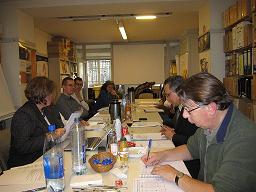
In September 2008, Euforic hold a three-day awareness and training session on web2 with new member Healthlink Worldwide, In London.

A preparatory day gave us the opportunity to discuss Healthlink’s expectations from the training, understanding their needs and see which specific needs could be addressed by the introduction of web2 tools.

With this picture in mind, the first day of the training focused on a general introduction to the social web, and how development organization are embracing it to run their back office, collaborate with different partners and communicate with the wider public. Two hands on session gave Healthlink staff the opportunity to set up their own ‘gourmet’ dish of information, using Google personal page, start publishing their news and reflections on a blog, and set up wiki pages to organize events and coordinate projects.

A roundtable discussion closed the day, giving us important feedback to arrange the agenda for the second day, so to accommodate the growing interest of the team.

On the second training day, we kicked off again in plenary by looking at the different ‘forks’ we need to navigate the ‘spaghetti’ junction of information now available on the net: different Google commands to make the most out of our web queries; specialized Google services like blogs and news searches; thematic portals such as R4D and AiDA; multimedia content with iTunes and Podscope.

Introducing Delicious provided a way start making sense of this wealth of content, using tags to organize it and creating new lists of items to be republished on different websites.

The last part of the plenary explored tools for remote collaboration, using applications such as Google Calendar and Google Docs; and understanding how and why development organizations are increasing their presence in spaces such as Facebook and Linkedin.

A final intensive hands-on session encouraged Healthlink staff to practice with their preferred applications: Often working in pairs, different people mastered the use of different applications, some working with blogs, others editing videos, others uploading presentations in Slideshare and pictures in Flickr. Allowing time for each person to work on what they preferred proved to be quite beneficial, as the team, together, has experience on a wide range of tools and can more easily support each other in using them.

The closing roundtable highlighted some of the lessons learned:

“It’s important for Heathlink to stay in the loop and see what’s going on in terms of using the web. This type of exercise has to become part of an ongoing learning process.”

“All the different things we’ve been experimenting with these couple of days are extremely useful and have huge potential; we now have to discuss and see how we go about it.”

“Now it’s all about practice: we have to see what the different team members are interested in mastering and try to combine our skills and expertise.”

“We could benefit a lot from the social web, in particular as far as coordination among the team is concerned.”

“We could think about linking this type of awareness and training session about the social web to our quarterly reviews, to reinforce our learning processes.”

“The most amazing thing is how user friendly all these applications are. Even more, they’re almost all free of charge!”


by Pier Andrea Pirani

See Euforic newsfeeds on Healthlink Worldwide, and on information, knowledge sharing and communication

Friday, June 20, 2008

Africa in 2048

On 17 June 2008, STT (Stichting Toekomstbeeld der Technologie/STT Netherlands Study Centre for Technology Trends) celebrated its 40th anniversary in The Hague. As a short introduction to his ongoing project on technology in Africa, project leader Jasper Grosskurth (grosskurth@stt.nl) presented a thought-provoking flash forward to 2048, when Africa would be the boom region worldwide.

* North Africa produces 200 giga watts of energy with solar thermal systems. Part of the energy is exported to Europe, and the rest is used to provide local electricity and desalinate sea water to resolve the drinking water shortage. After the installation of the third fibre optic cable in East Africa in 2010 and unrest in India in 2023, the local ICT sector exploded. In 2048, East Africa has become the hub for international service provision. From 2020 onwards, Nigeria heavily invested in flora technology, profiting from the viodiversity of neighbouring Cameroon. The technology caused an enormous economic stimulation for West Africa. *

During the next 18 months, the project will bring together experts from business, NGOs and research to develop scenarios on the future of technology in Africa.

See also euforic newsfeeds on Africa and the EU-Africa relations.

by Birthe Paul

Sunday, April 20, 2008

Afrikadag 2008: One Laptop per Child

iicd
During the Afrikadag 2008 in The Hague, IICD organized a workshop on “The 100$ Laptop: how can you make innovative solutions work in developing countries?” Professor Gerd Junne of the University of Amsterdam chaired the debate between Inneke Aquarius (Butterly Works), Prabhu Kandachar (Delft University), Stijn van der Krogt (IICD) and Petra Wentzel (Atos Origin). Discussion mainly focused on two questions: What are the preconditions to introduce a 'One Laptop per Child Programme' (OLPC)? What could be problems for the introduction of such a programme?

Concerning the preconditions, Inneke Aquarius argued that the 100$ laptops should just be distributed to see what happens, because changing the educational system is too complex and slow. Stijn van der Krogt and most other discussants disagreed and put more emphasis on the integration of the OLPC initiative in a comprehensive educational programme. Government, business, teachers and parents of participating schools have to accept, embrace and shape the idea. The national educational system has to be adapted, and teachers have to be trained by other locals (and not Europeans) how to incorporate laptops in their lessons and to develop their own content and software.

“We need to trust in their capabilities, and they will do it!”, Stijn van der Krogt argued. Only a bottom-up instead of a top-down approach will prepare the way for a 'OLPC success.

As for the challenges, Prabhu Kandachar identified affordability, acceptability and accessibility. A solution could be to gradually introduce the 100$ laptops in participating countries so that local lessons could be learned. Other challenges such as the plastic waste or maintenance of the laptops could also be opportunities as they will stimulate local entrepreneurship and create new business models and employment.

Other issues raised from the discussants and the audience: Will the laptops be used for an educational purpose, or just for personal communication? Won't the laptops be taken away from the children to be sold to much higher prices, and is that even more likely when the laptops are given away free? What is the hidden agenda of competing products, such as the Intel Classmate PC?

See also euforic newsfeeds from IICD and on education and ICTs.

Story by Birthe Paul

Afrikadag 2008: Why we need development cooperation

On 19 April, the Afrikadag 2008 took place in The Hague. With debates, workshops, lectures and a cultural programme on Africa and development cooperation, the Evert Vermeer Stichting (EVS) and partner organisations aim each year to raise awareness and change European policies.

Bert Koenders, the Dutch minister of Development Cooperation, was a keynote speaker. He argued strongly for a modern development cooperation, which observes human rights and also embraces military peacekeeping operations. According to Koenders, it is nonsense to abolish development aid, as some Dutch parliamentarians are demanding. Those politicians are only "anxiously closing their eyes" to the global challenges. "Development cooperation makes sense and is effective, but it can still be better", Koenders said. "What we really have to do is to take risks", he added, "and we should not be afraid of accusations of ancient neocolonialism". What we need is objectivity, soberness and humility to build up a strong political cooperation with the Southern partners.

During the lunch break, Paul Collier presented his book "The Bottom Billion." A Professor at Oxford University, it was Collier's first book that "anybody can read". He decided to write a popular science book because he wanted to inform citizens. He argued that "only an informed citizenship can help to escape from gesture politics".

While we may think that the aim of development has always been the reduction of global poverty, Collier revealed that it was a World Bank report in the 1990s that led to this focus. Precisely because it neatly fitted their interests: the political left could understand global poverty reduction in the sense of redistribution, and the political right could interpret it as the need for economic growth.

For Collier, the real challenge of development is to ensure that the one billion people living without any hope in the poorest countries on earth can join the four billion people living in emerging economies like China and India, who do have hope for a better future.

In his book, Collier explains that Africa combines several characteristics which make development harder. On in particular is the 'trap' of being resource-rich. Studies show that five years after the beginning of exploitation of resources, national income goes up, while 25 years later, it has dramatically gone down again. Research has also revealed that democracy seems to make this downward cycle of resource-rich countries even worse. The ideal form of democracy for resource-rich countries seems to be a democracy with very strong checks and balances, and not only democratic elections.

Although Collier stressed that he is not negative towards development aid, he reasoned that there is much more we can do. Europe could assist in developing commodity guidelines for resource-rich countries on how to manage resource extraction and the resulting financial flows. “And I know at least five African countries at the top of my head who would be willing to sign those guidelines”, Collier concluded.

See also Euforic newsfeeds for the Evert Vermeer Foundation, on Africa, on Dutch cooperation policy, and in Dutch.

Story by Birthe Paul

Thursday, January 24, 2008

CONCORD wins communication award

Agnès Philippart collects the award
In December 2007, CONCORD was awarded a European Excellence Award for outstanding pieces of communications work.

Agnès Philippart collected the CONCORD award. The NGO network was winner in the category 'Non-Profit Organisations' for the Pan-European press action on the reality of the European Aid for developing countries.

Communication strategies and approaches were discussed in a CONCORD-Euforic workshop in June 2007 - see the reality of aid presentation.

Friday, November 30, 2007

Creating a true and equal partnership between Europe and Africa?

One week before the EU-Africa Summit takes place in Lisbon, experts invited by the Friedrich-Ebert Foundation and WEED met on 29 November 2007 in Berlin to discuss the challenges ahead of a true EU-African Partnership.

During the summit, the European Union and the African Union plan to sign a new Strategic Partnership Agreement and a Plan of Action for its implementation. The aim is to concentrate segmented European Africa policies under one coherent framework. Designed by representatives from both continents, it focuses on new and old challenges such as peace and security, sustainable development and democratic governance.

Participants in the Berlin conference discussed whether institutions on both continents are prepared to take the EU-Africa relations to a new higher level and they questioned if the new cooperation is going to be a true partnership between equals.

In his introductory statement, Sven Grimm from the German Development Institute summed up 50 years of African-European relations. In his view the new EU-Africa strategy was prepared to respond to the political changes in Africa and Europe such as the upcoming of the African Union or the EU enlargement. It can also be seen as a reaction to the appearance of China as an important actor on the African continent. Grimm noted a change of focus which puts development aid behind trade and a stronger reflection of African views within the document.

Siegmar Schmidt (University Koblenz-Landau)
pointed out that the document reflects a smallest common denominator between the different actors and is more a diplomatic paper than a real strategy with clear aims and concrete plans of action.

The first panel dealt with the current EU Africa relations including issues like governance, security, energy and economic development. Speakers from research and civil society like Stefan Mair (SWP), Siegmar Schmidt (University Koblenz-Landau), George Ehusani (Catholic Bishops Conference Nigeria) talked about progress, problems and policy recommendations.

Father George Ehusani identified the low level of knowledge Africans have about EU-Africa relations and criticized the preparation process which lead to the new EU-Africa strategy:


An important role to empower African civil society was attributed to the African Peer Review Mechanism (APRM). However, participants said that the ‘naming and shaming’ culture within the mechanism does not go along with the African culture of ‘consultation and advice’ and might therefore be the wrong strategy.

Sven Grimm underlined the positive trend of the APRM. In his opinion the non-participation of some African states shows that the mechanism is treated seriously:

Prof. Siegmar Schmidt pointed out that the EU-Africa Partnership is largely based on a strong and effective African Union. He fears that the EU might overestimate its new partner which will need intensive capacity building to deliver towards the expectations. Hear his comments (in German):

In the second panel, participants discussed the new strategy which is going to be signed at the EU-Africa Summit, focusing on how to implement the strategy to become political reality. Keynote speakers were Aldo Ajello (Former EU Special Representative for the Great Lakes Region), Herta Däubler-Gmelin (Head of Human Rights Committee of the German Bundestag), John Mahama (Member of the Parliament of Ghana) and Matthias Mülmenstädt (German Federal Office).

Discussions also covered the ongoing EPA negotiations between the EU and African regions.

Klaus Schilder from WEED remarked that not enough time was spent by both sides to find a common policy and that the EU enforced its position without further analysis of its old trade policies towards Africa. Matthias Mülmenstädt from the German Foreign Service predicted that the talks will lead to a minimal solution which can be carried to the WTO in 2008.

John Mahama from the Ghanaian Parliament criticized the low involvement of parliamentarians during the EPA talks as well as during the preparation of the EU-Africa Strategy:


Regarding the development of democracy and human rights in Africa Mrs. Herta Däubler-Gmelin, head of the parliamentary committee for human rights of the German Bundestag, stressed the common basis of EU and the African Union. Questioned on the new role of China and its low appreciation for human rights in its cooperation policy, she mentioned that even the Chinese increasingly start to look after human rights in Africa since the kidnapping of Chinese workers in Nigeria and strong opposition by some African leaders against new colonization attempts by China.

Towards the end of the conference, all participants agreed that the new EU-Africa Strategy is going to be an improvement for relations between Europe and Africa.

Story by Martin Behrens

Have a look on the recently published summary report of the conference.

Wednesday, September 19, 2007

Africa unbound

Brussels, 19 September. Friends of Europe today hosted an interesting debate on policy challenges for Africa.

In the context of the forthcoming Lisbon Summit and the proposed joint EU-Africa strategy, the UK's Baroness Amos defined the challenges that Africa faces and the type of partnership that is needed to counter them. In spite of some positive exceptions, the lack of sustainable development and the fragility of state institutions undermine the future progress of the whole continent. In addition, Africa's failures and successes have an impact on Europe. Therefore "Africa can't be ignored." Europe has to recognise this, and act upon it, through a "new level" of partnership with Africa, a "people centered partnership".

Taking these ideas forward, Herta Daubler-Gmelin from the German Bundestag underlined the importance of the Lisbon Summit for taking to the next step the positive results of the 2007 G8 summit. She argued that Lisbon needs to be a place where European and Africa leaders agree on a limited set of issues, but devise a concrete action plan to tackle them. Among all, priority should be given to health, but also on migration Europe needs to adopt a "positive approach."

MEP Ana Maria Gomes suggested that a joint EU-Africa strategy responds to the need for the two continents to jointly face different policy challenges; but how can this strategy be translated into reality? For Gomes, there is "no need to reinvent the wheel; instead, there is a need for real political commitment to face together the global challenges ahead." In practical terms, this translates in more aid effectiveness and more aid for trade. But above all, in a more structured and constant dialogue between the two continents.

Finnish MP Kimmo Kiljunen offered a different perspective, looking into the past to justify a Europe-Africa strategy. Recognising that Europe and Africa have a long history of interdependence this means recognising the role that Europe had in determining Africa's present situation. The joint strategy finds in this historical bounds its reasons and its main elements: more aid effectiveness; more coordination; common voice for Europe in international financial institutions; more aid for trade and economic cooperation; new sources for financing development.

More information on the Joint EU-Africa strategy

See Euforic's Africa-Europe dossier

Friends of Europe web site

story by Pier Andrea Pirani