Google+
Showing posts with label knowledge_sharing. Show all posts

Tuesday, March 24, 2015

Learning - sharing what we know we know

Here's a terrible story whose details we'll hide. It’s from an excellent, well regarded development agency where around 1998 a smart, experienced project manager learned in a country programme that a particular approach didn’t work, it upset people and their lives and was a waste of money. As s/he recounted the experience another equally smart experienced person stood up and said s/he’d learnt the same lesson working in the same organisation in another country around 1989. And I later spoke to someone who works for the same organisation who was too embarrassed to admit in plenary that s/he had learnt the same lesson for the same organisation in another country in 2004!


Stories like this are dismayingly common, and not just in international development cooperation. DfID’s Learning efforts, to take just one, scored Amber/Red 1 in a 2014 assessment by the UK’s Independent Commission for Aid Impact (ICAI). So what can organisations do to learn better? This perennial question is at the centre of a review we’re doing with Water Aid UK on Knowledge Sharing and Learning. It overlaps with the other sanitation work we’re doing, KM in the Building Demand for Sanitation (BDS) programme. Three sub questions are interesting to both projects:
  • Are we too cautious about saying what we know we know
  • How do we record what we know and have learned in ways that people will pay attention to? 
  • How do organisations develop cultures where it is “socially unacceptable not to learn”, as one grantee put it recently? 

Known knowns

On the first point, a conclusion from the terrible story is that the first smart experienced person, who told the story, groaned as he learnt that the same error had repeated, in the same organisation. He suggested we don’t declare loudly and clearly enough what it is we know we know. We are often too tentative and vague, delivering high level bullet point recommendations or simply not sharing our conclusions. As part of the BDS KM programme we're supporting a Learning Exchange where he is going to sit down with two others from two organisations and try to write down what it is they have all learnt, what they know they know (about Sanitation Marketing, in this instance). We're encouraging them to tell the story using a range of media, to try and make their ideas sing and dance.

We'll also be encouraging the group to produce content that makes people think. If there is a document that tells you how to do something, and doesn’t require you to think, then it's probably only a technical fix: important for sure, in specific contexts, but not necessarily generalisable nor stimulating to other people's learning. Meaningful outputs that might enable people to learn across contexts are those that require people to talk together, question and reflect on the basis of what they read/hear/see in the documentation - to learn socially.

But it’s not easy to pronounce on what we know we know. It’s quite a bold thing to do. It’s much easier to ask questions, be tentative. I tried in a long, excellent conversation about knowledge and doledge on the KM4Dev discussion list, and I still feel uneasy about being so definite. A better example is a great blog, "Do we learn enough and does learning lead to improved sector performance?" The authors are two more smart, experienced, WASH specialists and the blog reflects on learning from the recent BDS annual convening meeting in Hanoi. The authors described elsewhere how, when they first re-read what they had come up, with they were startled at how obvious a lot of it seemed. But the blog has been well received, possibly because by stating the obvious, statements about which they were confident, the authors are providing navigational markers by which other people can steer.

But it takes time – and a learning culture - to mainstream that kind of reflection and recording. To quote from the ICAI report on DfID: “DFID is not sufficiently integrating opportunities for continuous learning within day-to-day tasks. In particular, staff do not have enough time to build learning into their core tasks. DFID is not fully ensuring that the lessons from each stage of the delivery chain are captured, particularly in relation to locally employed staff, delivery agents and, most crucially, the beneficiaries. Heads of office do not consistently define a positive culture of learning".

We'll be addressing culture in the next blog.


1. [programme performs relatively poorly overall against ICAI’s criteria for effectiveness and value for money. Significant improvements should be made]

Friday, June 12, 2009

Open space on story telling at the IMWG 2009 meeting

Richard Lalleman from the Focuss.Info initiative convened an open space session on story telling.
In Richard's views, when you try to codify your knowledge the context will fall apart. Talking seems to be a better way to share your knowledge. Quoting also knowledge management theories, he stated that "you know more that you can tell, and you tell more that you can write"

Among the different types of story telling techniques, Richard introduced the 'future-backwards'. This approach can increase the number of view points that a group has in understanding their past, and among the range of future possibilities. It can be used to compare and contrast different aspirations on the present situation and the future.

This approach seems particularly appropriate to learn from past experiences.

The discussion went on with participants comparing notes on the different methods used in their organisations to foster knowledge sharing.

See also Euforic newsfeeds on information, knowledge, communication, and from the IMWG 2009 workshop

Monday, January 19, 2009

Knowledge Share Fair for Agricultural Development and Food Security

This coming week, Euforic staff are attending and assisting at the Rome knowledge sharefair. More than 150 presentations (without powerpoint!) are scheduled covering all aspects of knowledge sharing in agriculture - from Bioversity, CGIAR, FAO, IFAD, and the WFP.
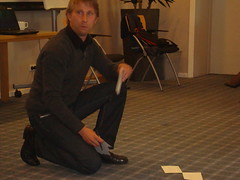
Euforic's Pier Andrea Pirani is 'blipping' participants for the '90 second challenge' - recording video responses to the question: "What's the added value of knowledge sharing to your work and your organization?"

Sunday, October 12, 2008

ComPart at ICCO: Update

icco
In July, we provided an update on the learning and knowledge sharing project at the ICCO Alliance.

Recent posts on the ComPart Learning Blog give a sense of progress and plans.

Monday, March 17, 2008

ATOL lanceert platform voor kennisuitwisseling

ATOL heeft de draad met economische en bedrijfsmatige ondersteuning weer opgepakt.

Na verschillende jaren meer de nadruk te hebben gelegd op informatietoelevering en methodiekontwikkeling in de domeinen van empowerment en kennismanagement (wat o.a. geleid heeft tot de AURA-, respectievelijk OASE-aanpak), willen we een bijdrage leveren aan het verbeteren van de diensten en ondersteuning van de economische activiteiten van basisgroepen in het Zuiden.

ATOL ontwikkelt hiervoor twee complementaire strategieën:
  1. Een platform voor kennisuitwisseling en –ontwikkeling rond deze thematiek, dat zich richt tot onwikkelingskaders van organisaties die hierrond actief zijn in hun zuidwerking. Dit platform biedt de mogelijkheid om doelgericht bestaande kennis te bundelen en aldus
    (beter) toegankelijk te maken. We doen dit op twee manieren:

    • Elkaar professioneel nuttige kennis doorspelen door het gebruik van web 2.0-applicaties. Voor zij die al een beetje vertrouwd zijn met deze internettoepassingen: we gebruiken een weblog om documenten te bespreken of uit te wisselen over een bepaald thema of vraag. Interessante websites worden via social bookmarking in del.icio.us (what's in a name) gedeeld. Via een nieuwe catalogus in PMB zullen binnenkort ook boeken en digitale documenten kunnen worden opgevraagd, becommentarieerd en gedeeld.

    • Rond bepaalde subthema's waarover een gemeenschappelijke interesse bestaat, worden workshops georganiseerd. We voorzien er een vijftal, gespreid over de komende drie jaren. Deze worden intensief voorbereid zodat er working papers kunnen worden voorgelegd aan externe experten en er stevig over gediscussieerd kan worden. De resultaten, in de vorm van theoretische inzichten maar ook operationele toepassingen, worden dan meegenomen naar de respectievelijke organisaties waar ze een weerslag vinden in de verbeterde interventiestrategieën.

    Tijdens het eerste atelier zullen we ons buigen over de link tussen de sociale/solidaire en economische/bedrijfsmatige aspecten. Het tweede atelier heeft als thema de ketenaanpak (filière). Een derde atelier zal bepaalde domeinen van organisatieversterking (nog nader te bepalen)van de partners in het Zuiden als onderwerp hebben. De thema's van de twee laatste ateliers worden in de loop van het proces bepaald.

    Het platform staat open voor iedereen die een bijdrage wil leveren aan het debat en concrete toepassingen wil geven. Enkel om een originele bijdrage te leveren aan de blog is een login nodig. Iedereen kan reageren op artikels of reacties van anderen. De uitwisseling op de blog gebeurt zowel op basis van eigen, interne informatie als van externe. De taal van documenten kan zowel Nederlands, Frans, Engels of Spaans zijn, maar de communicatie gebeurt in het Nederlands. Heel het proces is te volgen op de blog: www.atol.be/econsoc/

    De resultaten van deze uitwisselingen verschijnen op een thematische pagina in de respectievelijke talen (in eerste instantie in het Nederlands en het Frans): http://econsoc.pbwiki.com

  2. In het Zuiden begeleidt ATOL op een vijftal plaatsen een proces van methodiekontwikkeling ter verbetering van de ondersteuning door lokale NGO's (en andere vormen van dienstenorganisaties en toegepast onderzoek) van de economische activiteiten van hun respectievelijke partners aan de basis.

    Tijdens de volgende maanden gaan er twee startateliers door in Congo D.R, één in Benin en één in Mali De deelnemers zullen de specifieke subthema's waarrond gewerkt zal worden, zelf bepalen.

    De lijst van de effectief deelnemende organisaties zal worden meegedeeld na de eerste ateliers. Ook hier kunnen er steeds nieuwe aansluiten, op voorwaarde dat ze actief mee betrokken weten aan een kennis-uitwisseling en -ontwikkeling. Het zijn immers geen vormingssessies.

Zie ook de Euforic news feeds over ATOL en kennisuitwisseling

Friday, May 25, 2007

Behind the screens at Wikipedia

Brussels, 24 May 2007. The Club of Rome in Brussels hosted Wikipedia last night as Florence Devouard, the chair of the Wikimedia Foundation, gave a glimpse behind the service that now totals 6 million articles in 200 languages, 150 times the size of any print equivalent and all for free. It thrives, she points out, because "nobody knows everything but everyone knows something". The read-write Internet is possible because of four elements in the Wikipedia equation: software, community, neutrality and freedom.

Florence has a particular interest this year in bringing Wikipedia to developing countries, or rather bringing people to the service. African language content, for example, is used in Wikipedia, but as she puts it: only 350 articles have been posted by the 17.5 million people in the world that speak Amharic. As local subset copies of Wikipedia become available, the content is becoming accessible even where connectivity may be poor.

A vast array of projects is linked with Wikipedia: the children's encyclopedia produced by SOS children on CD, the virtual Wikibooks, a shared multimedia database, Wikimedia Commons, a quotation library, and Wikispecies - a directory of all life on the planet.

The core organisation is very small, 11 at present. The rest of the world works for Wikipedia for free, with local associations providing a face to face component to this virtual space. Managing the site is a challenge and dealing with issues of censorship, libel and grafitti doesn't fall just to the Wikimedia staff, the scale of participation means there are no shortage of people volunteering solutions.

The goals for the Wikimedia Foundation in 2007 are ensuring quality of content, raising awareness in developing countries, being recognised as a charity and ensuring sustainability.

The two last goals are closely linked. 98% of income comes from donation, with the foundation raising twice its $611,000 core costs last year. Perhaps this figure really shows the scale of what is going on at Wikipedia, it helps to keep the budget down when you have a voluntary workforce the size of a small country.

by Chris Addison

Saturday, March 31, 2007

Knowledge and Information Sharing Strategies in Dutch Development

On 21 March 2007, Euforic with WOTRO organized a half-day workshop on Knowledge and Information Sharing Strategies in Dutch development organizations.

For the host organization, Cora Govers introduced the work of WOTRO - Mobilizing knowledge at the interface of science, policy and practice; Sarah Cummings talked about the KM4D Journal, the IKM Emergent research proposal, and Dgroups as examples of a development 'polder model' bringing policymakers, researchers and practitioners together in knoweldge sharing partnerships.

Thereafter, four major actors in Dutch development shared some perspectives on their knowledge and information plans.

Julie Ferguson talked about the knowledge-based programming of Hivos, 2007-2010. Under the banner 'knowledge entrepreneurship', Hivos has developed a knowledge 'integrating' strategy that will prioritize knowledge development through research, knowledge sharing through linking and sharing, knowledge leveraging for lobby and advocacy, and knowledge application through spaces for reflection and learning. These activities will be focused on in-depth programmes focused on themes like civil society building in closed societies, freedom of expression, fundamentalism and democratic pluralism, and civil society building strategies.

Maarten Boers introduced the plans for knowledge sharing and learning of the ICCO Alliance capacity building programme. The plans are based around learning networks on different themes - such as peacebuilding, religion and development, food security - in which the knowledge of different partners will be mobilized and applied to development problems.

Kathelijn Hendrikse updated participants on Cordaid's new partner-oriented information sharing portal. This has multiple objectives, such as: To strengthen relationships between Cordaid partners and to create new ones, to exchange knowledge, lessons learned and practices, to keep Cordaid partners well informed about conferences, events, workshops, and news, and to create a platform for Cordaid related initiatives and information. The first testing phase is now almost complete and 75 partner organizations will soon be invited to test the platform. Some challenges identified by Kathelijn included: initiating thematic discussions, dealing with delicate subjects, getting partner organisations enthusiastic about the tool, and the complexity of the target group.

Finally, Ingeborg Denissen introduced efforts by the Dutch Ministry of Foreign Affairs to use knowledge and research effectively in efforts to combat poverty and bring about sustainable development. The issues are seen in a 'systems approach' that considers that knowledge relevant to poverty reduction (PR) and sustainable development (SD) is "not automatically generated and applied"; that PR and SD are promoted by "knowledge development and interactive learning within networks"; and that research is seen in "combination with other forms of knowledge acquisition." Two important instruments are the 'IS Academy' that promotes relations between research and policy makers; and the Ministry's 'Chief Scientist' who acts as an overall champion for knowledge management activities in the ministry.

After the plenary session, participants gathered in participatory 'world cafe' style groups - facilitated by Lucie Lamoureux - to discuss issues raised by colleagues attending from Stop AIDS Now (Adolfo Lopez), IICD (Joitske Hulsebosch), Bernard van Leer Foundation (Reinhard Skinner and Vera van der Grift), PSO (Bram Langen), and ECDPM (Niels Keijzer).

See also the Euforic dossier on information, knowledge, communication.

by Peter Ballantyne

Saturday, March 03, 2007

Norad library explores 'new web' applications and tools

For three days at the end of February, Euforic's Chris Addison introduced a range of new 'web 2.0' applications and tools to colleagues in the the NORAD library and staff from its Programme departments.

Under the title 'The web has changed - library use and support of new web tools and services', NORAD staff explored emerging web opportunities to retrieve and communicate information. In hands-on sessions, participants assessed the use of wikis, blogs, bloglines, and social bookmarking tools as part of the library's reference and intranet activities. More generally, NORAD staff updated themselves on web developments and increasingly personalised search and awareness tools.

More information on Euforic activities in this area is on our projects page; see also our dossier on information, knowledge, communication.

Monday, January 15, 2007

Infohub role and services the focus of Van Leer Foundation study

As part of its efforts to disseminate the rich variety of knowledge, know-how and lessons learned in its projects, the Bernard van Leer Foundation runs an ‘infohub’ as part of a wider set of information management, knowledge sharing, and learning tools.

Between November 2006 and February 2007, Euforic staff worked with the Foundation to clarify the niche and services offered by the infohub, with a view to extending its impact and more effectively engaging with staff and projects. Extensive discussions with staff reveal rather complex information and communication demands and needs and the need for a holistic view on the various tools and services available to staff.

As part of the project, Foundation staff were introduced to a range of emerging ‘social’ applications on the web – wikis, blogs, rss and so on – that could be part of a renewed infohub strategy to document and share lessons and information across the Foundation.

The Bernard van Leer Foundation aims to enhance opportunities for young children (aged 0-8 years) growing up in circumstances of social and economic disadvantage, with the objective of developing their potential to the greatest extent possible. It currently supports around 280 projects in approximately 40 developing and industrialised countries. The Foundation joined Euforic in late 2006.