Google+
Showing posts with label diplofoundation. Show all posts

Tuesday, June 19, 2012

The states of eDiplomacy

After a long, competitive selection process we are then told we know nothing and can't use the knowledge and skills we bring with us', said an exasperated new foreign diplomat based in Rome from a diplomatic service which lags a long way behind the mainstream in its adoption of social media and the other tools of eDiplomacy.  It was especially surprising to hear of such myopia in Italy where 73% of the online population are on Facebook (approx 37% of the population), making it Facebook's 11th most active market. The majority of the approximately 80 participants at the eDiplomacy day held at the  Instituto Diplomatico in Rome this week told more positive stories about how their own Ministries are engaging with the digital landscape. For example, Ambassador Bernardino Regazzoni, introducing the evening expert panel session, described how the Embassy of Switzerland in Italy employs the experience of younger diplomats in their drive to engage online.

In a time of constrained and reducing budgets, resource issues were understandably high on the agenda. Few countries could match the three staff working on communication at the US Embassy in Rome. Yet, like the Italian Instituto itself, most are creatively redeploying and retraining staff to be able to engage with what the majority recognised as essential tools for public diplomacy. Stefano Baldi, the Director of the Instituto illustrated how they are using all kinds of technology from video streaming to blogging, as can be seen in this impressively rapidly turned around video from the Italian Ministry (up a long time before I could complete this blog!).


Twitter, Facebook, YouTube, Flickr (or a similar photo-sharing application) and Blogging have emerged as the standard set of tools used to implement the kind of multi-channel communication strategy shown to be effective by those leading the band of eMFAs into the next phase of the digital age. Put on the spot, a narrow majority of the participants at the evening session agreed that Embassies should engage with at least three such channels. To sceptical looks from those struggling with budgets, participants from several Embassies told stories illustrating how, beyond an initial learning period, integrating different social media channels is an economical use of time, relative to the returns in term of closer engagement with the different audiences with which MFAs aim to connect.

In reviewing the eDiplomacy Hype Cycle, which we in Diplo have been discussing recently, participant's accounts of progress and good practice within their own institutions suggests that there are micro-cycles within an overall cycle which are applicable to national contexts. MFAs like the US, the Canadian and the UK FCO have been using social media tools for over three to four years and they have learned how to maximise returns from investing limited resources. Other later adopters are engaging with enormous enthusiasm but are likely to experience something of a backlash - a descent into the Trough of Disillusionment - as longer-term resource commitments become clearer, along with the typically slow build of a new online profile in a digital space which is becoming more and more crowded. As for what next, during his opening remarks to the panel discussion, Ambassador Carmel Inguanez from the Embassy of Malta in Italy invited participants to an Innovation in Diplomacy conference which is to take place in Malta on the 20th and 21st of November. The digital space changes so rapidly it will be fascinating to see what will already be history in six months time. Jovan Kurbalija reminded us that Diplomacy has always struggled with the acute tension between continuity and change, a tension screwed ever tighter by the imperative to adapt policy and practice to the new digital seas in which we all swim. (cross posted from Diplo Foundation site)

Tuesday, June 12, 2012

An eDiplomacy Hype Cycle

The recent surge of interest in Digital Diplomacy - perhaps eDiplomacy's younger-looking cousin - is the latest wave in the adoption and integration of computing and Internet enabled applications. While more and more MFAs and Governments are engaging actively online for good reasons, and with increasing confidence and success, there is the unmistakeable whiff of hype about some of the activity. There are also voices questioning the Return on Investment from deeper e-engagement. For example, in a fascinating piece about eDiplomacy in Indonesia Dr Shannon Smith questions just how many people Facebook and Twitter pages connect to in a given population and whether they represent a significant influencing group:
"US e-diplomacy needs to be put into perspective. There are 55 million internet users in Indonesia, which means that less than 1% of those are currently reached by the US Embassy. With a total population of 245 million, the US Embassy reaches only 0.21% of all Indonesians via social media..... [and]... Spiderman is five times more popular [on Facebook]"
Then the recent furore over the fight back on Twitter by the Chinese and Russian governments to US eDiplomacy targetting their populations suggests that, at best, any first-mover advantage enjoyed by those MFAs who have been quick off the mark has now been lost. At worst it may mean that in terms of Public Diplomacy, using Twitter is revealed as the equivalent of standing in London's Hyde Park corner shouting at your friends and passing tourists.

The Gartner Technology Hype Cycle reports are popular and influential. The format lends itself to reflecting about what might be real and what overblown in the current eDiplomacy/digital Diplomacy wave. Here are some first suggestions culled from a few of the Diplo team. We comment on both digital tools that lend themselves to eDiplomacy and Diplomatic functions that can exploit those tools.


What do you think? Have we left out some key tools or functions? Are we unkind or too timid? Please comment below, or send us your own versions.

(cross posted from Diplo Foundation website)

Tuesday, June 09, 2009

Diplo Foundation - Education for Globalisation

Diplomacy isn’t an immediately obvious candidate for consideration in the intense competition for international development funds and attention. Yet small and developing states can be enormously disadvantaged in international relations because they simply don’t have enough trained and knowledgeable people to represent their interests in crucial negotiations about global policy and practice. The enormous financial and human costs of participating in traditional training and Education in Diplomacy and International relations, generally located in expensive Northern centres, worsens the imbalance.

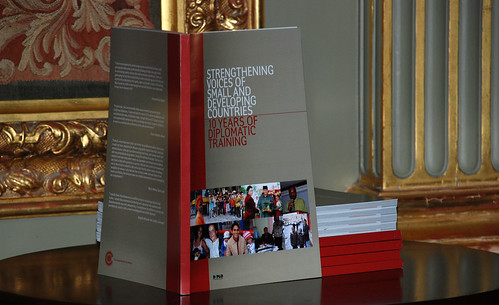
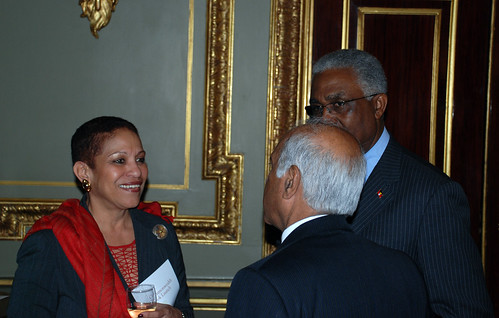
To address these problems the Diplo Foundation began providing high quality training and education in International Relations using modern ICTs to enable participation by Southern populations. Their work has been supported by a range of Governments and Agencies, including the Commonwealth, who hosted a reception in the gilded central hall of Marlborough House in London to mark ten years of collaboration. We were celebrating the major impact that this work has had on the lives of many of its participants, described in a publication launched at the event and in speeches from, amongst others, the Commonwealth Secretary-General, HE The Swiss Ambassador to London and the UK High Commissioner for Malta. The Secretary General was clear about the impact of the training:


Diplo has a number of lecturers who were themselves trained in the programme. Uchenna Okoli, a Nigerian graduate of Diplo, closed the presentation with a moving speech about the impact on her life. Here she talks about how it transformed her career and the key benefits of the training.


by Pete Cranston, Euforic Associate

Check also the Euforic newsfeeds on the Diplo Foundation and on capacity building

Friday, June 05, 2009

What our members are doing on climate change

Climate change is high on the international agenda these days. During the UN Climate Change Talks in Bonn (1 - 12 June) politicians, experts and activists aim to make progress in the preparation of a Post-2012 Climate Change Agreement. Obviously, the toughest task remains to find a compromise between industrialized countries, emerging economies and the developing world.

Within our diverse Euforic network several of our members are very active in the field of climate change. This is a good opportunity to present an overview of their activities.

Advocacy on climate change aims to influence the ongoing climate change negotiations on the regional and global level. Organisations involved wish to influence policy processes in a strategic way and make sure that the interests of the developing world are heard.


CIDSE is mainly engaged in the campaigning activities towards climate justice and a comprehensive new Climate Change Agreement. During the Bonn Climate Change Talks the network presents its report on the importance of adaptation technology for the Post-2012 Climate Agreement and - amongst other activities - organizes a video conference between Southern experts and conference participants on the issue of disaster risk reduction and adaptation.

APRODEVs Working Group on Climate Change and Concord are focusing on strategically influencing EU policies aiming to ensure that they are coherent with stated poverty eradication and development policies.

Research on climate change focuses on the impact of the phenomenon on the environment and livelihoods as well as on adaptation strategies to cope with these effects.


A research program of IDS is looking at cross-cutting issues between climate change and adaptation, policy, low carbon growth, building of networks and knowledge sharing as well as at training, teaching and mentoring. During the Bonn conference IDS organizes a panel discussion on 'Strengthening knowledge sharing on climate change adaptation in Africa'.

Also the Danish Development Research Network (DDRN) prioritizes climate change in its research. As well as the Danish Institute for International Studies (DIIS) whose research activities focus on the issue of climate change from a number of different perspectives ranging from security and international politics to trade, development, and livelihood.

ISS looks at the effects of climate change on resources, the environment and livelihoods. And ODIs research is trying to identify how increasing knowledge of the science of climate change impacts can be used to understand potential implications for developing countries, particularly in social, economic and political terms. Secondly it looks at how to ensure that emerging climate change mitigation and adaptation policies work for the poor.

Training courses provide services for policy makers to increase their knowledge on climate change and the international policy processes and negotiations.


DIPLO, the training institute for diplomacy, recognizes the importance of climate change negotiations on the global and regional level and developed a training course for diplomats and government officials involved in climate change policy processes.

Latest news, research and policy documents on Climate Change and related topics are provided by several Euforic members:


  • EADI - Information portal on climate change and energy
  • ECDPM - Newsfeed on climate change and development
  • IPS - News alert on climate change
  • ILEIA - Dossier on climate change, rural development and agriculture


Policy perspectives are given by the public institutions among our membership.


FINNIDA focuses on the Clean Development Mechanism and its political dimension as well as on the nexus between gender and climate change.

The Annual General Meeting which Euforic organizes alongside the meeting of EADIs Information Management Working Group takes place in Copenhagen from the 10 - 12 June. The meeting will shed light on the challenges of climate change and communication. See Mike Shanahan (IIED) talk about this issue:


by Martin Behrens

See also Euforic newsfeeds on climate change; information/knowledge, and from the 2009 annual workshop

Thursday, September 18, 2008

Three organisations join Euforic

This week, the Euforic Board approved membership applications from the DiploFoundation, Healthlink Worldwide and the Wellcome Trust (International Department).


The DiploFoundation is a leading training organisation in the field of diplomacy and international relations. Its objective is to provide capacity building activities in this area for a range of stakeholders in developing countries, including civil society. The activities of the DiploFoundation focus on offering (online) courses, capacity building, research, publications and software development.


Healthlink Worldwide is the specialist health and development agency, based in the United Kingdom, that empowers through communication to improve the health and well being of disadvantaged communities in developing countries. Healthlink provides expertise in communication, knowledge management and learning works with organisations and institutions at all levels, from local and national NGOs to national and international decision making bodies.


The Wellcome Trust devotes a significant amount of its international funding to supporting health-related research in developing countries. The three main strands of support are: personal and research support, with an emphasis on public health, tropical medicine and building research capacity; research fellowships support for outstanding researchers ; collaborations between developing countries and the UK, and major international partnerships between countries with developed market economies.

See the Euforic newsfeeds on research, health, the DiploFoundation, Healthlink Worldwide, and the Wellcome Trust. Also news from Euforic members