
 At the Brussels Briefing # 14, organised by CTA on 12 October, a lively discussion on media and rural development took place. The debate was fed by contributions of a variety of panelists and a large crowd of participants from ACP countries. Why is there so little reporting done on regular media on issues concerning farmers and rural communities? Why do the media treat the food crisis as an urban issue? Can journalists partner with farmers, politicians, policy advocates and researchers in promoting rural development? What is the role of the new media and do ICTs contribute?
To prepare for this session the organiser CTA hosted a 4 weeks e-discussion. Susana Thorp from WREN gave a brief summary of the outcomes. First and foremost, Mrs. Thorp emphasized that participants hope that discussion actually leads to action. The e-debate focused on constraints faced by media on – conflicting - expectations of various stakeholders on new media and ICTs, and on support for enhancing media activities and building capacities. A summary of the e-debate is available here.
It was interesting to observe that at this Brussels Briefing the majority of panelist and quite a number of participants were female. Mrs. Tumi Makgabo, lead discussant and former CNN anchor stressed that in the world of media women have more barriers to overcome than men. But together with Mrs. Violet Otindo of K24TV in Kenya, winner of the CNN African Journalist Award, and all the other women participating in this debate she showed it can be done.
How do women overcome these barriers? Violet Otindo mentioned the importance of mentoring, but she said it should be used with care. For a journalist mentoring involves risks because it exposes you to political and commercial interests. Lack of resources and equipment are the major barrier according to her. She remarked that when you have no resources, everything takes more time. As a journalist you have to work smart and time management skills are essential. She feels that more recognition for the work of local African journalists is important, the big media houses should make more use of local journalists. Also support initiatives involving training and awards can be helpful.
Tumi Makgabo defined herself as a feminist with three-inch heels. You have to counter the way media portray women as a victim by acting like the opposite. She wants women to have a voice and she feels she can contribute more working as an independent journalist from Africa. She also illustrated how women seek to balance professional and private goals by telling how for her living in Africa as opposed to Atlanta serves both. As for the professional goals: Mrs. Makgabo stressed that with the new technologies Africans can tell stories about Africa: “we can tell our stories from any place now”.
In his keynote address CTA’s director Hansjörg Neun observed that media tend to report on the extraordinary – a man biting a dog is news, the reverse is not. Much of the messages on rural development do not seem to qualify as news. The first panel was lead by Tumi Makgabo of South Africa, a former anchor of CNN Inside Africa, now African Broadcasting and Media, and director of the African Women Development Fund. She introduced the panelists: Mr. Jean-Philippe Rapp who founded in 1985 the International North-South Media Forum, Mrs. Brave Nsidale, Ambassador of Malawi, Mr. Ignatius Jean, Representative of IICA and former minister of Agriculture of St. Lucia, Mr. Thozi Gwanya, Director General of the Department of Land Reform in South Africa and Mrs. Krishendaye Rampershad, media consultant based in Trinidad.
Ms. Rampershad emphasized that it is important to differentiate: are we talking high tech corporate media or low tech community based. She felt the latter to be very powerful in serving development objectives. To those wishing to communicate messages to rural populations Ms. Rampershad had a clear advice: talk normal! Extension people have to be communicators and not talk science. Mr. Gwanya felt that media systematically ignored rural people and their interests. Mr. Jean of IICA observed that technical people in agriculture and media may not understand or like each other but they do need each other. In the Carribean Mr. Jean has observed that ICTs and the participatory information sharing they enable, have dismantled monopolies. He also emphasized that new partnerships emerge; in the oral, musical community of the Carribean the power of songs and the influence of musicians can support our communication for agriculture. Jean-Philippe Rapp commented on Hansjörg Neun’s example but he argued that the current food insecurity and plague of hunger is indeed a case of “man bites dog” and considered quite newsworthy. He observed a sincere interest among media for agriculture, but there is also a shift, he noted: media look for testimonies, there is less interest for the stories of the experts.
 After the contributions of the panelists Ms. Makgabo opened the debate and the floor. She challenged the panelists: if people continue to buy tabloids that pay no attention to issues and needs of rural people, who are we to question these priorities? Ms. Rampershad emphasized that you may see this disconnection in public and corporate media, but in community driven media agendas are set differently. Mr. Rapp emphasized that agriculture is not a difficult or grateful subject but you need to tell the story with passion and in original, authentic language.
In the ensuing debate the focus was on the relations between the various stakeholders. There is often antagonism between politicians and media but participants also commented on how scientists are suspicious of journalists and vice versa. You can remove that suspicion by talking about the differences and the different roles, looking for common ground. Specific, deliberate and focused education initiatives may help to bridge the gap between what media (thinks it) needs and what the industry needs and what both sides can do.
Ms. Protz, the coordinator of CARIMAC, noted that few agriculture ministries actually do have a communication strategy. She observed that the media coverage of the climate change issue was not lead by journalists but by communities, the corporate and public media enlisted later in the process. Maureen Agena of the Women of Uganda Network questioned the role of (urban) journalists: how do you report on something you are not involved in? WOUGNET works with citizen journalists, women reporting on their own problems. Other participants questioned whether these citizen journalists had the skills and ethics to communicate responsibly.
More information on this briefing and earlier editions are available on the website of the Brussels Development Briefings and - in French - Briefings sur le Développement à Bruxelles
To get regular updates subscribe to the Euforic English language newsfeed for the Brussels Briefings or to the French language newsfeed at Briefings à Bruxelles
More on EU cooperation with ACP countries is available in the corresponding Euforic newsfeed on EU-ACP cooperation. Euforic also has a newsfeed on information, knowledge and communication. Visit the CTA website for more on agriculture and rural development in ACP countries.

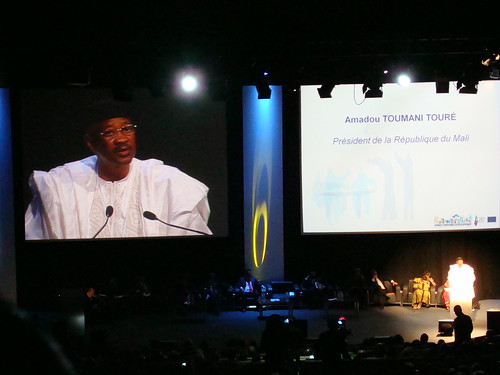 The European Development Days (EDD08) are underway in Strasbourg with over 55 events crammed into 3 days, a development village of 116 stands and over 1000 participants. Tracking everything that is happening is a little difficult, but here is your quick guide (or try the
