Google+
Showing posts with label research. Show all posts

Friday, February 01, 2013

Research to Impact Hackathon ....and the winner was...

Well, we were all winners, if truth be told, in the sense that we all learned a lot from the experience of the Hackathon at iHub Research in Nairobi last week. To begin with, the iHub itself is still under three years old yet has blossomed into an extraordinary innovation centre at the centre of a buzzing ecosystem of developers, projects, events, people, good coffee and, well, more people. There are over 10,000 registered members of the iHub community and it was through those networks that we were able to attract so many creative and plugged-in developers.

One of the newer projects is iHub Research, one of the co-organisers of the event. Leo Mukutu is Research Manager there and she was one of the judges of the competition. In this clip Leo describes the role of iHub Research and the criteria she used to judge the entries.


There were six entries in all, and in this video clip people from each team describe their proposals - and you can see who won!


Thursday, January 24, 2013

'Let me Hackathon that thing'

'Every good piece of software starts by scratching a developer's personal itch', says Eric Raymond, author of the fabulous book on Open Source software, The Cathedral and the Bazaar. Hackathons evolved to harness that personal passion of software developers to create interesting code that solves problems - or sometimes, just create elegant, interesting code simply to see what happens. Organisers provide a context - for example software platforms such as Ushahidi that constantly need to to be improved or movements and campaigns such as development data or aid transparency which need lots of programmes to import and aggregate data or present the data in a form usable by others and the public - and a space, with coffee, cakes and chocolate. Developers who enjoy working individually or in teams and are moved by the spirit of the organisers come together and have fun.

The Research to Impact Hackathon is different in significant ways to a standard hackathon. Firstly, there is often criticism that these events produce a lot of interesting but unfinished code, which is either taken over by the sponsor and developed internally or simply abandoned, with the developers un-engaged in the follow up. The sponsors of this event, IDS/ELDIS and CABI/R4D see this event as Phase One in a longer term process. They are providing small prizes for the best products but committing larger sums to supporting the development of particularly promising ideas and prototypes that have the potential to increase the use of research data.

Secondly, we wanted to provide focus to the developers based on an informed understanding of specific challenges faced on the ground, in East Africa, by those working in agriculture and nutrition, challenges which constrain the use of development data and opportunities it offers to enrich the development process. However, we had to steer carefully between being too directive of the developers - which could reduce creative and risk appearing to be asking for some free labour to help large organisations solve their problems - and not providing a clear enough set of scenarios.

So we were a bit anxious about how Day Two of the Hackathon would develop, especially since we were joined by some new developers who hadn't had the introduction to the personas, challenges and triggers which emerged from Day One of the Hackathon nor been part of the Ideation session. We should have known better: we are in the iHub, in Nairobi, Kenya, at the centre of a vibrant developer community, supported by the ideas and contacts of iHub Research. Many of the participants had been trained in mobile application development at the mLab - yet another source of energy within the iHub ecosystem (and the iHub is not even three years old!). And all the developers were in some way or another connected or developing software solutions to the needs of those in the agriculture value chain.

We introduced the data available from ELDIS, R4D and other relevant open data sources, including the World Bank's data site and the rapidly growing Kenyan Government OpenData portal; the ways to access the data through the ELDIS open API and the tools which Tim Davies is developing to access the data, including in Linked Data formats. Finally we introduced the personas from Day One, together with the ideas which had been rated as having the highest potential impact and most viable as the basis for developing a Proof of Concept in only two days (and nights!).

Chaos of the most productive kind ensued. People discussed ideas; formed, and reformed, teams; ate sausages; asked for more information about the personas; drank coffee; got support in exploring the data and learning to use the access tools available; fed-back ideas for discussion; storyboarded and planned; ate cake; began to hack. By the end of the day four groupings of ideas and people had emerged, all interesting and within the frameworks we had established, and some with the beginnings of demonstration code - either created or imported. Then we went for beer.

Day Three is a hack-day: teams will continue working on their ideas, preparing for a presentation on the morning of the fourth day, in some kind of Dragon's Den format. While the progress has been remarkable for two days, the acid test is, of course, what the teams can present on Day Four. Given their commitment to the longer term, the organisers are looking as much for coherent plans and realistic assumptions as finished code - but watch this space.

Wednesday, January 23, 2013

Research to Impact Hackathon with iHub Research, Nairobi

Open data on the web makes it possible to take information on research from many sources, and to generate ‘mash-ups’ that make it available in different places, on different platforms, and in ways that support action and impact. Open data can be remixed to answer key questions in ways that were not possible before.

One of the most interesting developments in the R4D project, which we have been supporting with CommsConsult and CABI, has been converting the metadata in the R4D database of DfID funded research to Open and Linked Data formats. The Institute for Development Studies (IDS) ELDIS team have been travelling in the same direction - working to open up access to their research information including by creating open APIs allowing anyone to tap into their 15+ years of curated development research. The rationale for this is that every year institutions, researchers and practitioners generate thousands of datasets, reports and articles about development issues. To give some idea of scale, DfID funds £200 million worth of research every year. Yet, much of this knowledge remains underused, locked away in online repositories such as R4D and ELDIS.
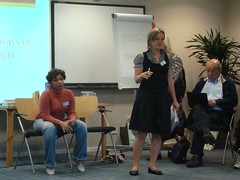
Presenting personas at the Research to Impact Hackathon

We tested this, perhaps a little unfairly, by asking the participants during the first day of the Hackathon we're working on this week in Nairobi, most of whom were subject experts we'd invited to provide context and scenarios for the developers to get their teeth into, how much they used either R4D or ELDIS data. About half had accessed the sites, very few accessed them more than once or twice a year. Yet these were researchers, information scientists and knowledge workers with intermediary NGOs like ALIN, all prime targets from the materials.

"Hackathons" (also known as a hackfest or hack day) are events in which computer programmers join forces with a number of other experts, such as designers, investors, project managers, and spend a short intense period together to develop technical ideas and solutions. The Research to Impact hackathon is focusing on the research data from R4D, ELDIS and other relevant sources - including those from Kenya such as KAINET - relating to agriculture and nutrition. We brought together subject matter experts with technical developers to explore and create innovative prototypes to increase the use and impact of research in development. The hackathon is being at the Nairobi iHub by iHub Research, a new programme within this open innovation space.

The first day focused on generating scenarios - use cases - for the developers to work on. We started by asking participants to identify some of the reasons that research data isn't accessed or used. The group then selected seven typical 'user types' who represent key potential audiences for the data. These personas included extension workers, researchers and knowledge workers - key intermediary roles for re-purposing data and linking with primary players in the agricultural value chain such as farmers, input suppliers and market intermediaries. The group also prioritised fleshing out the role of policy actors, key to addressing the whole range of issues which impact those working directly in agriculture. Working in groups these types were profiled and linked to the challenges previously identified. After rapid peer review specific 'triggers' were identified for each of the personas, things which might motivate them to change their behaviour in relation to the data. The personas will be shared in the EuforicWeb wiki as the Hackathon develops.

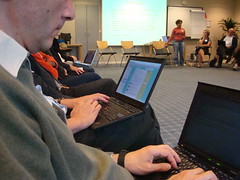
Evaluating ideas at the Research to Impact Hackathon
A group of developers joined in the afternoon. They were presented with the personas and had time to interrogate the subject specialists. We finished with an ideation session, when all participants were given 10 minutes to come up with at least 10 suggestions for technical developments - mobile or pad apps, web widgets or small pieces of linking or bridging code. Those ideas were located on a matrix representing high/low impact, high/low viability - in terms of being able to develop a proof of concept in the succeeding two days. There were an extraordinary number and range of ideas, both creative and very applied. The ideas which were voted as high/high will be taken into the hackdays to help kick-start the process.

Wednesday, October 21, 2009

R4D at the European Development Days

During the 4th edition of the European Development Days - held from 22 to 24 October in Stockholm - Euforic actively promotes the Research for Development (R4D) project.

R4D is a free access portal containing information about research programmes supported by DFID. It provides you with the latest information about research funded by DFID in the framework of its 2008 Research Strategy, including news, case studies and details of current and past research in over 20,000 project and document records. Information is available on a broad range of topics, such as sustainable agriculture, climate change, economic development, health and capacity building.

R4D is unique in the sense that it makes information available to researchers, students and policy makers that hitherto was circulated at a limited scale. Documents and reports are presented in full text, there are various search options for different types of information, plus the Research Dialogue and Communications Corner blogs allow for reflection and debate.

Please feel free to meet with Euforic's Rosien Herweijer at stand 25 to hear the latest about R4D and to subscribe to the newsfeeds of your choice.

You can also visit Euforic's research feedfinder page to subscribe to selected R4D newsfeeds.

Monday, October 05, 2009

What's your view on R4D?

R4D is a free access portal containing information about research programmes supported by DFID. It provides you with the latest information about research funded by DFID, including news, case studies and details of current and past research in over 20,000 project and document records.

We are conducting a short survey to help inform future improvements. It covers what you think of the current service from R4D, and what you would like to see on the R4D portal. The survey should take around 5 to 10 minutes to complete, depending how much you choose to say. It does not ask for personal, identifying data.

We need your views on R4D and thank you in advance for your input!

To start the survey, please click here.

This survey is being conducted on behalf of DFID, the UK Department for International Development.

Visit Euforic's research feedfinder page to subscribe to selected R4D newsfeeds

Monday, September 28, 2009

Research communication: Act now!

Euforic was in Vietnam last week working for the Danish Development Research Network (a member since last year). We were facilitating a workshop on research communications. Euforic was approached because of our work with communication between development actors and our involvement in the research for development project (R4D) for DFID in the UK.

Strengthening communication in N/S research partnerships for development

The workshop was designed to support DANIDA funded research projects and is a continuation of the series begun in Tanzania.

Over 45 participants drawn from all over Vietnam together with research colleagues from Denmark met for 3 days in Hoi An to develop their understanding of developing communication strategies and approaches for their projects. The two projects involved are both examining the impact of climate change, one focussing on physical changes, while the other has a multidisciplinary approach including geographers, natural scientists and socio economists.

The workshop aimed to develop communication skills, build strategies and make practical products.

Group work in project teams ran through the three days, resulting in a draft communications plan for each project and the development of example products such as press releases and leaflets. These working sessions were interspersed with demonstrations, papers and presentations and culminated with a presentation exercise to explain the final results of each project team to the rest of the workshop.

The sessions covered standard methodologies to developing communication strategies, identifying target groups, establishing the aim of the communication, developing messages for that group and chosing the appropriate channel to reach them.

One of the most popular sessions was looking at new opportunities on the web for research communication and ways the projects could work with these systems.

Wiki

A common Wiki platform for the resources and learning from the workshop process has been developed by Euforic for DDRN and provides a resource base for those who have attended the Tanzanian and Vietnamese workshops. The commscorner and web2share sites also provide reference points on Web2 tools and communications advice for researchers respectively.

Learning by acting

The final presentations were a learning exercise in themselves with one project team demonstrating clearly how a theatre exercise could explain the communications plan through role play, a synopsis of
their presentation is given below.

ACT1: The local authority
Set in the office of the local authority, we saw project members explaining their project with the aid of a leaflet they planned to have distributed by various actors in the community and to win the support of the local authority in the process. As this scene was acted out we saw an image of the proposed leaflet they were discussing as a backdrop to the piece of theatre.

ACT2: The donor
The scene set at the Danish embassy showed how the project team planned to communicate with the funder of the project, using their communications strategy to demonstrate they had planned more communication activities than expected, and would seek additional funding for some specific activities. Meanwhile the screen behind them highlighted the relevant part of their communications strategy.

ACT3: The farming community

Here the scene quite clearly illustrated the local community concerns with changes in climate andthe ways the project team had considered explaining their study activity and considering how they could present eventual findings.


Setting the scene: Open meeting
The other project group staged a local open meeting attended by all stakeholders touched by the projects, i.e. local authorities, CSOs, local social organisations as a way to present their strategy.

The take home message
In discussing all the information products and actvities there were three elements the researcher needed to consider.

1)Start by putting yourself in the shoes of your audience, think of what their interests are and what will make them act on information.

2)The inverted pyramid - don't write all your communications like a research paper, most audiences want the conclusions first rather than last.

3)Answer the Who, What,Where,Why,When and How questions in everything you write.

Finally we summed this all up in an active mnemonic.

Make a pyramid with your hands above your head and then invert it 6 times by swinging your arms down to point at the ground and at the same time look at your shoes. Each time you bend down say to yourself each of the six questions...Who, What,Where,Why,When and How.

- Who.... will benefit from the research and who is doing it?
- What... is it all about?
- Where... is it happening?
- Why... does it need to be done?
- When... will the results be ready or events happening
- How... is it all being done?

We all learnt a lot from the workshop, in particular how to communicate across two languages and two cultures. For this we found two solutions. For the first we had a great translation team and for the second............

Good singing voices and a common sense of humour.

Tuesday, August 25, 2009

DDRN workshop on communication in North/South research partnerships

Increasingly donors who fund development research programs stress the need to communicate about research priorities, programs and outcomes. Researchers themselves as well as intermediaries have an important role to play in this. Examples of donors with a strong interest in research communication are DFID, DGIS/WOTRO and Danida.

On 12 - 14 August 2009 DDRN, the Danish Development Research Network, convened a workshop in Tanzania to promote effective communication during and after the implementation of three new research projects in Tanzania for which Danida granted funding in 2008. The projects look at livestock, dried fruits and climate change and will be carried out in partnership with Danish universities.

The workshop addressed a variety of issues regarding research communication. Euforic and CABI, another Euforic member, developed and co-facilitated the workshop with assistance from staff of DDRN and the Danish Water Forum (DWF). Over 30 researchers and external stakeholders attended the workshop that was held at the Sokoine University of Agriculture (SUA) in Tanzania.

Drawing on the experience of the Euforic network and aiming to respond to the needs expressed by the participants, the event was designed tailor-made to cover the formulation of a framework communications strategy for each project and to elaborate some example communications products. Also included was a session on how to use the internet to disseminate and access research results.

The workshop began with an analysis of the various stakeholders of research projects and the aims of communicating with them. The goal of communication can be to change the behaviour of stakeholders, to raise awareness about specific issues, to encourage dialogue, or to collect needs. To reach such goals you need to be clear: What is it you want to achieve with your research communication? Who do you want to address? What is your message for them?

This first module of the workshop was followed by presentation sessions that drew on case studies of messages and channels for different communities and actors. In a variety of hands-on exercises participants worked on different products and media. A specific session on writing press releases was supported by a meeting with local journalists from the Tanzanian newspapers “Business Week” and “The Citizen”.


The workshop culminated in a presentation session entitled “The SuperProjects” in which the participating research projects made presentations based on their press releases and communications plans, illustrating the different impact of various styles of presentation. The peri-ubran livestock project illustrated a selection of target audiences and the messages and channels they would use to reach these audiences. The Dried Fruits project proved to be popular with samples of the product available for the audience to taste. The Climate Change study on Kilimanjaro was enhanced by spectacular images.

The workshop provided key documents, many produced by other Euforic members, and illustrated issues with videos from the euforic.blip.tv and r4d.blip.tv channels.

Earlier, Euforic was involved in launching the DFID Research Strategy works with CABI on R4D, a DFID funded project on research communication. Research communication was also a central theme at the June 2009 EADI IMWG-meeting supported by Euforic.

See also Euforic newsfeeds on information, knowledge, communication, and from the IMWG 2009 workshop

Monday, June 15, 2009

Who are we hearing?

Listening to multiple knowledges, attempts to redress the current bias.

In this open space session during the EADI IMWG 2009 meeting the group discussed what efforts are currently made to ensure that different groups are included in development research activities and that their views can be heard. This is the core concern of an EADI project funded by DGIS, the department for development cooperation at the Dutch Ministry for foreign Affairs.

The conversation was wide ranging around the issue of research information and communication and covered three elements:
  • Providing access to research information from various groups;
  • Bias in the research agendas set in research organisations;
  • Communicating the outcomes of research to the community.
Providing access to research information
In discussing views of and access to research the following portals within the EADI network (which included also NGO research) were mentioned: research4development and search4dev.
Large portals are not the only way to present collections. Using custom search engines like focuss.info organisations have made increased access to views from their networks documents. Good examples are the Sangonet search from South african NGOs and the recently constructed Codesria search. Providing this information is only part of the story. Management need to be convinced of the issue.

There is not only a need to work on mobilising research but also promoting access to and creating demand for other sources of research, in the North as well as in the South. The internet may have provided more access to materials but it also means they can be shared whilst still work in progress. ICCO explained how their materials are shared before the final version is loaded onto Search for dev. ICCO research can be found on their wiki which is part of ComPart, their knowledge sharing platform.

Informing research agendas to make them relevant
How could we be sure that research is relevant and really served development goals?
There was the discussion of how donor agencies have produced a projectisation of research rather than organisations setting their own research agenda. This runs the risk of research agendas no longer being local and set by countries. Examples of these are the EADI Geneva conference last year and the UNRISD 2004 conference (see UNRISD News 27).

In discussing the last EADI conference the issue of action research and studies being more clearly of benefit to communities was raised. This was examined in some depth at the IKM emergent session at the EADI meeting.


Mike Powell introduces the IKMemergent project

Impact and uptake of research has been examined by several donors, one of the largest attempts is the DFID program 'Research Into Use' . This demonstrates a change in how research for development is perceived, with the recognition that participation in research leads to better communication. However, some participants were worried that there are few incentives to work in this way. As we were twittering this discussion we received the recommendation to look at RAAKS as an example of participatory research . In conjunction with discussing new innovative approaches we were encouraged to read Knowledge on the move.

Communicating the outcomes of research to the community
In addition to the difference that participatory research makes to communicating results to the community we heard of different approaches. For example how researchers had worked with the journalist Manuel Torres to write newspaper articles on the results of their research. Other materials were produced to reach the farming community.

A full description of the IKMemergent project and further details on each of these elements and more is available at IKMemergent.net and in previous articles on this blog.

by Chris Addison

See also Euforic newsfeeds on information, knowledge, communication, and from the IMWG 2009 workshop.

Thursday, June 11, 2009

Peer-assist session at the IMWG 2009 meeting

After the key note speech of Lea Santana (NEIM - see also her blip interview), participants in the IMWG 2009 meeting jumped into the peer assist session, to discuss some of the issues they are facing in their daily work.

The group identified a series of specific questions on which to compare notes and exchange views:

1. How do researchers share knowledge and learn form the knowledge that is produced and exists?

Some participants noted that learning has to be part of the research process. In this process, important is also to share lessons of what did not work so to learn form failures. A fundamental question remain: How do you learn to do things different, especially bringing together people that speak different languages (researchers, NGOs, policy makers)?

A good example comes form DIIS, that hosts staff from Foreign Affairs and DANIDA for a period of time. This way researchers learn how to write in a way that is more immediate to grasp for policy makers: concise, to the point, in a way that can be useful and not just good for academic carrier. It works also the other way around, with researchers outplaced to DANIDA and working there.

2. What's the role of intermediaries?

If you want your research being applied, it has to be communicated, it has to be made known to the target group that needs to use it. The way you write and communicate research findings needs to have the format geared to the audience. You need to to know who you talk to in order to decide your language. In this process, you also choose the appropriate tool(s) to reach your target group.

The role of communication professionals is therefore a key one. Researchers generate very specific outputs; therefore you need 'brokers' that translate these outputs in formats that can be used and applied. There needs to be an expert in between researchers and non-researchers. However it's was underlined that these intermediaries have to work with the researchers and not for the researchers. Therefore the dialogue between researchers and intermediaries needs to start before the research takes places.

Lastly, it was noted that also other professions have trouble in communicating; what can we learn from experiences in other fields to deal with these issues?

3. Copyright issues

More and more organisations are adopting Creative Commons licenses, what are the pros and cons of this?

Creative Commons allows new distribution ways of information and knowledge produced, making sure that other people can use our work. But as with every deal concerning peoples intellectual property, there's some hesitation around in doing that.

A good example comes form Development in Practice which decided to go for a Creative Commons-Attribution-Noncommericial-No Derivatives license, as it was felt that this protects the interest of the author. However, when you want to apply similar licenses, you need to make it clear to the author from the beginning.

Furthermore, the choice of license very much depends also on where you see that your info is potentially useful.

Plagiarism can happen anyway, regardless of the way of publishing and the license you use; others are the checks and balances which are needed.

One of the participants commented that there need to be more debate on commercial vs. non commercial use of content under CC license.

Useful information on this issue can be found on the web dossiers on open access from EADI, ELDIS and Wellcome Trust. See also the blog post from the open space discussion on the issue during the IMWG 2009 meeting.

Other issues briefly touched upon during these peer assist session included:
- The 'long-tail' of research outputs [Some research outputs are peer reviewed and get increased value and recognition only after the research funds are finished: How do donors go about that?]

- How to compile annual reports [strategy and tools] and how to make them 'live' longer that the time span they cover?

See also Euforic newsfeeds on information, knowledge, communication, and from the IMWG 2009 workshop.

Communication: what for who?

This small group of EADI IMWG 2009 meeting explored differences in communication processes related to research, advocacy and policy. Lea Santana of NEIM, Brazil [see also her blip interview] explained how she tries to package information in ways that serves the purpose of advocacy. Academics can communicate with other academics but for politicians you need to re-package information. You need to "translate" the information.

Mike Powell, IKM Emergent Programme, emphasized that not all research is academic. Research is about recording experiences. Lea agreed, a photographic exhibition can be research. Another participant stressed that whether a publication is actually considered academic research depends on in which journal you publish. There are quality standards, peer reviews etc. These quality standards seem to serve to protect, to legitimize.

The type of communication has very much to do with your audience. In development research you have to realize that there are people involved in such research that do not read academic journals, for example the people in developing countries who's life is being researched one way or another. So what do you do to communicate with them? Is not the basic idea of doing development research that it contributes to development? So you have an obligation to share your research in a accessible way.

Maarten Boers concluded that the differences may not seem fundamental particularly when you try to inform public decision-making.

See also Euforic newsfeeds on information, knowledge, communication, and from the IMWG 2009 workshop

Tuesday, April 07, 2009

ÖFSE on New Private and State Donors

A recent Working Paper (pdf in German) of the Austrian Development Research Institute (ÖFSE) looks at the discourse on the 'New Donors' in development cooperation and assesses the impact of these new private and state actors on the global aid and governance system.

While the traditional (Western based) donors refer to the OECD indicators to describe and legitimize their aid, new donors have a rather different attitude towards these standards. This is ranking from a more or less loose reference (i.e. new European Member states or Israel) to clear opposition (i.e. China, India or Russia) to what is seen as a Western dominated system.

This is even amplified by their unclear role in the global aid and governance system. China or India, the biggest new state donors, both still have to deal with severe internal development problems while at the same time acting as donors in Asia and Africa. Additionally these countries can no longer be ignored by global governance arrangements taking into account their rise as global economic players. Combining cheap labor with a high investment in R&D they also show new success strategies for economic development. Last but not least the connection of economic interests with development programs poses additional challenges for the traditional aid system.

This makes it difficult to analyse the real impact of the new actors. Nonetheless the authors predict that the OECD paradigm regarding the definitions, categories and practices of aid can no longer be maintained in the future without taking into account the new donors' activities.

The paper also looks at the increasing private engagement in development. According to the World Bank private foundations contributed 5 to 7 Billion $-US in 2006 compared to 104 Billion $-US ODA. However, considering the stagnating public aid figures and the growing private investments there is a great awareness of these private activities.

The authors see the political and economic independence with a possibility for long-term engagement, the willingness to take higher risks compared to state actors, and the professionalization of private donors as rather positive. Their low experience in the field, their tendency to combine aid with public relations strategies can be seen as a challenge for the future. Furthermore the paper criticizes that money is not always spend were most needed which might have a negative influence on policy prioritisation in aid-dependent countries. This can result in a withdraw of resources from one sector in support of the sector prioritized by the private donor (i.e. personnel from basic health care to HIV/AIDS).

The authors conclude that more research is needed to assess the real impact of new private and state donors on the global development agenda.

By Martin Behrens

See also EADI's EDC2020 project on the New Drivers in Development Cooperation

Monday, March 30, 2009

R4D, tool to access DFID-funded research

Over the last decade, DFID has invested around £700m in international development research. Hundreds of research partners around the world, running thousands of projects and programmes, have generated knowledge to shape our thinking on key development topics.

For the first time, information about this research is available on a free searchable database through DFID’s research portal (R4D). 

It has never been easy to find out what research topics, projects, and programmes DFID is funding or has funded. Researchers all over the world (and even DFID staff) had to rely on a network of personal contacts or inspired detective work to discover who was already working in a particular area, what was already known, and what lessons had been learned.

But now, R4D puts that information at your fingertips. Responding to a demand expressed by many DFID stakeholders for better and open access to all this information, R4D is a free on-line database containing information about research programmes supported by DFID.

R4D contains nearly 5,000 project records, and details of more than 20,000 research outputs. Every month we add new items, update existing information, and add historical documents as they become available. In addition to the database, R4D publishes research news and case studies, and keeps you up to date on the latest from DFID, including calls for new research programmes commissioned under the DFID Research Strategy 2008-2013.

R4D could become a vital link in your information chain, both for keeping in touch with other researchers’ work and for sharing your own DFID-funded research results.

Keep in touch ...

R4D’s monthly e-mail newsletter alerts you to the latest on R4D. There are also 60 themed e-mail alerts or feeds on specialist subjects, from agriculture to water, and more than 160 more related to specific countries. You can also produce your own tailored feeds, or let us know and we will do it for you.

Hot off the Press ...

DFID’s Research Strategy promised to spend up to 30% of its overall £1bn funding in ‘making research available, accessible and useable through a range of means’. This week sees the launch of R4D’s revamped Communications Corner. Its purpose? To provide practical support and guidance to anyone wanting their research to be communicated effectively. A weekly CommsCorner Blog aims to inspire with examples of innovative communications, both from within the DFID research community and from further afield. A companion blog R4D Podium Posts invites DFID researchers to share communications approaches, tactics, successes and challenges with other researchers. Take a look!

Monday, March 23, 2009

Democracy promotion: No end of history

While democracy promotion became a 'Boom Industry' of International Cooperation in the 1990s, governance indicators show a negative global trend today. At the same time International Democracy Assistance is criticized for not showing measurable results.

A Briefing Paper of the German Development Institute looks at strategic challenges for Democracy Promotion and Assistance.

The authors come up with 10 recommendation:
  1. Invest in research about the preconditions, catalysers and processes of democratization
  2. Take regard of conflicting political targets
  3. Ensure a coherent policy towards partners
  4. Take regard of regional and local contexts
  5. Take a strategic and long-term approach
  6. Chose the right partners to support change
  7. Be aware that the time of invention offers different opportunities, be flexible if change happens
  8. Take the right measures at the right time (i.e. human rights before democratic elections)
  9. Ensure coordination and synergies with other policy sectors
  10. Take a holistic systemic approach for evaluation instead of looking only on project outputs
See the Euforic newsfeed and dossier on governance.

See also ICCO on Democratization and Peacebuilding

Wednesday, March 18, 2009

Translating research into action

A recent post on the R4D blog introduced the importance of 'knowledge translation' that helps get research into use.

A new 'knowledge translation toolkit' from IDRC and SDC shows how researchers can can link their research with action. With a focus on health, contents include:

Chapter 1 - Knowledge Translation: An Introduction

Chapter 2 - Bringing in the Demand: Towards the Harmony of Push and Pull - demystifies the “demand side” of research, how decisions are made, what we mean by “evidence”, strategies for promoting linkage and exchange, as well as knowledge brokering.

Chapter 3 - Knowledge Management - a starter’s kit to KM, examining the people, processes and technology that can maximize the utility and impact of both tacit and explicit knowledge.

Chapter 4 - Context Mapping

Chapter 5 - Evaluative Thinking

Chapter 6 - Designing a Communications Strategy - ten Essential Elements that any strategy must answer to get a better picture of where we are, what we have to say to the world, and how we intend to say that.

Chapter 7 - Communicating Research: Print Media - discusses peer-reviewed articles, newspaper articles, press releases, policy briefs, and newsletters.

Chapter 8 - The Two-Pager: Writing a Policy Brief

Chapter 9 - Systematic Reviews

Chapter 10 - Open Access - outlines the logic, the history, the various “routes” to OA, and how researchers can both access and contribute to it.

Chapter 11 - The Conference 2.0: Better Presentations, Better Conferences - discusses oral presentations, poster presentations, and conference presentations.

Chapter 12 - Tapping Technology: Integrating Technologies - focuses on the three major applications that we all use every day – email, the internet, and word processing.

More in the Euforic newsfeed on information, knowledge and communication

Wednesday, February 18, 2009

Call for submissions: EADI Prize for Development Studies 2009

The European Association of Development Research and Training Institutes (EADI) announces the 2009 prize for excellence in development research. The prize, worth €1 000, will be awarded for an essay on an issue of development studies in any field of the social sciences submitted and written by a postgraduate student from an EADI member country or attending a programme at an institutional member of the Association.

Subjects may be chosen from any field of development studies, but contestants are asked to bear in mind that their work will be subject to scrutiny by one of the EADI Working Groups prior to being sent on to the jury. Entries coherent with Working Group themes will, therefore, clearly enjoy an advantage. A list of the Working Groups can be found on the Association’s web site.

All entries for the EADI Prize for Development Studies should reach the Association’s offices in Bonn no later than 31 May 2009 by e-mail.

The Jury for the 2009 EADI Prize for Development Studies will make its decision known in September 2009. The prize winner will be invited to the Association's Annual Directors' meeting in Copenhagen (Autumn 2009, date tbc) where the award ceremony will take place. Both the winning entry and other high quality entries might be considered for publication in the European Journal of Development Research (which is upon the decision of the Editors after a refereeing process).

For further information please visit the website or contact:
European Association of Development Research
and Training Institutes
Kaiser-Friedrich-Str. 11
53113 Bonn
Germany
Tel. +49-228-261 81 01
Fax +49-228-261 81 03
E-Mail: prize2009@eadi.org

See also Euforic's newsfeeds on research, and on EADI

Wednesday, February 04, 2009

Natural resources - blessing or a curse?

Speaking at the GDN conference in Kuwait, Albert Zeufack argues that natural resources can be a blessing for development, but most of the time they are a curse:


Monday, February 02, 2009

Natural Resources and Development - 10th GDN Conference

Six pre-conference workshops, four plenary sessions, some twenty parallels, and over four hundred participants: these are the impressive numbers of the 10th GDN Annual Conference taking place in Kuwait City, 1-5 February 2009.

The main theme of the event is "the crucial relationship between natural resources and development", and delegates will address this by discussing the political economy aspect of the issue, its the relations with sustainable development and the management of natural resource.

Among others, speakers include Ernesto Zedillo, Director of the Center for the Study of Globalization at Yale University, Justin Lin, World Bank Chief Economist and Senior Vice President, Paul Collier, Director for the Center for the Study of African Economies at the University of Oxford. See the complete agenda on the conference website.

Euforic's Chris Addison and Pier Andrea Pirani are participating in the conference and working with GDNet colleagues to 'blip' participants and to collect impressions, reactions and opinions on the issues discussed.

Follow the blog

View the blip interviews

Thursday, January 29, 2009

The EU: An imperial power?

Civil Power, economic giant or incapable multi-level government system – a recent paper (pdf in German) of the German Institute for International and Security Affairs (SWP) looks at publications in 2008 on the nature of Europe's foreign policy.

According to the authors, a new research trend is to apply the theoretical concept of a hegemonic or imperial power to the European Union. While the extent this concept is used to describe European Foreign Policy differs, authors applying it argue that today's hegemonic powers extend their influence by promising peace and economic development and not primarily by using military might. In this light the European Union is said to be a perfect example.

Others insist that the EU is no different from other global powers which always redefine particular interests as universal goods which will also serve the rest. The EU's self-concept of being a moral or ethical power defects from its interest-driven policy implemented through conditionality, military missions, neighborhood and enlargement policy.

A last group of publications reviewed disagrees with the whole idea of the EU as global player. According to them, the multi-level government system does not allow Europe to speak with one voice and to do more than react to crises. Although the EU has all the means to become a global player, its member states lack the political will to let this happen.

by Martin Behrens

See the Euforic news alert and dossier for more on Europe's International Cooperation

Thursday, December 18, 2008

Launch of Search4Dev, a repository for Dutch development information

On December 16th, the Search4Dev portal was officially during a presentation in the library of the Royal Tropical Institute (KIT).

The initiative originated within the Development Policy Review Network (DPRN), a virtual network of development experts, focusing on bringing people together, establishing partnerships, and stimulating informed debate. DPRN seeks to bridge the gap between research, policy, practice and the private sector. In this context, information exchange was seen as essential in achieving these goals and therefor the Global-Connections portal was set up.

The Search4Dev initiative builds on the experiences of DPRN in this area - in particular the concern to make research information relevant for policy and practice - and aims to provide a repository for all publications and documents produced by Dutch development organisations, both academic and non-academic. It fosters open and easy access to information, guarantees that the information remains available in the long term, and allows for harvesting by search engins and other information platforms with a specific focus, such as Euforic.

KIT Information and Library Services manages the project, bringing in its expertise and networks in the areas of information, communication, and research.

For more information contact Ingeborg Nagel, Project Manager Search4Dev.

See also Euforic's newsfeed on information, knowledge and communication

Sunday, October 26, 2008

Innovation, information, communication - maximising research impact

An important change in the discourse on agricultural and rural development is the emergence of an ‘innovation systems perspective’ that focuses on interactions among different actors working to bring change. According to Hall, the innovation systems perspective fundamentally recognizes that the determinants of innovation, as a process of generating, accessing and putting knowledge into use, are the interactions of different people and their ideas, and the social setting of these interactions and relationships.

At last week’s workshop to discuss how improved communication can help maximize the impact of agricultural research in Africa, we caught up with David Spielman of IFPRI and Patti Kristjanson of ILRI - both of whom work in this area.

We asked David to explain what such innovation systems entails:


We also spoke to Patti Kristjanson, Leader of the ‘Innovation Works’ Initiative at the International Livestock Research Institute in Kenya for an example of such thinking, in action, so to speak. The 'Innovation Works' initiative is about "how we do the research, more innovatively, with partners, to have more impact on sustainable poverty reduction." According to Kristjanson, how the research is done "absolutely matters" - she and her colleagues have identified some principles and strategies that can "indeed increase the probability that the research will generate knowledge that leads to actions." More ...


By coincidence, during the Addis Ababa workshop, Louise Clark, Knowledge Transfer manager at the Research Into Use Programme launched a new blog with the name: RIU: An Innovation System Story!

The Addis Ababa workshop is organized by the Global Development Network (GDN) in partnership with the Overseas Development Institute (ODI), the World Bank Institute (WBI), and the International Food Policy Research Institute (IFPRI), with support from the Information and Communications Technology – Knowledge Management (ICT-KM) program of the Consultative Group on International Agricultural Research (CGIAR).

Photos from the workshop
Video interviews at the workshop
More stories on this blog / on IAALD blog / on ICT-KM blog
Euforic news on communication and knowledge-sharing
R4D news on research communication

story by Peter Ballantyne