Google+
Showing posts with label rural_development. Show all posts

Thursday, December 10, 2009

EC invites to comment on Issues Paper on Agriculture and Food Security

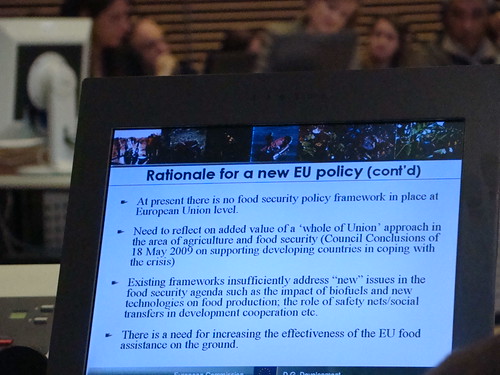
Food Security and Agriculture are very much back on the agenda. Building on its Food Security Thematic Strategy Paper 2007-2010, the European Commission is currently developing a new Policy Framework to assist developing countries addressing agriculture and food security challenges. On 9 december 2009, at the CTA organized Brussels Briefing “From Global Food Crisis to Local Food Insecurity”, the Directorate General for Development elaborated on its Issues Paper on food security.

DSC01913


The new policy framework will build on central elements of the past framework:

• The aim remains not simply to deliver food aid but to achieve Food Security for all
• Maintain a link between relief and protecting sustainable livelihoods and crisis prevention
• Address four pillars: availability (1), access (2), quality and utilization (3), and crisis management and prevention (4)

The Issues Paper was published 16 november 2009 and is part of the consultation and policy development process which has to lead to Council Conclusions – an official statement of the ministers of EU members states – on a Policy Framework on Agriculture and Food Security in May 2010.

Until 9 January 2010 you can voice you opinion about the Issues Paper at www.ec.europa.eu/yourvoice/consultations


Several participants at the Brussels Briefing organised by CTA commented on the presentation by the DG-Development representative. ActionAid welcomes the EC initiative but feels the Commission has no long term approach to investment in agriculture and food security. Also, according to ActionAid, the EC approach lacks attention for women’s access to credit, land and services. For example, compared to an earlier version, the chapter on agriculture has been removed from the current version of the EC Gender Action plan, a document stakeholders may comment on next week. ActionAid also warns about the so-called “whole of union approach” that the Commision wishes to explore in connection with issues of Food Security. This approach suggests that members states – besides official development cooperation - use all kinds of other resources to achieve development objectives. However, ActionAid and Concord are concerned that the "whole of the union" approach is more about “counting all resources” as opposed to really “using all resources”.

Subscribe to the euforic newsfeeds on food security and eu cooperation for more news

Tuesday, December 08, 2009

Brussels Briefings live on the Internet

The Briefing “From Global Food Crisis to Local Food Insecurity” live on the Internet!. This way, you can easily follow the presentations and debates.

WHEN: December, 9 – 8:30 – 13:00 (Brussels Time)

This service (in English and French) is FREE and requires simply the use of a computer connected to the Internet.

To get access, please click on this link: http://scic.ec.europa.eu/str/index.php?sessionno=401 (use of the Internet Explorer browser is recommended)

For the programme, background note and registration form, please check http://brusselsbriefings.net/.

Sign up for the Brussels Briefing newsfeed; see also the Euforic newsfeeds on rural development, food security and the food crisis

Tuesday, December 01, 2009

Next Briefing on food crisis and food insecurity

The next Brussels Development Briefing will be held on 9th December and will discuss “From Global Food Crisis to Local Food Insecurity” in the context of the new EC policy on Food security to be released.

The Briefing will be looking at the domino effects of increased speculation in food markets (How has the global food and financial crisis affected food production and distribution and the food security of the poorest? Is global food production at risk in the medium and long term and will national food security and food sovereignty be the priority over global food availability? Is the small-scale farming more effective and resilient in times of crisis in least-developed countries?) and the on what realistic policy options can secure food supply and availability at global and local levels.

For the programme and registration form, please check http://brusselsbriefings.net/.

Earlier Brussels Briefings looked at 'ACP Agricultural and Rural Development: why Media matters?', 'Upgrading to compete in a globalised world: What opportunities and challenges for SMEs in agriculture in ACP countries?','The Role of Livestock for ACP countries: challenges and opportunities ahead', ' Meeting Food Safety Standards: Implications for ACP agricultural exports', 'Fighting against Illegal, Unreported and Unregulated fishing (IUU): Impacts and challenges for ACP countries', 'Land access and rural development: New challenges, new opportunities', 'How does international migration affect ACP rural development?', 'Rising food prices: an opportunity for change?', 'New drivers, new players in ACP rural development', 'Does Fair Trade contribute to sustainable development?', 'The climate challenge for ACP agriculture', 'Aid for Trade', 'Advancing African Agriculture' and 'Challenges to rural development in ACP countries.'

Sign up for the Brussels Briefing newsfeed; see also the Euforic newsfeeds on rural development, food security and the food crisis

Thursday, November 12, 2009

Brussels Development Briefings: more background information available

The report of the Briefing on “Upgrading to compete in a globalised world: What opportunities and challenges for SMEs in agriculture in ACP countries?” held on 23rd September 2009 is available now. The report presents a detailed account of the presentations and debates, and can be downloaded here.

The reader provides extensive background information on the issue - including online resources - and is also available online.

Sign up for the Brussels Briefing newsfeed; see also the Euforic newsfeeds on rural development and agriculture

Wednesday, October 14, 2009

CTA’s 14th Brussels Briefing: woman bites dog or why media matter for rural development

At the Brussels Briefing # 14, organised by CTA on 12 October, a lively discussion on media and rural development took place. The debate was fed by contributions of a variety of panelists and a large crowd of participants from ACP countries. Why is there so little reporting done on regular media on issues concerning farmers and rural communities? Why do the media treat the food crisis as an urban issue? Can journalists partner with farmers, politicians, policy advocates and researchers in promoting rural development? What is the role of the new media and do ICTs contribute?

To prepare for this session the organiser CTA hosted a 4 weeks e-discussion. Susana Thorp from WREN gave a brief summary of the outcomes. First and foremost, Mrs. Thorp emphasized that participants hope that discussion actually leads to action. The e-debate focused on constraints faced by media on – conflicting - expectations of various stakeholders on new media and ICTs, and on support for enhancing media activities and building capacities. A summary of the e-debate is available here.

It was interesting to observe that at this Brussels Briefing the majority of panelist and quite a number of participants were female. Mrs. Tumi Makgabo, lead discussant and former CNN anchor stressed that in the world of media women have more barriers to overcome than men. But together with Mrs. Violet Otindo of K24TV in Kenya, winner of the CNN African Journalist Award, and all the other women participating in this debate she showed it can be done.

How do women overcome these barriers? Violet Otindo mentioned the importance of mentoring, but she said it should be used with care. For a journalist mentoring involves risks because it exposes you to political and commercial interests. Lack of resources and equipment are the major barrier according to her. She remarked that when you have no resources, everything takes more time. As a journalist you have to work smart and time management skills are essential. She feels that more recognition for the work of local African journalists is important, the big media houses should make more use of local journalists. Also support initiatives involving training and awards can be helpful.

Tumi Makgabo defined herself as a feminist with three-inch heels. You have to counter the way media portray women as a victim by acting like the opposite. She wants women to have a voice and she feels she can contribute more working as an independent journalist from Africa. She also illustrated how women seek to balance professional and private goals by telling how for her living in Africa as opposed to Atlanta serves both. As for the professional goals: Mrs. Makgabo stressed that with the new technologies Africans can tell stories about Africa: “we can tell our stories from any place now”.

In his keynote address CTA’s director Hansjörg Neun observed that media tend to report on the extraordinary – a man biting a dog is news, the reverse is not. Much of the messages on rural development do not seem to qualify as news. The first panel was lead by Tumi Makgabo of South Africa, a former anchor of CNN Inside Africa, now African Broadcasting and Media, and director of the African Women Development Fund. She introduced the panelists: Mr. Jean-Philippe Rapp who founded in 1985 the International North-South Media Forum, Mrs. Brave Nsidale, Ambassador of Malawi, Mr. Ignatius Jean, Representative of IICA and former minister of Agriculture of St. Lucia, Mr. Thozi Gwanya, Director General of the Department of Land Reform in South Africa and Mrs. Krishendaye Rampershad, media consultant based in Trinidad.

Ms. Rampershad emphasized that it is important to differentiate: are we talking high tech corporate media or low tech community based. She felt the latter to be very powerful in serving development objectives. To those wishing to communicate messages to rural populations Ms. Rampershad had a clear advice: talk normal! Extension people have to be communicators and not talk science. Mr. Gwanya felt that media systematically ignored rural people and their interests. Mr. Jean of IICA observed that technical people in agriculture and media may not understand or like each other but they do need each other. In the Carribean Mr. Jean has observed that ICTs and the participatory information sharing they enable, have dismantled monopolies. He also emphasized that new partnerships emerge; in the oral, musical community of the Carribean the power of songs and the influence of musicians can support our communication for agriculture. Jean-Philippe Rapp commented on Hansjörg Neun’s example but he argued that the current food insecurity and plague of hunger is indeed a case of “man bites dog” and considered quite newsworthy. He observed a sincere interest among media for agriculture, but there is also a shift, he noted: media look for testimonies, there is less interest for the stories of the experts.

After the contributions of the panelists Ms. Makgabo opened the debate and the floor. She challenged the panelists: if people continue to buy tabloids that pay no attention to issues and needs of rural people, who are we to question these priorities? Ms. Rampershad emphasized that you may see this disconnection in public and corporate media, but in community driven media agendas are set differently. Mr. Rapp emphasized that agriculture is not a difficult or grateful subject but you need to tell the story with passion and in original, authentic language.

In the ensuing debate the focus was on the relations between the various stakeholders. There is often antagonism between politicians and media but participants also commented on how scientists are suspicious of journalists and vice versa. You can remove that suspicion by talking about the differences and the different roles, looking for common ground. Specific, deliberate and focused education initiatives may help to bridge the gap between what media (thinks it) needs and what the industry needs and what both sides can do.

Ms. Protz, the coordinator of CARIMAC, noted that few agriculture ministries actually do have a communication strategy. She observed that the media coverage of the climate change issue was not lead by journalists but by communities, the corporate and public media enlisted later in the process. Maureen Agena of the Women of Uganda Network questioned the role of (urban) journalists: how do you report on something you are not involved in? WOUGNET works with citizen journalists, women reporting on their own problems. Other participants questioned whether these citizen journalists had the skills and ethics to communicate responsibly.

More information on this briefing and earlier editions are available on the website of the Brussels Development Briefings and - in French - Briefings sur le Développement à Bruxelles

To get regular updates subscribe to the Euforic English language newsfeed for the Brussels Briefings or to the French language newsfeed at Briefings à Bruxelles

More on EU cooperation with ACP countries is available in the corresponding Euforic newsfeed on EU-ACP cooperation. Euforic also has a newsfeed on information, knowledge and communication. Visit the CTA website for more on agriculture and rural development in ACP countries.

Thursday, October 08, 2009

Next Brussels Development Briefing on rural development and the media

The next Brussels Development Briefing will be held on 12th October 2009 (14h30 – 18h30) on the role of the media in rural development.

We will discuss the need to mainstream media in development and increase donor’s attention to media as well as the challenges the journalists and media specialists face when addressing agricultural and rural development issues in their work. We will try to find more on how media can better serve rural communities in ACP countries. This Briefing will be part of the 25th Anniversary events of CTA and we will have with us prominent policy-makers and media specialists sharing with us their experience and views on these issues.

For the programme and registration form, please check http://brusselsbriefings.net/.

Earlier Brussels Briefings looked at
'Upgrading to compete in a globalised world: What opportunities and challenges for SMEs in agriculture in ACP countries?','The Role of Livestock for ACP countries: challenges and opportunities ahead', ' Meeting Food Safety Standards: Implications for ACP agricultural exports', 'Fighting against Illegal, Unreported and Unregulated fishing (IUU): Impacts and challenges for ACP countries', 'Land access and rural development: New challenges, new opportunities', 'How does international migration affect ACP rural development?', 'Rising food prices: an opportunity for change?', 'New drivers, new players in ACP rural development', 'Does Fair Trade contribute to sustainable development?', 'The climate challenge for ACP agriculture', 'Aid for Trade', 'Advancing African Agriculture' and 'Challenges to rural development in ACP countries.'

Sign up for the Brussels Briefing newsfeed; see also the Euforic newsfeed on rural development and media

Thursday, February 19, 2009

Ninth Brussels Briefing on land access and rural development

The next Brussels Development Briefing will be held on 25th February 2009 in Brussels (Centre Borschette) on 'Land access and rural development: New challenges, new opportunities' and will discuss the links between property rights, investment and the generation of economic opportunities in rural areas.

It will look at the correlation between inequality in the distribution of land and economic growth. It will also discuss the new challenges of global commercial interest in land and natural resources and the issue of rich countries buying millions of hectares of agricultural land in ACP countries.

For more information please visit the Brussels Briefings website to see the draft programme and to register.

Earlier Brussels Briefings looked at 'How does international migration affect ACP rural development?, 'Rising food prices: an opportunity for change?', 'New drivers, new players in ACP rural development', 'Does Fair Trade contribute to sustainable development?', 'The climate challenge for ACP agriculture', 'Aid for Trade', 'Advancing African Agriculture' and 'Challenges to rural development in ACP countries.'

Sign up for the Brussels Briefings newsfeed; see also the Euforic newsfeeds on rural development, and agriculture

Thursday, December 11, 2008

Eighth Brussels Briefing on migration and rural development

On December 11th, CTA and Euforic - in partnership with the European Commission-DG Development and EuropeAid, the EU Presidency, the ACP Secretariat, Concord and IPS Europe - have organised the eighth in the series of Brussels Development Briefings, entitled 'Does international migration affect ACP rural development?'

This Briefing discussed the benefits and challenges that migration can have on the agricultural and rural development of ACP countries, looking at the effects of remittances in this sector as well as the role of ACP diasporas in the development of their economies.

The programme, the background note, and the presentations are available online.

Earlier Brussels Briefings looked at 'Rising food prices: an opportunity for change?', 'New drivers, new players in ACP rural development', 'Does Fair Trade contribute to sustainable development?', 'The climate challenge for ACP agriculture', 'Aid for Trade', 'Advancing African Agriculture' and 'Challenges to rural development in ACP countries.'

Sign up for the Brussels Briefing newsfeed ; also Euforic newsfeeds on rural development, agriculture and migration

Thursday, September 11, 2008

Seventh Brussels Briefing discussed food prices

On October 16th, CTA, Euforic, and other partners organised the seventh in the series of Brussels Development Briefings, entitled 'Rising food prices: an opportunity for change?'

This Briefing addressed the causes and consequences of the rise of the food prices from a development perspective. It looked at the urgent actions that need to be taken, as well as at the best options and political measures on the middle and long term to safeguard the food security situation of the poorest households and market stability of ACP economies.

The programme, presentations, speaker information, video interviews, and further readings are online.

Earlier Brussels Briefings looked at 'New drivers, new players in ACP rural development', 'Does Fair Trade contribute to sustainable development?', 'The climate challenge for ACP agriculture', 'Aid for Trade', 'Advancing African Agriculture' and 'Challenges to rural development in ACP countries.'

The Briefing will be held at the Centre Borschette of the European Commission, rue Froissart 36, Brussels. For registration, please contact Romano Purro or Isolina Boto

Sign up for the Brussels Briefing newsfeed ; also Euforic newsfeeds on rural development, agriculture and food security

Tuesday, June 24, 2008

Newsfordev: an aggregator of agricultural and rural development feeds

During the Euforic/EADI workshop ‘Showcasing Knowledge and Information Services’ Kevin Painting (CTA) introduced Newsfordev, a RSS aggregator with thematic feeds on rural development and agriculture.


The project is the result of a workshop in 2005. It targets especially users with low bandwidth internet access by offering customised newsletters and options to personalize homepages.

Currently the database includes 680 feeds with about 650.000 articles organized in thematic dossiers and searchable via keywords.

As main challenge Kevin Painting sees the inclusion of other languages besides English.

See Kevin's presentation:


Read more stories from the workshop

See the Euforic dossier and the feed on Information, Knowledge and Communication.

See also the news feed from CTA

LEISA Network Portal

During the Euforic/EADI case study workshop ‘Showcasing Knowledge and Information Services’ Wilma Roem (ILEIA) talked about the LEISA Network Portal, which is standing for 'Exchanging Information on Low External Input and Sustainable Agriculture'.


LEISA offers a magazine providing experience articles on sustainable smallholder agriculture. The global edition of the magazine is published in English but beside that there are regional editions for West Africa (French), India (English), China (Chinese), Latin America (Spain), Brazil (Portuguese) and Indonesia (Indonesian).

Over 4000 articles are available on the LEISA portal which mainly serves the exchange for the 7 partner organisations of ILEIA but also offers resources for a broader community. The interactive site offers information about events, provides library resources using tools including newsletters, discussion forums, thematic dossiers, intranet for the partners, blogs and rss-feeds.

According to Ms. Roem the portal is the leading portal on sustainable smallholder agriculture and is a treasure for all practitioners.

See Ms. Roems presentation:


Read more stories from the workshop

See the Euforic dossier and the feed on Information, Knowledge and Communication.

See also the newsfeed from ILEIA

Thursday, February 14, 2008

The climate challenge and ACP responses the focus of the fourth Brussels briefing

On 13 February, CTA, Euforic, and other partners organised the fourth in the series of Brussels Development Briefings.

The briefing hosted two panels: the first discussing 'Climate change and Development - Overview of some key and emerging issues'; the second focussing on the 'Impacts of climate change on rural development'.

Speakers included the EC, ODI, ACP Secretariat, ENDA, Development Commmittee of the European Paliament, Concord, African farmers organisations (SACAU), the Joint ACP-EU Parliamentary Assembly. The programme, presentations and video materials, speaker information, video interviews, and further readings are available at the Brussels Briefings website.

Climate change and agriculture was also the topic of a CTA-Euforic side session at the EU Development Days.

Earlier Brussels Briefings looked at 'Aid for Trade', 'Advancing African Agriculture' and 'Challenges to rural development in ACP countries.'

See also Euforic news on rural development and climate change.

Monday, December 10, 2007

Aid for trade the focus of the third Brussels briefing

On 5 December, CTA, Euforic, and other partners held the third in the series of Brussels Development Briefings.

The briefing focussed on the theme: Can aid fix trade? The new Aid for Trade Agenda in the context of ACP countries. It consisted of two panels: the first reviewing Aid for Trade (AfT) multilateral and EU initiatives; the second looking at the financial resources mobilized for the AfT agenda, along with their scope and impacts.

The programme, presentations and video materials, speaker information, video interviews, and further readings are available at the Brussels Briefings website.

Earlier briefings looked at 'Advancing African Agriculture' and 'Challenges to rural development in ACP countries.'

See also Euforic news on rural development and aid for trade.

Thursday, July 05, 2007

CTA, Euforic, launch Brussels Development Briefings

The ACP-EU technical Centre for Agricultural and Rural Cooperation (CTA), the European Commission, the EU Presidency, the ACP Group, Euforic, Concord, and other partners plan to organise regular development briefing sessions in Brussels on key issues and challenges for rural development in the context of EU/ACP cooperation.

A growing number of challenges have an impact on the agricultural and rural sector of the ACP countries, including climate change, migration, low interest and funding of the agriculture sector and low priority to rural development, impact of globalization on small-scale producers, opportunities and challenges posed by biofuels...

These are other issues are being tackled by a range of development organizations (international, governmental, NGOs, networks) at national and regional levels in ACP and developing countries and in Europe. However, we believe that a more structured exchange of information and experience amongst the development community in Brussels would greatly strengthen these dispersed efforts, by enhancing communication, promoting coherence, and increasing collaboration and partnerships.

The target group of such briefings is the wider 'development' community in Brussels (EC services, European Parliament, NGOs and networks, ACP group, EU Member States representatives...)

The first briefing was held in Brussels on 4 July 2007. It focussed on key challenges to rural development: (1) the macro-economic environment and its impact on the rural poor in ACP countries; (2) the policy context, especially African regional integration processes, and (3) aid effectiveness and the harmonization of donor support directed towards rural issues in ACP countries.