Google+
Showing posts with label euforic. Show all posts

Wednesday, October 10, 2012

Content Objects - Nectar for busy social media bees

Online content on its own, however interesting, informative or attractive, is as static as a poster on a wall. It will attract attention from people who pass, who might tell other people, but the impact of the work you have put into developing and posting your content - often quite a lot of work - will be a fraction of its potential unless you put as much effort into promoting and spreading the word. After our first social media training workshops at FAO in July 2012 we developed a new metaphor to try and communicate both how this can happen and the value of the random connections which fuel social media communications and very, very rarely, make content go viral.

An iris in Oxford's Botanical Gardens 
During the second workshop at FAO last week we introduced the new idea, using a natural metaphor since, as ever, nature got there first. With some trepidation, to an audience composed mainly of scientists, we talked about the role of bees in pollination. It was an excuse to show nice pictures of flowers - always good after lunch - which can represent an individual content object - a photo, video, blog or tweet. Flowers have evolved a variety of mechanisms to attract the insects they need to reproduce - colour, shape, smell, location and their structure, making it easy for bees and other insects to visit, collect nectar and pass on. In the same way, content needs to use all the tricks of the trade to stand out from the crowd. As well as the normal techniques for making the content communicate, these days that means ensuring that 'share this' buttons, or the equivalent, are prominently displayed - like the landing stage of the flower (see the bottom of this blog post).

A bee visiting an iris, already carrying pollen
The second element in the metaphor is the pollen that collects on the bees as they go from flower to flower. Randomly, unaware of their central role in passing on genes, the bees transmit the pollen from one flower to another. The parallel with social media is, we hope, obvious: the famous - and very shaky - claims that a tweet reached n1000 people operates on the same principle. If someone re-tweets one of my tweets then all of that person's followers will see it and, in the random way that tweet-viewing works, a tiny fraction of them might spot something in the second that it scrolls by and pass it on, and so on.

To enrich the metaphor, bees go back to their hives and communicate the location of the flower. I was startled that this amazing piece of scientific decoding wasn't universally understood. At the risk of stating the obvious, as these pictures below show, patient scientists observed and decoded the movements of bees returning to hives and recognised that they were communicating direction and distance through a precise set of dance moves (well, sort of dance moves, of a bottom waggling kind). Other bees set off to the same spot, and so the cycle continues. Again, we hope the link to social media is clear: adding a link to a tweet, or mentioning people in a blog, or tagging a photograph is doing the same thing as the bee dance: telling our hive - followers, friends, readers - precisely where this good smelling, tasty, bright content object can be found.

Bees dance, communicating direction &  distance in relation to the sun

And in the wonderful way of the world, bees also turn the nectar into honey, which is harvested across the world by animals and humans. Without being too fanciful about it, this can be seen as analogous to the way that learning and knowledge spreads and is shared, where other people's ideas and learning help us manufacture something that is both new and made up of millions of ideas from other people, places and times.

It's always good when you arrive at a point and see the marks that show someone else has passed this way. I learnt that Peter Casier has developed a similar metaphor in his work for CGIAR on social media strategy. Peter uses the metaphor of candy and shops, where the research item is the candy, the site the shop, and the social media task is to go out and spread the word - through tweets, blogs etc. We must both have a sweet tooth.

Friday, October 05, 2012

Two sides of the Evaluation Coin

Evaluating projects is probably the most demanding of development roles. Good Development depends on learning, on knowledge sharing and on adapting projects to emerging issues and changes in the external environment. It sounds so easy put like that, but changing direction - especially if it involves reducing or closing down activities - is difficult and fraught. Evaluators walk into a minefield of expectations, anxieties, conflicting interests and plain old financial pressures when they take on the task of reviewing progress within a project and reporting back to all those who are involved - the people in whose name the project is being run, the project staff, the managers and the donors.

As we reported back in December 2010, together with CommsConsult and John Rowley, we carried out an evaluation of the AfricaAdapt project for the Institute of Development Studies (IDS). The evaluation, as many do, took up far more time than we had estimated - and budgeted - and was a difficult exercise involving a lot of negotiation, both with the client and the project staff. However, we learnt a lot in the process and the engagement with our colleagues was intense and, generally, enjoyable.

Determined to walk our talk we signed up for the  virtual writeshop process led by Irene Gujit for the Better Evaluation project. The aim was to work with the contractor - Penelope Beynon, then of IDS - to write a joint account of the project, exploring what worked and what didn't work, and suggest recommendations so others could possibly avoid the problems we faced.

Looking at the Better Evaluation new website, full of fascinating and insightful resources, including the report we developed on the evaluation - Two sides of the Evaluation Coin. It's quite possibly unique amongst the resources in being written by both the contractor and the consultants, and where we couldn't agree on a joint account, we spelt out our differences.  

Wednesday, December 02, 2009

Members vote to dissolve the Euforic Cooperative

After nearly 15 years the Euforic Cooperative will disappear. Twenty-four members (out of 34) represented at the special general meeting of members, held on 26 November 2009 in Brussels, voted for the dissolution of the Cooperative.

Fifteen years ago, when the Internet started to become a key tool in information and communication, a diverse group of organizations in development cooperation acknowledged its importance for communication and collaboration and constituted Europe's Forum on International Cooperation (Euforic). Euforic was founded by ECDPM - independent, funded by governmental donors -, Clong, Eurostep, CIDSE and APRODEV - all NGOnetworks - and the ACP Secretariat - representing southern governments. The current group of members remains very diverse, including also a number of research networks and institutions.

In a joint effort the Web was used to communicate and to collaborate. Initially the focus was on sharing and disseminating information, over the last years Euforic supported members in using Internet interactively (Web 2.0) in support of networking and collaboration. Euforic always remained on the forefront in working with members on innovative projects and supporting them through training and consulting.

More recently, Euforic supported ICCO’s Compart project that uses Web 2.0 for collaboration and learning within ICCO and with its partners. With ILEIA a similar project was undertaken on a smaller scale. Euforic was also involved with CABI in setting up a repository storing products of all DFID funded research – Research for Development (R4D). In the process of transforming D-Groups, Euforic associates played a critical role. Similarly Euforic has been a partner in support of CTA’s Brussels Briefings since 2007. With NIAS and DDRN Euforic worked in 2009 on using Web 2.0 for communication of research. Campaigns and events were promoted through social reporting, working with FAO, GDN, Concord, IDS, Helvetas and CTA. In training sessions - either open, or targeted for specific clients – Euforic has been building capacities among a diverse groups of staff of member organizations. Euforic staff will work until mid December to transfer outputs of projects and completing work on the IKM-Vines project and the Brussels Briefings.

Funding Euforic has always been a complex issue. As a Cooperative it had limited income from membership fees which were always kept low as the Cooperative was supposed to earn its keep. The combination of a first class, independent public information service on Europe’s development cooperation while at the same time servicing the diverse membership as well as working with individual members on a project basis was not always easy to manage. Over a period of years deficits accumulated, a loan from one of the members allowed a re-start in 2006 but eventually the members agreed that there was no structural viability to the organization, at least not in this form.

To enable the Cooperative to pay all its outstanding debts and close with a zero balance, ICCO, ECDPM and EADI committed ad hoc contributions, at the same time APRODEV, CIDSE, Bernard van Leer Foundation and ISS doubled their membership contribution over 2009.

While the Cooperative is dissolved, there are also indications that – besides project outcomes and capacity development activities over the years - Euforic's heritage will live on: EADI has agreed to host the public information services that are provided through www.euforic.org. Also former Euforic staff and associates will continue to provide training and consulting services under the name 'Euforic Services' communicating through this blog euforic.blogspot.com.

Note: the liquidation also includes the sale of office furniture. For those interested, please click here.

Monday, November 23, 2009

Information, knowledge and communication – 3rd training on the social Web in Bonn

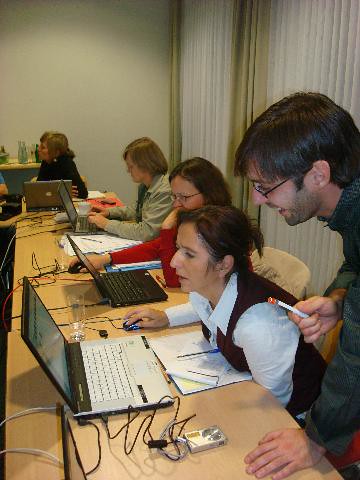
In a good tradition Euforic facilitated the third Web2Share Training in Bonn. The event took place from 19-20 November 2009 and was co-organized with EADI, the European Association of Development Research and Training Institutes.

Like in the years before a diverse group of information and communication professionals from several countries, including Switzerland, Norway, Italy and Germany joined the training. Among other things they expected to learn how to work with social webtools such as wikis to cooperate and to share knowledge in open and closed networks. Furthermore they were looking for guidelines for social media usage in NGOs, good monitoring tools and podcasting.

The Euforic trainers provided an up-to-date overview of possibilities and advantages that web 2.0 tools and social media offer for their work. Popular buzzwords included “social bookmarking”, “RSS”, “wikis”, “blogs”, "Googling", and “podcasting”. Besides, we looked at how to connect and integrate these new tools into daily business processes across the organization, for communication, knowledge sharing and campaigning.

Since an increasing number of our participants have already some experience with the new Social Web, we spent more time on storytelling and discussion then in our first trainings. We compared experiences and explained new ways to apply tools strategically for different purposes. To name just a few, discussions touched upon issues like the pros and cons of social networking sites for organizational purposes, privacy and content ownership, or the use of internal micro-blogging tools.

Towards the end of the training participants were fascinated by the different possibilities the new Web provides but also called for more advanced training.

Some interesting quotes from the evaluation:


"I think I can teach the communication crowd how to work with some of the new tools but I'm afraid it won't go that well with the researchers, who are not always keen on sharing."
"I knew most of the tools already, but this workshop confirmed that you really need to look at the target group to know which tool or package to use. I feel that I don't have the time to use all this, but what is worse is that my colleagues think that everything connected to a computer is up to me, because I'm the IT person"

"The Web still very depends on written language but I'm sure that podcasts are the future."

"I heard what is going on on the Web before but now I'm not afraid anymore to try it out and use it for my organization"
Former Euforic associates and staff will look into possibilities to organize a Master Class in the first half of 2010 which will address the challenges participants face when they go back to their organizations.

See some pictures of the workshop

Explore the Euforic Web2Share Wiki

Find more information about Web 2.0 in our newsfeed

Thursday, November 05, 2009

Cooperative Euforic: in the process of closing down

Euforic has called an Extraordinary General Meeting of members to take place on 26 November 2009 in Brussels. On the agenda is the complete close-down of operations and dissolution of the Cooperative.

Over the past few years the Board and staff of Euforic have tried to achieve a minimum degree of financial sustainability of the organization. After a profound financial crisis in 2004/2005 the organization’s finances seemed to recover somewhat in 2007 and 2008 but in the course of 2009 the structural financial instability of the organization showed again. When this became clear the Euforic members were contacted and the Board decided on 30 September to proceed to scale down operations and to dismiss staff (see also the announcement)

Over the years Euforic has provided a free, public information service, funded through membership income and surpluses that were generated through the implementation of specific projects with members. Because of the limited core income, and the small surpluses on projects and services, Euforic has always been financially unstable.

In September 2009 it became clear that the operational losses the organization would incur, required that the ExCo and Board seek immediate financial support for the organization to comply with contractual obligations, particularly regarding the personnel. At this stage however it was very much evident that the financial problems are structural, which is why the Board proposes to completely dissolve the Cooperative. Various member have committed contributions - in particular ICCO, ECDPM, APRODEV, EADI and CTA – that enable (financial) closure of the Cooperative.

Euforic has few assets and the motion to dissolve that the Board is presenting to the members of the Cooperative includes arrangements to dispose of these assets. EADI has kindly offered to seek ways to continue to provide some sort of public information services on matters that used to be covered by Euforic, possibly linking to the original Euforic URL. Some staff have indicated they may continue to provide consulting services as independent consultants together with former Euforic associates, for which they consider to establish a collaborative association provisionally called Euforic Services.

Check also the newsfeed for more news about Euforic's cooperative life

Monday, October 26, 2009

European Development Days 2009: the power of networking

Last week Stockholm hosted the European Development Days, a three day event involving a number of heads of State and thousands of development professionals and students from all over Europe, indeed the world. You can read it all on the official EDD-website.

Even though Euforic – as readers of this blog will know – is scaling down its operations, we were present in Stockholm to promote one of the many exciting projects Euforic has been involved in over the last few years: R4D, an information service providing free access to information on DFID (co)financed research for development programs and over 20,000 outputs of these research efforts.

Several Euforic members presented panel discussions at the European Development Days, or the Development D-days as Rajendra Pachauri, Director General of the Energy Resources Insitute in New Delhi and one of the keynote speakers, called them. CTA invited twelve partners from the South to have stands at the Development Village and organized an important event about land acquisition (also known as “land grabbing”). At an event co-organized by AFD, Koos Richelle, head of AIDCO and others examined aid practices. AFD also organized with DFID and DIE a debate about the evolving aid architecture. Concord co-organized an event about development education, sharing ideas and experiences around involving and mobilizing citizens for development. Citizens were also central to the ECDPM-organized event about the EU-Africa Partnership. EADI together with the Development Gateway Foundation looked at the future of European Development Cooperation: Development Beyond 2015 and APRODEV, CIDSE and Concord staged an event on Copenhagen, Climate Justice and the Right to Development. SNV had a session on Accountability and Transparency and cheered us all up with a musical spectacle at the end of the second day.

Most events attracted quite some interest. A crowd of EDD-visitors lined-up outside the forum on Media and Development. In the panel, Ellen Johnson-Sirleaf, President of Liberia, Raile Odinga, Prime Minister of Kenya, blogger and digital activist Ndesanjo Macha and others discussed the role of media in development. Dominique Darmon of SNV was lucky to get in and reported that there was an extensive discussion around the role of new media. Nowadays in Africa over 17 million phones are in use ... or at least, in use when there is electricity, as Ellen Johnson-Sirleaf noted, underlining that energy and infrastructure are critical priorities for investment in this continent. Odinga explained how he used a blog to communicate with the electorate during the recent presidential election campaign in Kenya, but someone in the audience noted that comments from readers of the blog were screened and the comments criticizing Odinga actually never made it to his blog. So new media can promote interaction and participation but they do not eliminate exclusion, whether because of lack of electricity or because of censorship.

Written communication does not reach too many Africans because of the high illiteracy rates, television is important but technically much more demanding than radio which is the number one “old” means of communication in the continent. At the same time, mobile devices are changing the way the good old radio is operating, boosting its use through for example podcast. During the session several other examples of mobile phone use were highlighted for example how they were used to warn people during recent floodings in Burkina Faso. Phones can also be used to hold the government accountable as the HIVOS/SNV project Twaweza demonstrates.

Some participants in the audience felt that new media pose a greater risk of misinformation while others laud their potential to promote democracy. A BBC reporter asked the politicians in the panel what at the end of the day would make them more uncomfortable: a bad news paper story, or a critical blog ... thus showing that the good old newspaper remains critically important.

Having to attend my R4D stand in the Development Village I saw few live presentations. But I made an exception for the “testimonies” on climate change that were given in the morning of the last day, 25 October. Michelle Duvivier Pierre-Louis, Prime Minister of Haiti and former executive of the Soros-sponsored Knowledge and Freedom Foundation told about the seven (7) hurricanes that hit her country over the last few years and asked for fairness and just reparations as part of the strategy to confront the climate change crisis, “The market mechanism is not going to save the planet”, she insisted. Moderator Sackur, known from BBC’s “Hard Talk” highlighted her systematic emphasis on fairness and justice and he asked her whether – when talking with European leaders, she felt they actually “got it”. Very honestly she replied that her gut feeling was not very good, but she also made it clear she will not give up fighting for climate justice.

President Emanual Manny Mori of the Federated States of Micronesia explained how his country has been fighting for climate justice for quite some time already. The small islands state is very much exposed to the potentially disastrous effects of the sea level increase. To anyone who doubts whether this is a serious crisis he urged to reflect “Who are you fooling? Not the oceans and disappearing species”. Mori insisted that all nations will have to bite the bullet: “We will face a different world in our lifetime”

Mary Simon has been an activist for Inuit interests for decades. “My homeland is melting” she stated, “the situation is terrifying, villages just sink in the ground because of melting permafrost”. The changes may very well exceed the traditional capacities op her people to adapt. Simon concludes that previous efforts to reduce carbon emissions have not done the job, public policies have fallen short and emissions have continued to grow. Simon stressed the interrelation between economic and environmental security and calls for massive investments in clean technology. A Climate Change Adaptation Fund of 20 billion euro needs to become operational now, not by 2022 as current proposals suggest. Besides climate change, Simon also warned for what she labeled to be misguided policies that affect the Inuit people like the upgrade in CITES of the polar bear which makes them an endangered species, and the EU ban on seal products. It is climate change that endangers the polar bear, she said, Inuit hunting practices are sustainable. She felt that such policies negatively affect the Inuits capacity to adapt and preserve their livelihoods.

Back at my R4D stand, I listened to Margot Wallström, Vice-President of the European Commission, through a video live-stream. She said that the political realities will force the EU to be more ambitious about reduction of CO2 emission and deliver climate justice. With Michelle Duvivier and the others we continue to hope (but fear her gut feeling).

For more stories on the European Development Days, check the official EDD-site and sites of Euforic member organizations.

by Rosien Herweijer

See also Euforic's newsfeeds on Euforic cooperative life on European Development Days and on Information, knowledge, and communication

Wednesday, October 21, 2009

R4D at the European Development Days

During the 4th edition of the European Development Days - held from 22 to 24 October in Stockholm - Euforic actively promotes the Research for Development (R4D) project.

R4D is a free access portal containing information about research programmes supported by DFID. It provides you with the latest information about research funded by DFID in the framework of its 2008 Research Strategy, including news, case studies and details of current and past research in over 20,000 project and document records. Information is available on a broad range of topics, such as sustainable agriculture, climate change, economic development, health and capacity building.

R4D is unique in the sense that it makes information available to researchers, students and policy makers that hitherto was circulated at a limited scale. Documents and reports are presented in full text, there are various search options for different types of information, plus the Research Dialogue and Communications Corner blogs allow for reflection and debate.

Please feel free to meet with Euforic's Rosien Herweijer at stand 25 to hear the latest about R4D and to subscribe to the newsfeeds of your choice.

You can also visit Euforic's research feedfinder page to subscribe to selected R4D newsfeeds.

Friday, October 09, 2009

Financial constraints force Euforic to scale down operations

Euforic is facing financial problems. The operational budget of the cooperative is funded through membership fees, income from projects and grants. Membership fees cover only a very small part of that budget. After reviewing the current situation, the Board of the cooperative issued the following statement in a message to members:

"The Euforic Board met 30 September 2009 in Brussels to discuss the financial situation of the organization. All members of the Board agreed that the current situation is extremely serious. Several options to address this critical situation in the short and medium term were reviewed during the meeting.

The Board observes that the lack of structural financial viability of the cooperative inevitably means a continued risk of operational deficits, particularly since the cooperative has a negative general fund and no reserves. Because of this structural dimension and considering that the expected deficit for 2009 may amount to over 50,000 euro, the Board has unanimously decided to proceed to ask relevant authorities for permission to serve all staff redundancy notices and scale down Euforic operations accordingly. It is expected that the staff will continue to work until 31/12/2009. How to handle grants and service contracts with members that go beyond December 2009 will be looked at over the next few weeks.

Meanwhile the crisis implies that the cooperative urgently needs 50,000 euro to cover the 2009 operational deficit and to avoid bankruptcy. A swift transition in which we down-scale and prevent any further operational losses, may enable us to review the long term perspectives for the cooperative during the first half of 2010. To make such a transition, the Board urgently request members to make a contribution financially or otherwise during the coming months. Any contribution, small as it may be, can make a difference! The Board agrees that it is in the interest of all members to avoid Euforic avoid a forced demise of Euforic."


See also Euforic's newsfeeds on Euforic cooperative life and on information, knowledge, and communication

Thursday, August 20, 2009

Pertinence and quality in an (Inter)networking environment

Over the years, quality of services both in terms of content and usefulness has been a recurrent issue for debate at meetings of development information professionals. It proved to be a difficult issue to come to grasp with, in particular because of the changes that the sector has gone through and – by consequence – the new challenges created by the rapid technological and organizational evolution.

IDS Knowledge Services has recently released a “how we” guide about upholding editorial quality. It is the result of extensive internal reflection and debate at IDS, with the aim to share its experiences and good practices with external parties. And in fact the guide is a nice condensation of the discussions on quality management that were high on the agenda of the information and communication sector.

It is interesting to see that the criteria that were applied in the traditional libraries are still valid in an online electronic setting. And maybe even they have become more critical since the Internet has provided the world with open and accessible channels to publish and share information.

Individual Euforic members may very well draw lessons from this interesting guide. It addresses information providers that produce their own content and want to assume the final editorial responsibility for the broadcasting of it. It does focus strongly on organizations that deliver information services to specific audiences. Particular emphasis is given on information services in an academic/research environment. Useful tips, definitions and lessons center around a series of questions about the elaboration of editorial policies and the management of services. At first sight some of these questions may seem a bit obvious, but they go to the heart of the matter and can be applied as a useful methodology in various types of settings.

What are the lessons that Euforic can draw from this guide? Euforic serves primarily as a ‘relay hub’ for the content produced by its members. Nevertheless, the guide offers useful tips for defining the editorial scope – which may evolve overtime in line with the changing interests of the membership – and suggestions for assessing the quality and relevance of the services.

One of the important lessons is that the information intermediary needs to maintain a strong and intense relationship with its network, content providers and clients. Information doesn’t flow by itself but requires a dynamic and pro-active ‘promoter’. Another valuable lesson for Euforic is that as an information provider the level of ambition definitely needs to match your resources and vice versa.


by Jacques van Laar

See also Euforic's newsfeeds on information, knowledge and communication and on IDS

Tuesday, August 04, 2009

Eastern Partnership Civil Society Forum to meet in November

Source: EU News, issue 5, July 2009.

In its Communication of December 2008 on the Eastern partnership, the Commission proposed “to support the further development of Civil Society Organisations” (CSOs) and, in particular, “to establish an Eastern Partnership Civil Society Forum to promote contacts among CSOs and facilitate their dialogue with public authorities”.

To ensure transparency of the process leading to the establishment of the Civil Society Forum, all interested parties were invited to provide their opinion. The consultation process started on 25 March and was closed on 25 April. Some 40 contributions were received, mainly from civil society organisations based in the Eastern Partner countries but also from several EU-based organisations. A reasoned analysis of the contributions received can be found under Results of the consultations with CSOs and NGOs.

In the Eastern Partnership joint Prague Declaration, from 7 May 2009, “the participants of the Prague Summit invited the European Commission to develop and propose modalities for the establishment of a Civil Society Forum of the Eastern Partnership”. The Commission proposed the following Concept-paper.

On June 29 the Commission invited all interested parties, i.e. grass roots organisations, trade unions, employers' organisations, professional associations, NGOs, think-tanks, non-profit foundations, national and international CSOs/networks and other relevant Civil Society actors, to submit their Expressions of interest to participate in the Eastern Partnership Civil Society Forum, using the following form. Note that information and the form are also available in Russian here.

The deadline for submission of expressions of interest is set at 31 August 2009.

The European Commission, together with the EU Presidency and the European Economic and Social Committee, will organise the launch of the Eastern Partnership Civil Society Forum in mid-November 2009 in Brussels.

See also Euforic's newsfeeds on EU neighbourhood and civil society

Priorities of the Swedish Presidency

Source: EU News, issue 5, July 2009.

On the 1st of July, the Czech Republic handed over the Presidency of the European Union to Sweden. In this time of crisis, the Swedish Presidency has nominated economy and climate change as its key priorities for the next six months.

With regards to development issues, the Swedish Presidency will focus on climate and democracy. It wants to bring on the one hand development and democracy-building and on the other hand development and climate change agendas closer together. For the latter, the Swedish Government will use the report of the International Commission on Climate Change and Development that was launched in May and will encourage actions towards climate proofing investments, increasing attention to adaptation and finding ways to better integrate climate change into development assistance. Furthermore, the Swedish Presidency emphasizes the importance of aid effectiveness and policy coherence for development. Sweden aims to prioritize the Policy Coherence for Development (PCD) agenda with the European Commission’s submission of its second EU biennial PCD report in October.

The Presidency will also call for an action-oriented response to the commitments made in the Paris Declaration and the Accra Agenda for Action.

Increased free trade continues to be a major priority under the Swedish Presidency. Trade negotiations are being prioritized, primarily a rapid conclusion of the Doha Round, but also progress in negotiations with regional groupings. The Presidency aims to work towards making substantial progress in the negotiation and conclusion of regional Economic Partnership Agreements (EPA) between the EU and the Africa, Caribbean and the Pacific countries and in the negotiations on a revised Cotonou-agreement.

It is the Swedish Presidency’s ambition to strengthen EU preparedness to deal with the unexpected and coordinate its actions in crisis situations, in particular in Africa. Therefore, it wants to use all of the EU’s instruments; from civilian and military crisis management operations to dialogue and diplomacy within the common foreign and security policy, and trade and development policy initiatives.

The Swedish Presidency aims to enhance the European Neighbourhood Policy (ENP) both with regard to the Eastern dimension through the Eastern Partnership, concerning Ukraine, Moldova, Azerbaijan, Armenia, Georgia and Belarus, and to the Mediterranean dimension, within the Union for the Mediterranean. Sweden will oversee the development of the new ENP Action Plans, with particular emphasis on policy reform, good governance and human rights. The work on enlargement will also continue under the Swedish Presidency, with the continuing of the accession process of the Western Balkan states and Turkey. Croatia’s negotiations with the EU could enter a final stage during the autumn. Moreover, the Presidency will work to make further progress in the EU integration process of the countries of the Western Balkans.

Regarding asylum and migration, the Presidency strives for common policies and systems, focusing on the common asylum system, and resettlement (see article on Stockholm Programme). The Swedish Presidency supports the Stockholm Programme, which should allow increased labour immigration to the EU, and the EU Global Approach to Migration, which Sweden considers as an important tool to strengthen the positive link between migration and development, and to counteract irregular immigration.

More at www.se2009.eu/en
CIDSE Presidency Outlook for Development available soon at www.wdev.eu and www.cidse.org

See also Euforic's newsfeed on the EU presidency

Wednesday, July 29, 2009

Debates about the new Dutch development cooperation policy

This autumn there are a number of meetings organised by MDF Training & Consultancy, the Institute of Social Studies (ISS) and Vice Versa to contribute to the discussions for the formulation of new policies for Dutch development policy from 2010 onwards. It is a continuation of the conference 'Understanding Development Better' of last August and related to the DPRN process on the future architecture of the Dutch development cooperation.

On Thursday 1 and Friday, 2 October, 2009, a public meeting, the Kick-off conference will be held in Hotel de Bosrand, Ede. On the agenda of this public meeting are discussions with experts from science, policy and practice. We will talk about what policy is actually or what should it be; on sources, foundations and axioms in the current policy, the implications of the shift from Development Cooperation to a much wider agenda and the applicability of policies in a rapidly changing complex world.

Language of the meeting is Dutch.

Costs for the two-day conference is € 200 and € 280 (incl. 1 night). More information and registration? From 29 July onwards, the website will be on air.

Check also the Euforic newsfeeds on MDF and on Dutch development cooperation

Friday, July 24, 2009

Three vacancies at CONCORD, Brussels

CONCORD is the European confederation representing, through its 40 members, over 1800 European NGOs for relief and international development. The Secretariat of CONCORD is looking for:

  • An experienced INTERNAL SERVICES MANAGER

    The manager will be responsible for the timely provision of statutory information for Belgian authorities and for the Board and General Assembly of CONCORD, managing CONCORD’s overall budget and ensuring the production of timely management accounts, coordinating CONCORD’s fundraising activities, developing and overseeing financial and procurement procedures, developing HR policies, systems and processes, ensuring the smooth functioning of CONCORD’s internal infrastructure and ensuring that CONCORD respects its statutory obligations.

    The postholder will manage a small team of experienced and qualified finance and support staff and will join CONCORD’s management team.
  • A PERSONAL ASSISTANT

    The post is a key role within the organization directly supporting the work of the Director, of the Management Team and of the Board and handling sensitive information.

    The successful candidate will be able to demonstrate 3 + years similar experience, organizational and planning skills, enthusiasm, energy and discretion, be English mother tongue and fluent in French with an understanding of NGO culture.
  • A FINANCE & ADMINISTRATION OFFICER (for 30 months, 4 days per week)

    The officer will ensure efficient, effective and transparent administration and oversight of the finances, donor relations, core meetings and communications of the Open Forum on CSO Development Effectiveness, a global process of Civil Society Organisations. CONCORD is leading a consortium of 6 regional and global CSO networks supporting the Open Forum. The Finance & Administration Officer will report to the CONCORD Internal Services Manager.

Also check out Euforic's newsfeeds on CONCORD, and on civil society

Thursday, July 23, 2009

Vacancy at ECDPM, Maastricht


We have pleasure in announcing the following vacancy:

Research Assistant for the Economic and Trade Cooperation Programme


The European Centre for Development Policy Management (ECDPM) is looking for a creative individual for a 6 month assignment (with possible extension/promotion based upon outstanding performance) to execute activities that will maximize the impact of the Centre's dialogue,
networking and capacity development activities in the context of ACP-EU cooperation.

Your expertise will allow you to assist in the research and execution of activities of the centre’s ACP-EU Economic & Trade Cooperation Programme as well as to assist the manager of the website www.acp-eu-trade.org

Closing date: August 14, 2009

For further details and application form, please visit: www.ecdpm.org/vacancies

Also check out Euforic's newsfeeds on ECDPM, and on ACP trade

Tuesday, June 23, 2009

Impact of the MDG paradigm on poverty reduction

The first panel of the ‘MDGs After 2015’ event in Brussels on June 23, jointly organized by DFID, DSA, EADI, IDS, ActionAid and the Broker, focused on the impact of the MDG paradigm on poverty reduction.

Lawrence Haddad (IDS) introduced the topic by underlining that the preconditions for realizing the MDGs are very different from 2000, the year of their creation. Whereas the millennium year was characterized by growth and stability, our times today are marked by climate change, financial and economic crises, pandemics, and the rise of new economies. This triggers questions on the post-2015 MDG framework: “Should the MDGs focus on outcome or process, should they be global, national or local, should there be less or more accountability, and finally, should there be MDGs or not?”

Salil Shetty (United Nations Millennium Campaign) underlined the achievements of the MDGs from 2000 until 2009. We do not spend enough time on reviewing the successes, although “the MDGs help to make change happen!" Instead of being a 'straight jacket', they are a public good, which can be interpreted differently. However, he acknowledged weaknesses, such as the donor and state-driven and technocratic nature and the ignorance for processes of change and structural causes of poverty. As key challenges, he identified the economic, food and climate crises which create a 'cloud of uncertainties'. Successes have been the weakest in the areas of maternal health and child mortality, and the trade element of MDG 8. The action plan until 2015 should, according to Mr. Shetty, focus on the 'de-aiding' process of the MDGs, move action from the global to the local, and serious reporting.

Enrico Giovannini, the chief statistician of the OECD, clarified that the word ‘statistics’ actually comes from ‘science of the state’. What we need would be 'sotistics, statistics for the society. Further, confronted with multiple crises, he underlined that we need to develop a new narrative which goes beyond mere aid narratives. Equitable and sustainable well-being definitions should be participatory and decided on local levels. “We have to be careful in preparing the repeated game in 2015”, claimed Mr. Giovannini.

Sakiko Fukuda-Parr from the New School University, New York presented her analysis of how the MDGs have influenced policy priorities and Poverty Reduction Strategy Papers (PRSPs). On the one hand, the MDGs were created as a reaction to the Washington Consensus, instead embracing the idea of inclusive globalization. On the other hand, the strategies of the 22 researched countries focused on the Washington Consensus (liberalization and privatization with little government intervention) plus social investments. In this way, many PRSPs undercut inclusive globalization and counteract the driving motivation of the creation of the MDGs. Despite the lack of impact on policy and the development paradigm, the MDGs did have a huge impact at a normative level. They are a very powerful message, which succeeded to shift international norms, although in a truncated way. Finally, Mrs. Fukuda-Parr underlined that we have to recast the MDG agenda. Most importantly, we have to add a goal on reducing inequality.

See also:


This project is co-financed by the European Union. The views expressed do not necessarily reflect the opinion of the European Commission

Wednesday, June 10, 2009

Collaboration, Communication and Climate Change

Copenhagen, 10 June 2009. Today's Euforic workshop was convened in view of the forthcoming COP 15 Climate Change meeting in Copenhagen in December 2009. It was hosted by NIAS in Copenhagen.

After Ramesh Jaura, President of Euforic and Director of IPS Europe introduced the theme, we heard from NGOs, research organisations and think-tanks on the issue of 'Collaboration, communication and climate change'.

Ramesh explained that, before the Rio conference on environment and development in June 1992 (UNCED), development was considered in a different way, being funding and project based; the phrase "sustainable development" emerged from the conference. Since then, more and more NGOs and researchers started to explore the implications of climate change. In Bali, organisations like Third World Network took part in the negotiations representing Southern views.

Four Euforic members - IDS, the DiploFoundation, CABI and DIIS presented their work, this was followed by an overview of other Euforic members.

DIIS presented their climate subweb, including their involvement in the Commission on Climate Change and Development, their work on climate adaptation, REDD studies on Forest conservation, and the DIIS reports on low carbon development. They have also produced a thematic issue of the Danish language journal Den Ny Verden. [see presentation]

DiploFoundation shared their work on training and communication towards diplomats and other foreign affairs professionals.


The training begins online, it is followed by an online collaborative policy research case and placement in policy organizations. During this process, participants create a community of practice online. This approach is unique in its combination of online and face to face activities; it empowers people as influencers of change, it merges CoPs that make a difference, and includes those in the south that otherwise wouldn’t have access. Now the question is how this approach could serve the climate change process. As a cross cutting field this has a broad appeal.

Alan Stanley presented IDS knowledge services communicating research on climate change and development.

He highlighted three projects: LCA, Community Based Adaptation Exchange and Africa Adapt. The purpose of these different communications initiatives is to ensure that more decisions are evidence-based. The IDS approach is based on the following elements: expertise, diversity, learning, engagement and partnership. Partnership is the most important, as IDS initiatives are just one of many initiatives; working together instead of duplicating efforts is the take away message [see also this video blip with Alan]

Martin Parr from CABI presented their work on communicating research using the Research4development portal.


First they had built a collective database of all DFID funded research together with links to other websites containing the information. At it’s heart lies 5000 projects and 20000 outputs cross linked by themes, countries and actors. As a second step, they turned the site into a service focused on reaching the desktops individuals. This means for example presenting types of information by audience or presenting thematic pages including feeds from DFID communication partners. The information is made more accessible through the use of RSS. To promote this information, a news service fits on top, using for example blogs to discuss research communications and the launch of the new DFID research strategy.

Lastly, Chris Addison gave an overview of the activities undertaken by Euforic members in the different areas they are working, from advocacy to research, from meetings to communications strategy, from online new services news to training.

See also a previous blog post highlighting some of these issues.

Subscribe to the Euforic AGM 2009 newsfeed.

See also Euforic newsfeeds on climate change; information/knowledge, and from the 2009 annual workshop.

Saturday, May 09, 2009

Development NGOs call on Europeans to vote against poverty

CONCORD has launched a campaign across the European Union to highlight the EU’s role in the world and encourage people to vote in the European elections on 4-7 June.

Called “10Days4Development”, this campaign encourages voters to ask their MEP candidates about what they intend to do to promote international development and to address climate change if elected. The campaign runs from 9 till 18 of May.

All around Europe, international development NGOs are organising activities, including public meetings, meeting with politicians, campaigning stunts, opinion polls and so forth. Voters can get information about the activities taking place in their country by visiting

http://10days4dev.wordpress.com

For more information, check out Euforic's newsfeeds on Concord and the EU elections

Tuesday, May 05, 2009

Euforic Annual General Meeting 2009

Euforic is a diverse network of development organisations, focusing on information, communication and knowledge management matters from a European perspective. Euforic organises different types of events for learning, training and exchange, providing excellent opportunities to catch up with current developments.

The 2009 Annual General Meeting of Euforic members will take place on Wednesday 10 June in Copenhagen, Denmark, in conjunction with the meeting of the EADI Information Management Working Group on 11-12 June. NIAS – the Nordic Institute of Asian Studies - will be hosting the Euforic AGM and the EADI meeting. Besides a regular business meeting we will organize a open workshop on ‘Collaboration, Communication and Climate Change’ for which we invite Danish guests.

The program for the Euforic AGM is as follows:

11:00 - 13:00 Members meet on business matters of the cooperative
14:00 - 17:30 Workshop ‘Collaboration, Communication and Climate Change’
17:30 Reception (hosted by NIAS)

As part of the afternoon workshop members will make brief presentations on:
  • what their organization does in the area of climate change
  • and/or how they communicate towards policy makers, researchers and practitioners on climate change
  • and/or what kind of collaboration (or information) they seek in the area of climate change within the Euforic network

For more information on the AGM 2009 and on Euforic membership please contact us via info@euforic.org

Information about previous AGMs can be found here:

Friday, April 17, 2009

Dgroups Partnership meets in The Hague

On April 15 and 16, representatives of 13 members of the Dgroups Partnership met in The Hague. Margarita Salas from Sula Batsu in Costa Rica joined most of the meeting remotely, in spite of the huge time difference, and participated virtually in the discussion. Damir Simunic from WA research, technical host of the platform, also participated in the majority of the sessions.

The agenda of the meeting was quite dense, with a lot to be discussed both on the technical side, as well as on the partnership side. Among other things, the following items were on the table:
  1. review the new platform, its usability, hosting, and support provisions;
  2. agree priorities for further platform development and enhancements;
  3. elect board members to the Foundation, discharging the current executive committee;
  4. agree management, coordination, financing arrangements for the coming years.
This meeting was the first opportunity for Dgroups members to meet face to face to review all the actions and changes since their last meeting (January 2007).

In spite of the short time available, all the items on the table were addressed and clear decisions for future actions taken. A new board was elected; the usability of the platform was discussed at length; support mechanisms have been put into place; and agreement on the main governance elements of the partnership were taken.

Christian Kreutz argues that the Dgroups commmunity is as important as the platform:


Sarah Kerr, ex-Bellanet and long term Dgroups supporter reflects on recent developments:


Euforic participated in the meeting as coordinator and sub-contractor to Dgroups. In this role, we've been nurturing the partnership and catalyzing the various steps along the way.

A report of the meeting will soon be available. More information on the meeting can be found on the Dgroups blog; see more video interviews on Dgroups.

Subscribe to Dgroups newsfeed.

Friday, March 20, 2009

Information and knowledge intermediaries powerful force for social change

An affirmation of the potential contribution of knowledge and information intermediaries to social change is one of the outcomes of the Between Ourselves workshop that took place in Pretoria in July 2008.

Emerging from the discussions and captured in the report, 4 of the insights about the role of intermediaries in development and how it can be strengthened are"

1. Intermediary work can enhance information flows between actors, stimulate demand for information and maintain access to information over time.

2. Some intermediaries go beyond playing a “repository” - 'just in case' - role. They argued that proactive - 'just in time' - communication and engagement with stakeholders are necessary. 

3. A deep understanding of the actors we seek to reach and the changes we seek to bring is necessary to contribute to greater use of evidence in policy and practice. 

4. Collaboration between people undertaking intermediary work is a central means to achieve our objectives.

The workshop was the second meeting of the I-K-Mediary Group an emerging network of research intermediaries who work to increase access to and use of research in development. Peter Ballantyne and Chris Addison attended from Euforic / see related report.

Full report of the workshop

More in the Euforic newsfeed on information, knowledge and communication