Google+
Showing posts with label euforic project. Show all posts

Thursday, February 12, 2015

Collaboration for teams and projects using Google Apps

Online collaboration is a fact of life in International Development programmes. Teams and individuals are scattered across organizations, across countries and regions, as well as time zones. Sadly, we hear more grumbling about platforms and processes than success stories. So working with organisations to improve how they work together online takes up a lot of our time.

The problems vary with the size of organisation, to some extent. Large organizations normally have Intranets or private networks, but these aren’t always open to project partners from other organisations. But their rich features often make them difficult to access from international locations, especially where Internet access is still expensive and/or unreliable. However, there is also a downside to the use of free tools, which we at Euforic Services have often promoted. That option normally means using several different platforms, like wikis, blogs, project management systems, etc., that need to be brought together somehow and may require multiple sign in and entry points for users.

So sometimes it’s worth investing a little in developing an integrated platform. But money is always an issue, so how easy is it to customise a collaboration platform on a tight budget?

We had the chance to learn and experiment last year. With our friends Antonella Pastore and Tania Jordan, we were contracted by IDRC to configure and deploy an online platform that would support knowledge management and communication in a new collaborative research programme.
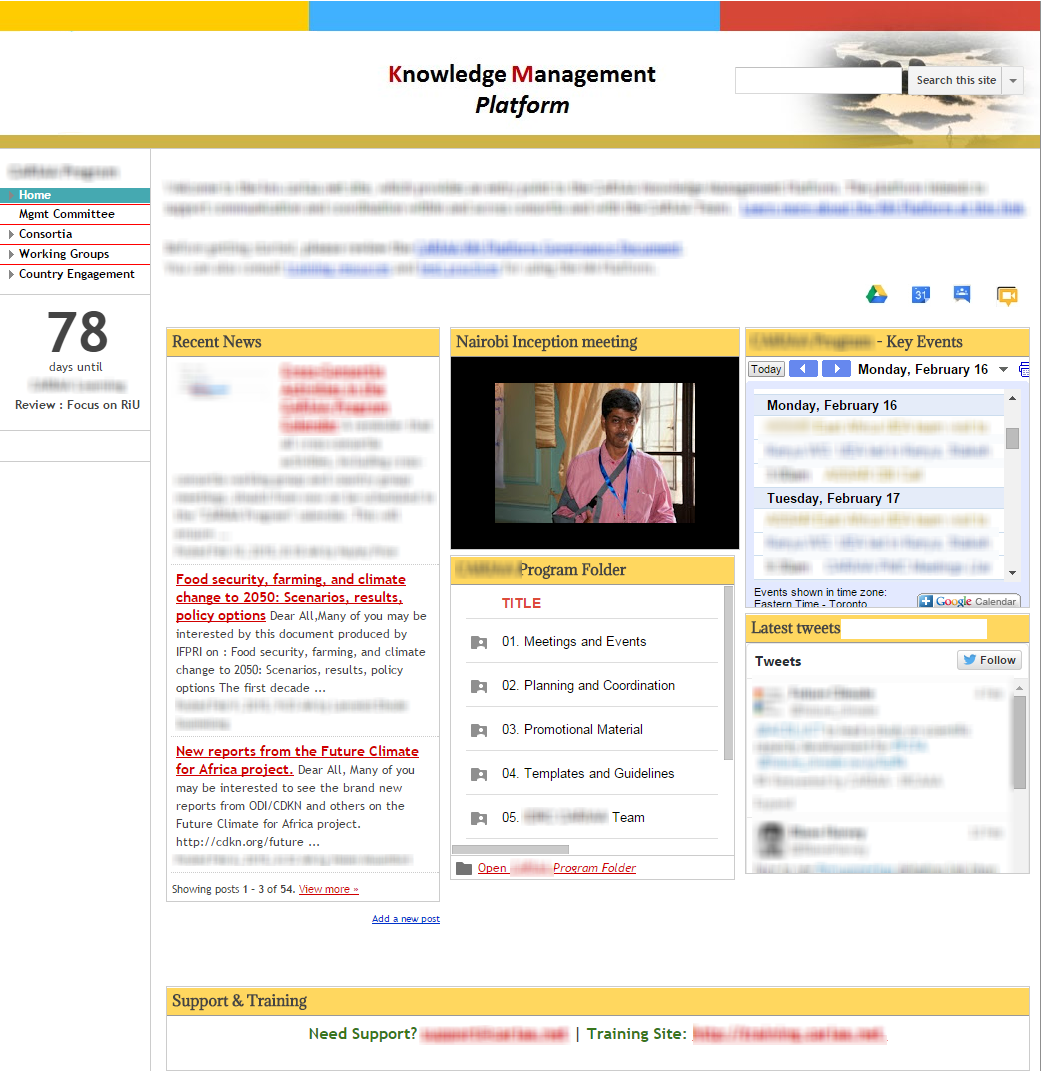
Homepage of the KM platform

The platform was to be based on the Google Apps infrastructure, previously selected by IDRC during an earlier phase of the project.

In Euforic Services we’ve been using Google Apps for several years now in our own work and for external projects and consultancies, in relatively small teams. But this was a new challenge, how to deliver a fully fledged collaboration platform and get over 200 people on board? So what does it take to configure and deploy a platform that is functional and it is actually used by teams and individual users? And what did we learn in the process?

Our project plan and implementation followed a rather standard approach and sequence - from configuration and set up to pilot phase and iteration, to soft launch and go live. But for each of these phases there are some specific elements that is important to consider for a successful deployment of the Google Apps - as well as for any other online collaboration solution.

Decide what is in and what is out - and think 'around' the box

From the initial scope of the work and during the inception phase, we agreed with the IDRC team on which Google Apps would form the core of the collaboration platform. These included: Sites, Drive, Calendar, Google+ and Hangout, Picasa Web Albums.

If you are familiar with Google Apps, you may have noticed that Gmail was not included in the configuration of the platform. Indeed, each of the potential end users already had an institutional mailbox and the idea of having to manage a secondary email address was not negotiable.

So how to get around it, when Gmail is central for the Google Apps? The solution we found was to set up the new user account with an automatic forward so that all emails sent to their new Gmail address would be automatically sent to their primary email box. As a consequence, we also created a Site as central entry point for the whole platform (see image above) and worked with Google Groups to define and manage the sharing and access rights to documents on Google Drive.


Walk the talk - use the tools to support project management 

From the very start of the project, during the inception phase, we used the exact set of tools that had to be deployed in the new platform. While this was business as usual for us (the combination of Google Docs, Calendar, Hangout etc is our standard modus operandi), this also allowed the project team at IDRC to improve their own skills and knowledge of the tools in a learning by doing approach. As a result, not only they learned the ins and out of the Apps but could later act as super-users and platform champions.


Make it real - pilot and soft launching 

When defining the pilot, we wanted users to go through a set of test cases. These were documented in a step by step pilot guide, developed using a combination of Google Sites and Docs. As the pilot users were all from the same working group, we defined the pilot using real content and for a real purpose: finalizing the organization of a working group meeting. Working with this real live case and with real content was instrumental in getting pilot users on board, as they saw the results of their participation in the pilot coming together and being used in the actual face-to-face meeting.
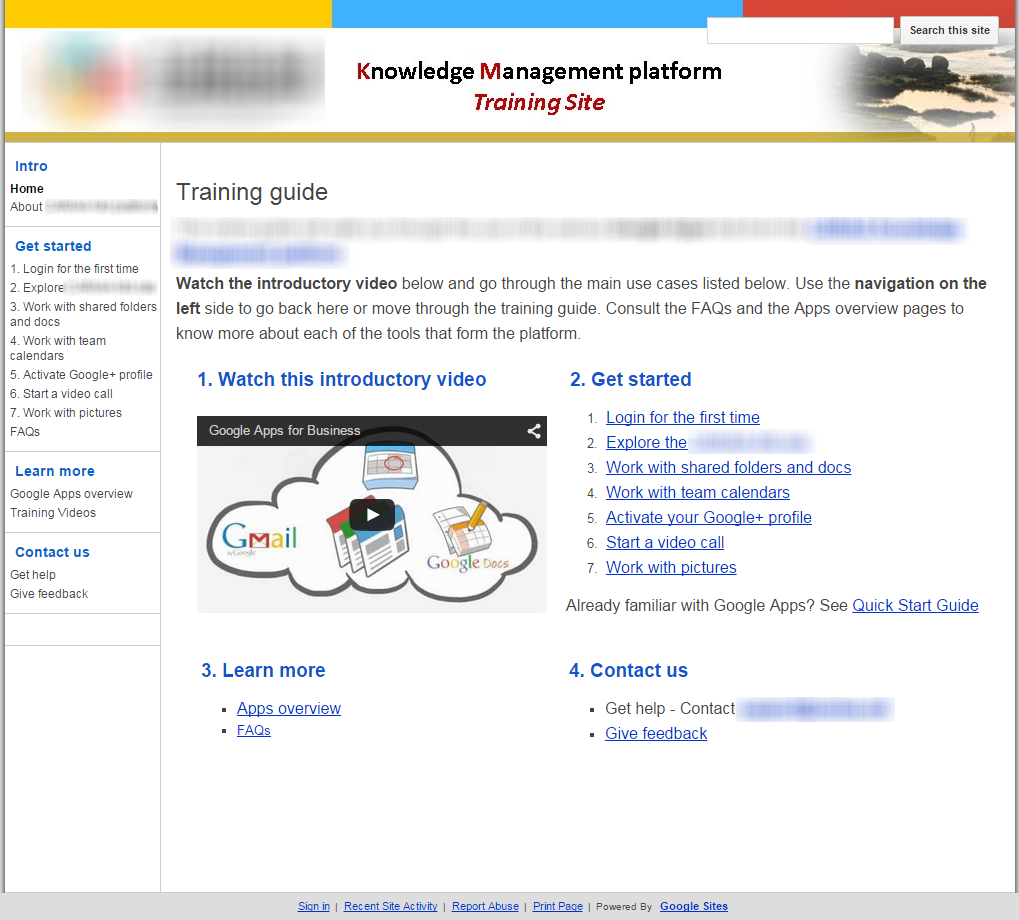
KM Platform training guide


Get your users on board - training, demos, helpdesk 

As we opted for a managed rolled-out in the deployment of the platform, we were able to consolidate the training and support documentation, as well as the platform navigation, with the feedback received by the first pilot users. At the opening of the platform to a larger number of users (around 100), we run two online demos sessions (using Hangouts - again, learning by doing) which were also recorded for later playback. Additional webinar sessions were planned after the third round of accounts creation. A helpdesk was (and still is) also in place for troubleshooting and additional users’ support, with guaranteed response time within 24 hours.


Give users solutions - not tools 

With a lot of focus on the tools and technical solutions that are available out there, we should not forget that what is actually needed by users are effective (and possible simple) solutions that can enable their work. For example, working in geographically dispersed teams, one primary need of platform users was to held online meetings - so Hangouts is the solution. Adopting a functional perspective (instead of a tool focused perspective) helps users to understand how to work more efficiently and effectively - and to buy in into a new online platform.

With a new batch of users accounts created recently, the platform has now over 200 active users. While it’s still too soon to evaluate users’ engagement and activity, the usage statistics look promising so far. However it’s clear that the success of the platform will now depend on getting most of the users to work along - or at least get a large enough critical mass of users doing it.

Friday, April 11, 2014

CTA web2.0 and social media trainings - What have we learnt?

Over recent years, CTA web2.0 and social media training programme has become a flagship initiative of the organization, receiving positive feedback from participants and host institutions and being awarded the WSIS Project Prize 2013 in the category e-agriculture.

While we are in the process of finalizing the evaluation of the second phase of the programme (2011-2012), I was recently invited to present and discuss the initial findings of the evaluation with CTA staff and managers.

 
Web 2.0 and social media capacity building initiative - What have we learnt over the period 2011-2012? Results of an impact study from Euforic Services

A few of the headlines emerging from the evaluation are:

  • There is general, high satisfaction of how the training is conducted and its content; 
  • Participants describe the training events as an eye opener and they feel inspired by the potential of social media to support their work;
  • The trainings work for improving participants' social media skills and knowledge;
  • Face-to-face trainings perform better than online trainings in terms of adoption of different social media tools;
  • There is a clear ripple effect, with the training being replicated (in different forms and degrees) by participants in their workplace or with their own partners;
  • Institutional adoption of social media is increasing, but only a few organizations use social media in an advanced way.
  • Resistance to change and lack of management support are the most common challenges to social media adoption.
Some recommendations include:
  • Putting more resources into the documentation and sharing of success (and failure) stories of putting social media to work in the agricultural sector;
  • Investing in a training of trainers programme, to expand the formation of a solid base of trainers across the ACP countries;
  • Sensitize senior and middle managers on the advantages of social media.
The meeting provided a good opportunity for CTA staff to reflect on what has been done so far in the programme, and discuss how to take it forward.

 - 


Friday, March 07, 2014

Using ICT with older people - a workshop with HelpAge International

Help Age International (HelpAge) has been working with older people across the world for over 30 years. It’s far from being the sexiest end of development, so there’s little money and less attention from many major donors and Foundations. That perception doesn’t come from insider knowledge but is a supposition based on the way they’ve built their programme, focused on local level activities supporting, advocating, campaigning, mostly voluntary. The small offices are as full of creative, committed, wise people as you’d expect of long-lived NGOs. So it was a privilege to help facilitate a fascinating exchange with HelpAge staff in a session on the use of ICT to support their programmes. As well as the people in London, we had on Skype people from international offices, including Tanzania, Pakistan, South Africa, the Occupied Palestinian Territories and a South Asian regional programme manager.

First, a facilitator’s note, especially for those working in ICT4D: don’t forget the obvious, which is that many people come to conversations about using ICT in programmes suspicious, often on the basis of experience, about whether or not good development practice will be trumped by talk of tech-led programmes or a belief that programmes and people’s lives can be transformed by new-tech. So it’s important to have assumptions and challenges out on the table at the beginning, to get as quickly as possible to a creative conversation about how to engage in the new context constantly being created by the march of ICTs. Some that could usefully have been stated at the beginning:
  • ICT4D isn’t (shouldn’t be) technology led: technology is a core enabler
  • New developments must be programme led, which means country and/or regional offices, in decentralised organisations
  • Don’t make assumptions without some data – do we know about uses of ICT by segments such as older people? 
  • Don’t simply focus on the obvious constraints (connectivity, cost etc.) that don’t take into account the existing spread of ICT like mobiles, even in the context of shared ownership. People came up with plenty of examples of engaged use by older people
  • Don’t use digital as the topic header, use ICT, otherwise the conversation is all about mobiles – important enough in itself – but ignores older ICTs like radio
  • Context is all important in determining what might be useful, based on what is already happening as well as the goals and capacity of the people involved
I gave a brief presentation about trends, drawn from four sources:
The presentation was intended partly as a collection of useful links but for an audience relatively new to the field, and with very specific sectional interests, more abstraction would have helped. I separated out two areas that I think need in depth investigation – the use of mobiles and trends grouped around Open….. and Crowd…..

The digital dimension

Part of the interest for me was comparing our conversation with those I've had in Oxfam GB over the years. In 2002 nobody was much interested in ICT4D, even as we showed how many international partners were starting to use computers. Our work in Oxfam in 07/08 was part of the the development of a Digital Vision. Having seen how much ICT4D and digital activity was already happening, and recognising the strategic implications of what were then the new Web 2.0 trends, OGB set up a series of work streams. The Regional Director for South East Asia, where a lot of ICT4D innovation was happening, took on leadership for OGB. The wheel came full circle in 2012, when an ICT4D coordinator was appointed.  

Before and during the HelpAge workshop a list was developed of current projects using ICT. Without a lot of effort, ten were identified, some historical but many live, many using mobile phones but others integrating radio and video. I think I am right that nobody had seen that list collated before, which is as it was in Oxfam GB when we did surveys in 2002 and again in 2008: there is a lot of innovation within the on-the-ground programmes, most of which is only known about only by a few, directly involved people. It was the same in the University of the Arts, London, when we explored what was going on across the University as part of work to develop a Digital Vision. Lots of innovation, little visibility and less money. One of the College Directors coined the term, digital dimension, arguing that the digital impacted, and could benefit, all of the creative and admin processes within the University. It's a useful concept for organisations like HelpAge  it's not so much a question of where ICT could be useful, but rather starting from the perspective that there is a potential digital or ICT tool or service that could be used in support of all programme - or organisational - aims.

Participants drew a useful distinction between aiming to build from and develop usage of ICTs by older people and ICT use by the organisations. We agreed that, while it’s important for organisations to get good at integrating ICT, which can be a basis for sharing that knowledge and capacity with others, that can also represent barriers to those less well connected or experienced. One of the major issues for older people in many OECD countries, for example, is precisely that ICT based-services and communication is becoming the default, meaning people need to gain control of the tools and channels in order to access services like pensions. That has, in turn, given extra impetus to digital inclusion programmes in countries like the UK. Digital access as a right has traction in such countries but is unlikely to be a priority with older people in most of the places where HelpAge works, was the general consensus.

The bottom line for HelpAge  and other similar organisations, is that this is - will be - an evolutionary process, exploring and adapting ICT tools as and when they fit, and generally staying well back from the bleeding edge of innovation. It will be enough to focus on simply being more efficient - focusing on the Information and Technology nexus, as in the GOAL Ireland project presented at the INTRAC workshop - and recognising that any kind of communication process or project is likely to be able to be access ICT that supports  collaboration, enables more effective communication, builds and strengthens networks and links into existing organisational communication.

Thursday, June 27, 2013

Announcement - Dgroups online peer exchange, 15 July 2013

As part of the communication and management support services we are proving to the Dgroups Foundation, we are organizing a new online peer exchange session on 15 July, 2013, from 1600 to 1730 CEST.

The Peer Exchange series started last November, in the context of the 2012 Dgroups Annual General Meeting, with the aim to strengthen peer-to-peer learning amongst Dgroups Partners, moderators, and users - and in general development professional working with online groups and communities. You can see the presentation shared in the previous two sessions, as well as video recordings of the meetings, on the website of the Foundation.

The upcoming event will discuss the use of "Email discussion forums for health and development professionals." 

You can read more about the event, and find the registration link to participate in the peer exchange, on this post on the Dgroups Foundation website.

 - 

Thursday, March 07, 2013

Social reporting at ERF2013 annual conference

Image credits: GDNet on Flickr
I've just returned yesterday for Kuwait City where, together with colleagues from GDNet, I've supported the social reporting at the 2013 ERF Annual Conference.

This is the third year I have attended this conference which have always found to be extremely interesting events, in terms of topics discussed and quality of speakers invited. This year event focused on the rise of Islamist parties following the Arab uprising, and what this means for the economic development of the region.

The plenary sessions looked at the causes of the Arab uprising and the rise of Islamist parties to power in Tunisia and Egypt; a comparison between these countries in terms of economic development policy since Islamist governments came to power; and finally a look at some future scenarios for the region.

With a small team of just three people we had to be selective in terms of what social reporting we could realistically do. We chose the usual suspects but we also tried something new.

Even if the crowd was not particularly Twitter-savvy - and unfortunately participants were not provided with Internet access till the third and last day of the conference (no need to comment on this...) - we covered the plenary sessions with live tweets using the hashtag #erf2013 - several tweeps from outside the event re-tweeted and joined in the conversation.

We also recorded several short video-blips with most of the speakers at the event. The videos are available on YouTube on this playlist. Most - if not all of them are - are also published on the ERF blog, together with short write-ups of the plenary sessions.

Further, we collected all social media outputs into a daily curated summary using Storify - see here the social stories for day one, two and three.

Last but definitely not least, we had done a bit of R&D (as in "robbing and duplicating") and got inspired by the multimedia coverage of the recent TED Global 2013 and their TED Quotables. We created a series of images with the most relevant quotes from speakers and participants at the ERF conference. While a bit more time consuming than we'd expected, these images worked well as we were displaying them on the big screen in the plenary room before each sessions started, alternating with pictures form the event. This attracted the attention of the participants who could view them as they were entering to attend the sessions. It was a nice experiment, and I think one I'll repeat in future social reporting of events.

Besides blogging, tweeting, blipping, photo-sharing and slide-sharing, what do you use when you do social reporting?

 - 

Friday, February 01, 2013

Research to Impact Hackathon ....and the winner was...

Well, we were all winners, if truth be told, in the sense that we all learned a lot from the experience of the Hackathon at iHub Research in Nairobi last week. To begin with, the iHub itself is still under three years old yet has blossomed into an extraordinary innovation centre at the centre of a buzzing ecosystem of developers, projects, events, people, good coffee and, well, more people. There are over 10,000 registered members of the iHub community and it was through those networks that we were able to attract so many creative and plugged-in developers.

One of the newer projects is iHub Research, one of the co-organisers of the event. Leo Mukutu is Research Manager there and she was one of the judges of the competition. In this clip Leo describes the role of iHub Research and the criteria she used to judge the entries.


There were six entries in all, and in this video clip people from each team describe their proposals - and you can see who won!


Thursday, January 24, 2013

'Let me Hackathon that thing'

'Every good piece of software starts by scratching a developer's personal itch', says Eric Raymond, author of the fabulous book on Open Source software, The Cathedral and the Bazaar. Hackathons evolved to harness that personal passion of software developers to create interesting code that solves problems - or sometimes, just create elegant, interesting code simply to see what happens. Organisers provide a context - for example software platforms such as Ushahidi that constantly need to to be improved or movements and campaigns such as development data or aid transparency which need lots of programmes to import and aggregate data or present the data in a form usable by others and the public - and a space, with coffee, cakes and chocolate. Developers who enjoy working individually or in teams and are moved by the spirit of the organisers come together and have fun.

The Research to Impact Hackathon is different in significant ways to a standard hackathon. Firstly, there is often criticism that these events produce a lot of interesting but unfinished code, which is either taken over by the sponsor and developed internally or simply abandoned, with the developers un-engaged in the follow up. The sponsors of this event, IDS/ELDIS and CABI/R4D see this event as Phase One in a longer term process. They are providing small prizes for the best products but committing larger sums to supporting the development of particularly promising ideas and prototypes that have the potential to increase the use of research data.

Secondly, we wanted to provide focus to the developers based on an informed understanding of specific challenges faced on the ground, in East Africa, by those working in agriculture and nutrition, challenges which constrain the use of development data and opportunities it offers to enrich the development process. However, we had to steer carefully between being too directive of the developers - which could reduce creative and risk appearing to be asking for some free labour to help large organisations solve their problems - and not providing a clear enough set of scenarios.

So we were a bit anxious about how Day Two of the Hackathon would develop, especially since we were joined by some new developers who hadn't had the introduction to the personas, challenges and triggers which emerged from Day One of the Hackathon nor been part of the Ideation session. We should have known better: we are in the iHub, in Nairobi, Kenya, at the centre of a vibrant developer community, supported by the ideas and contacts of iHub Research. Many of the participants had been trained in mobile application development at the mLab - yet another source of energy within the iHub ecosystem (and the iHub is not even three years old!). And all the developers were in some way or another connected or developing software solutions to the needs of those in the agriculture value chain.

We introduced the data available from ELDIS, R4D and other relevant open data sources, including the World Bank's data site and the rapidly growing Kenyan Government OpenData portal; the ways to access the data through the ELDIS open API and the tools which Tim Davies is developing to access the data, including in Linked Data formats. Finally we introduced the personas from Day One, together with the ideas which had been rated as having the highest potential impact and most viable as the basis for developing a Proof of Concept in only two days (and nights!).

Chaos of the most productive kind ensued. People discussed ideas; formed, and reformed, teams; ate sausages; asked for more information about the personas; drank coffee; got support in exploring the data and learning to use the access tools available; fed-back ideas for discussion; storyboarded and planned; ate cake; began to hack. By the end of the day four groupings of ideas and people had emerged, all interesting and within the frameworks we had established, and some with the beginnings of demonstration code - either created or imported. Then we went for beer.

Day Three is a hack-day: teams will continue working on their ideas, preparing for a presentation on the morning of the fourth day, in some kind of Dragon's Den format. While the progress has been remarkable for two days, the acid test is, of course, what the teams can present on Day Four. Given their commitment to the longer term, the organisers are looking as much for coherent plans and realistic assumptions as finished code - but watch this space.

Wednesday, January 23, 2013

Research to Impact Hackathon with iHub Research, Nairobi

Open data on the web makes it possible to take information on research from many sources, and to generate ‘mash-ups’ that make it available in different places, on different platforms, and in ways that support action and impact. Open data can be remixed to answer key questions in ways that were not possible before.

One of the most interesting developments in the R4D project, which we have been supporting with CommsConsult and CABI, has been converting the metadata in the R4D database of DfID funded research to Open and Linked Data formats. The Institute for Development Studies (IDS) ELDIS team have been travelling in the same direction - working to open up access to their research information including by creating open APIs allowing anyone to tap into their 15+ years of curated development research. The rationale for this is that every year institutions, researchers and practitioners generate thousands of datasets, reports and articles about development issues. To give some idea of scale, DfID funds £200 million worth of research every year. Yet, much of this knowledge remains underused, locked away in online repositories such as R4D and ELDIS.
Presenting personas at the Research to Impact Hackathon

We tested this, perhaps a little unfairly, by asking the participants during the first day of the Hackathon we're working on this week in Nairobi, most of whom were subject experts we'd invited to provide context and scenarios for the developers to get their teeth into, how much they used either R4D or ELDIS data. About half had accessed the sites, very few accessed them more than once or twice a year. Yet these were researchers, information scientists and knowledge workers with intermediary NGOs like ALIN, all prime targets from the materials.

"Hackathons" (also known as a hackfest or hack day) are events in which computer programmers join forces with a number of other experts, such as designers, investors, project managers, and spend a short intense period together to develop technical ideas and solutions. The Research to Impact hackathon is focusing on the research data from R4D, ELDIS and other relevant sources - including those from Kenya such as KAINET - relating to agriculture and nutrition. We brought together subject matter experts with technical developers to explore and create innovative prototypes to increase the use and impact of research in development. The hackathon is being at the Nairobi iHub by iHub Research, a new programme within this open innovation space.

The first day focused on generating scenarios - use cases - for the developers to work on. We started by asking participants to identify some of the reasons that research data isn't accessed or used. The group then selected seven typical 'user types' who represent key potential audiences for the data. These personas included extension workers, researchers and knowledge workers - key intermediary roles for re-purposing data and linking with primary players in the agricultural value chain such as farmers, input suppliers and market intermediaries. The group also prioritised fleshing out the role of policy actors, key to addressing the whole range of issues which impact those working directly in agriculture. Working in groups these types were profiled and linked to the challenges previously identified. After rapid peer review specific 'triggers' were identified for each of the personas, things which might motivate them to change their behaviour in relation to the data. The personas will be shared in the EuforicWeb wiki as the Hackathon develops.

Evaluating ideas at the Research to Impact Hackathon
A group of developers joined in the afternoon. They were presented with the personas and had time to interrogate the subject specialists. We finished with an ideation session, when all participants were given 10 minutes to come up with at least 10 suggestions for technical developments - mobile or pad apps, web widgets or small pieces of linking or bridging code. Those ideas were located on a matrix representing high/low impact, high/low viability - in terms of being able to develop a proof of concept in the succeeding two days. There were an extraordinary number and range of ideas, both creative and very applied. The ideas which were voted as high/high will be taken into the hackdays to help kick-start the process.

Wednesday, January 16, 2013

Evaluation of CTA web2.0 and social media trainings 2008-2010


One of the most interesting piece of work we carried out in 2012 was an evaluation for CTA of its web2.0 related capacity building events (2008-2012). The goal of this study was to learn from three years of this web2.0 and social media training programme; to understand which demographic is the most enthusiastic adopters of web2.0 tools, and the impact that digital tools have in terms of personal development and institutional changes.

CTA Web2forDev Training Opportunity - Photo credits: Web2forDev website

Today, a blog post on Web2forDev summarises the main findings of the study:
  • Between 2008 and 2010, CTA delivered 20 web2.0 related capacity building events, reaching a total of 510 trainees from over 20 ACP countries, mainly in Africa
  • Not surprisingly, trainees under 36 are more likely to adopt web2.0 applications, except for online social networking, which interestingly was not affected by age;
  • Female trainees have higher adoption rates than males for almost every web2.0 application;
  • Trainees working for NGOs and national and international organisations are more likely to adopt web2.0 tools than those in educational and research institutions;
  • Nearly 90% of trainees have improved their capacity to search for, access and share information;
  • The use of the iMark module is the preferred way chosen by trainees to introduce colleagues and co-workers to social media;
  • Bringing about systematic adoption of social media in institutions is much more challenging.

The article has generated some interesting comments and discussions, both on the Web2fordev website as well as in Web2forDev community on Dgroups.

A follow up post will soon be published to presents some of the recommendations included in the final report.
 - 

Monday, November 05, 2012

Dgroups 2012 Annual Meeting and online peer exchange


As part of the management support services we are proving to the Dgroups Foundation, we're working with the its Board to organize the 2012 Annual Meeting.

After having met in Rome last year during the ShareFair , this year Annual Meeting will be held online on 15 November from 14:00 GMT and it will consist of two parts:

  1. The Dgroups Partners Business Meeting - open to Dgroups members
  2. An open peer exchange session on “How to make most effective use of Dgroups” - this session is open to all interested participants. It will be the occasion to hear from two different Dgroups Partners, FARA and RWSN, which will share their experience and lessons learned in using Dgroups for their work. 
If you are interested in joining the public peer exchange session, few seats are still available from the event registration page on Eventbrite. 

 - 

Sunday, October 21, 2012

WBI social reporting apprenticeship programme on innovative procurement reforms

We're in South Africa this week for a new, exciting collaboration we have started with the World Bank Institute (WBI). It's about social media, ça va sans dire, but this time we'll be working with quite different types of development professionals and on a very specific topic.

Indeed, for the next four months we will be working with the WBI to facilitate an apprenticeship programme in Social Reporting on Innovative Procurement Reforms.

The rationale for this apprenticeship program is that innovative procurement reform initiatives are happening around the world, including in Fragile States. These efforts can offer powerful insights about what drives procurement reform. However, they are infrequently well documented and shared as practitioners don’t have tools or the support to document their work, leading to a missed opportunity to bring visibility to their work and share with peers.

The programme seeks to address this knowledge and capacity-building gap.

The WBI has identified innovative procurement champions committed to advancing public procurement reform, transparency and efficiency and we'll be kicking off the programme with a 3 days face-to-face workshop in South Africa. In the workshop, we'll train participants in the use of web 2.0  and social media  tools to capture and share their experiences.

One of the excellent features of this programme is that it goes well beyond the more usual social reporting training events. At the workshop, participants will agree the activity(ies) that they will explore and the colleague(s) with whom they will collaborate for the remaining months of the apprenticeship following the workshop.  It will be up to participants to identify and agree upon activities. These could include examples such as:
  • documenting their own experiences of what works, 
  • identifying  and documenting common good practices across countries or regions, 
  • developing training materials which describe the stages of a process or 
  • reporting on a deeper follow-through on the implementation of a specific activity.  
We'll support the apprentices with coaching throughout the duration of the programme, through online webinars, email discussions and virtual conferences.

All knowledge generated will be shared with a global community of practitioners for further learning and uptake - mainly through the Pro-Act platform.

In the video below, Marcela Rozo (WBI) introduces the Apprenticeship Program, its objectives and process.


 - 

Wednesday, October 10, 2012

Content Objects - Nectar for busy social media bees

Online content on its own, however interesting, informative or attractive, is as static as a poster on a wall. It will attract attention from people who pass, who might tell other people, but the impact of the work you have put into developing and posting your content - often quite a lot of work - will be a fraction of its potential unless you put as much effort into promoting and spreading the word. After our first social media training workshops at FAO in July 2012 we developed a new metaphor to try and communicate both how this can happen and the value of the random connections which fuel social media communications and very, very rarely, make content go viral.

An iris in Oxford's Botanical Gardens 
During the second workshop at FAO last week we introduced the new idea, using a natural metaphor since, as ever, nature got there first. With some trepidation, to an audience composed mainly of scientists, we talked about the role of bees in pollination. It was an excuse to show nice pictures of flowers - always good after lunch - which can represent an individual content object - a photo, video, blog or tweet. Flowers have evolved a variety of mechanisms to attract the insects they need to reproduce - colour, shape, smell, location and their structure, making it easy for bees and other insects to visit, collect nectar and pass on. In the same way, content needs to use all the tricks of the trade to stand out from the crowd. As well as the normal techniques for making the content communicate, these days that means ensuring that 'share this' buttons, or the equivalent, are prominently displayed - like the landing stage of the flower (see the bottom of this blog post).

A bee visiting an iris, already carrying pollen
The second element in the metaphor is the pollen that collects on the bees as they go from flower to flower. Randomly, unaware of their central role in passing on genes, the bees transmit the pollen from one flower to another. The parallel with social media is, we hope, obvious: the famous - and very shaky - claims that a tweet reached n1000 people operates on the same principle. If someone re-tweets one of my tweets then all of that person's followers will see it and, in the random way that tweet-viewing works, a tiny fraction of them might spot something in the second that it scrolls by and pass it on, and so on.

To enrich the metaphor, bees go back to their hives and communicate the location of the flower. I was startled that this amazing piece of scientific decoding wasn't universally understood. At the risk of stating the obvious, as these pictures below show, patient scientists observed and decoded the movements of bees returning to hives and recognised that they were communicating direction and distance through a precise set of dance moves (well, sort of dance moves, of a bottom waggling kind). Other bees set off to the same spot, and so the cycle continues. Again, we hope the link to social media is clear: adding a link to a tweet, or mentioning people in a blog, or tagging a photograph is doing the same thing as the bee dance: telling our hive - followers, friends, readers - precisely where this good smelling, tasty, bright content object can be found.

Bees dance, communicating direction &  distance in relation to the sun

And in the wonderful way of the world, bees also turn the nectar into honey, which is harvested across the world by animals and humans. Without being too fanciful about it, this can be seen as analogous to the way that learning and knowledge spreads and is shared, where other people's ideas and learning help us manufacture something that is both new and made up of millions of ideas from other people, places and times.

It's always good when you arrive at a point and see the marks that show someone else has passed this way. I learnt that Peter Casier has developed a similar metaphor in his work for CGIAR on social media strategy. Peter uses the metaphor of candy and shops, where the research item is the candy, the site the shop, and the social media task is to go out and spread the word - through tweets, blogs etc. We must both have a sweet tooth.

Friday, October 05, 2012

Two sides of the Evaluation Coin

Evaluating projects is probably the most demanding of development roles. Good Development depends on learning, on knowledge sharing and on adapting projects to emerging issues and changes in the external environment. It sounds so easy put like that, but changing direction - especially if it involves reducing or closing down activities - is difficult and fraught. Evaluators walk into a minefield of expectations, anxieties, conflicting interests and plain old financial pressures when they take on the task of reviewing progress within a project and reporting back to all those who are involved - the people in whose name the project is being run, the project staff, the managers and the donors.

As we reported back in December 2010, together with CommsConsult and John Rowley, we carried out an evaluation of the AfricaAdapt project for the Institute of Development Studies (IDS). The evaluation, as many do, took up far more time than we had estimated - and budgeted - and was a difficult exercise involving a lot of negotiation, both with the client and the project staff. However, we learnt a lot in the process and the engagement with our colleagues was intense and, generally, enjoyable.

Determined to walk our talk we signed up for the  virtual writeshop process led by Irene Gujit for the Better Evaluation project. The aim was to work with the contractor - Penelope Beynon, then of IDS - to write a joint account of the project, exploring what worked and what didn't work, and suggest recommendations so others could possibly avoid the problems we faced.

Looking at the Better Evaluation new website, full of fascinating and insightful resources, including the report we developed on the evaluation - Two sides of the Evaluation Coin. It's quite possibly unique amongst the resources in being written by both the contractor and the consultants, and where we couldn't agree on a joint account, we spelt out our differences.  

Tuesday, August 28, 2012

Learning social media online - UNITAR ICfD course

UNITAR ICfD Online CourseWhen Euforic Services approached me last year to facilitate an online course on social media, I didn’t imagine I would have so much fun. Last year I had participants from many different countries and regions as well as professional backgrounds and levels of knowledge. This definitely made for a good mix of people and certainly their contributions were inspiring. This year, I’m having the privilege to facilitate the course again along with a colleague based in Nigeria, Johnson Opigo. I’m still enjoying it very much!
 
The online course Innovative Collaboration for Development (ICfD), jointly developed by UNITAR and FAO has a unique approach to teaching and learning that is hands on and focuses on knowledge sharing. Six different modules (one or two weeks in length each) build up on concepts and skills gained throughout the course. Besides having interactive lessons, there are many online resources that help reinforce the concepts and tools reviewed. Activities and exercises help participants familiarize themselves with a wide range of tools and approaches to social media. For busy professionals, this course is ideal as all is needed is a computer and internet connection. People are able to fit the exercises, assessments and evaluations within their own schedules. We all are based in different parts of the world, and we don’t need to be connected at the same time!
“This course has been an eye opener for me. I've always seen social media as a tool that business and for profit organization could leverage but I've never considered how it could be used for non-profits, particularly those at the community and grassroots level. I'm really glad I had the opportunity to participate in this training as it has caused me to think differently.” – Summer 2011 participant 
The emphasis is not on the tools available, but rather on how an organization can choose and use the tools effectively to achieve specific goals according to their needs. Therefore, at the end of the 6 modules, each participant designs a social media strategy for his or her organization with clear objectives and measurable outcomes, giving them the opportunity to take something concrete back to work. 
"The knowledge gain will definitely be an asset to me and my organization. I plan to put these skills gained into practice as soon as possible.” – Summer 2011 participant 
Furthermore, this course concentrates specifically in the not for profit sector, with examples, case studies and stories that are relevant, so participants can relate to similar challenges and opportunities and they can adapt strategies that suit their requirements.

What makes a difference in this course is the participation of all the people involved. It’s definitely not a linear contribution facilitator-participant, but rather a collective collaboration where participants are encouraged to share their own experience and provide insights and recommendations to fellow colleagues. We all learn from each other. 
“It was really great meeting all these great minds for you all where great inspiration to me. Thank you all for your contributions and dedication to the course.” – Summer 2011 participant 
Following the success of the previous online courses, UNITAR and FAO are launching the Innovative Collaboration for Development (ICfD) course again this fall from 15 October to 14 December, 2012. Registrations are now open and applications must be submitted online until 28 September.

More information can be found on the course introduction and application page. There is still time to be part of this exciting experience!

by Rosamelia Andrade - Euforic Services Associate

Friday, August 10, 2012

R4D Peer Exchange on Theories of Change - Videos and resources

On July 31 2012 we organised a Peer Exchange session on Theories of Change (ToC). The event took place at DFID in London, was organised in the context of the R4D project with our colleagues from CABI and CommsConsult. The aim was to better understand how ToC can be used in research uptake and communication programmes.

Around 15 people took part in this two-hour session. For the occasion, as well as DFID staff, we were joined by Duncan Green from Oxfam GB and Simon Batchelor from IDS, who have both done a lot of thinking and and writing on the subject of ToC and research.

Two excellent summaries and reflections on the meeting can be found on Duncan Green's blog and on Research to Action website:
After the session, we recorded a short conversation with Simon Batchelor and Duncan Green. In the video below, Simon and Duncan explain how they got interested in Theories of Change. They discuss how ToC can be used in research programmes and how DFID and other donors could created incentives for researchers to use ToC in their work. 


The video is about 12 minutes long but worth watching there is rich content and insights that reflect the discussion and debate of the day.

In case you don't have time to watch the full recording, we have also produced these five short clips:
More resources and discussions on Theories of Change in research can be found on the Research to Action website.

Blog posts from previous R4D Peer Exchange sessions are available at this link.

 - 

Monday, July 30, 2012

Social media peer exchange session with FAO senior managers

Social media and other collaborative web 2.0 tools are now firmly embedded in the mainstream of information, communication and knowledge sharing processes, both strategic and everyday. However, in our experience running social media training workshops in organizations over the years we have often seen how difficult it is to translate the enthusiasm of participants learning to use new tools into changed work functions and processes.

Sometimes, this has to do with the lack of management buy-in, resulting in little or no space for staff to try and experiment with social media on a daily basis - let alone the integration of new tools to support existing processes.

After the social media workshop we recently held at FAO, we had organized a two-hour session for Senior and Middle managers. This session, structured as a Peer Exchange, was meant to addresses three questions:
  1. How can social media enrich communications and knowledge sharing activities, bring communities of practice closer and facilitate the flow of information and knowledge?
  2. From an operational perspective, what is the most effective way to mobilise and manage resources to support these processes in teams, programmes and across projects?
  3. Over a three to five year time-frame, what are the most effective strategies for maximising the impact of knowledge sharing and communications through building up and integrating the use of social media and other digital tools?
After a quick run around the table to introduce participants and collect the questions they had brought to the session, we kicked off with a presentation on the relationship between social media and information, knowledge sharing and communication. In particular, we looked at two case studies from other agricultural development organisations illustrating how social media can enhance information, knowledge sharing and communication activities. 

The first case study, prepared by our colleague Vanessa Meadu, highlighted the experience of the CCAFS programme and how they used social media for communications and outreach during the Rio+20 event. The second case study instead presented the work of the ILRI KMIS Team and how they have been integrating social media in everyday business processes.

Using Social Media to communicate online and share knowledge from Euforic Services

The discussion that followed covered a range of interesting issues, some specific to FAO and some more generically applicable:
  • FAO, like other organisation, already  has  20 years of experience in web communications: it is important that with social media typical mistakes from the past are avoided (which in a way was the aim of the session, to share learning and experience!).
  • There is a trade off for FAO programmes and projects between doing more social media and diverting resources from other activities, especially as resources are limited. Having social media strategy templates would help managers decide where and how it is worth investing resources.
  • Strategies are not enough, clear work plans are also necessary - and having example templates here also would help managers in their decision-making.
  • With social media, the goal is engagement, it's about dialogue and conversations.
  • The Communication and Partnership team of FAO is developing a new version of FAO Social Media Policy to ensure that social media is used consistently across the organization and FAO projects itself as one single organization across the social media landscape. Therefore, Facebook is being used centrally and there is only one official FAO Facebook account. The 'one account policy' is a sensible approach followed also by other UN agencies.
  • The different teams and departments need to provide the Communication team with content and they will take care of disseminating it through Facebook - however, these content objects  need to come with the right metadata and descriptions. A description of this work flow is being developed and will soon be shared within the organization so that staff is made aware of this.
  • It is important to realize and understand that the shelf life of individual content objects is longer than one of individual websites set up for specific programmes and projects.
  • In some FAO divisions, there are already several early adopters and innovators. Their talent and enthusiasm could be leveraged by asking them to produce content objects that work well across social media channels such as Facebook; example of these include quizzes and 'did you know' type of questions.
Overall, it was a fascinating session - even though only five managers were able to come on the day (it was mid-July in Rome!).

We'll continue these conversations at the second and third FAO social media workshop planned for October and November.

Thursday, July 26, 2012

FAO Social Media Workshop

Last week both Pete and I were in lovely Rome for the first of three social media workshops with FAO staff. It was great to facilitate again a workshop together - as we work together almost on daily basis, but virtually. It was also great to be back at FAO and work with our good friend and colleague Gauri Salokhe.

However, I must confess I was a bit nervous as we were getting closer to the kick off of the workshop... 

Well, it certainly was not our first social media workshop, quite the contrary...And we were well prepared: we had spent quite some times over the weeks prior to the event to design the workshop and produce slides and training materials, counting also on the excellent collaboration of Vanessa Meadu (CCAFS and Euforic Services Associate, who will co-facilitate in the next two session) and the useful feedback from Gauri. 

However, this time around we had opted for a complete new methodology and we were very curious and excited to see how it would be received by the participants. 

[Workshop participant Uwe Barg reflects in what he learnt in the Social Media workshop]

 
Over the years, we had learnt the lessons that social media tools are fun to use and you can get training participants very enthusiastic when they put their hands onto things like Google reader and Netvibes, or when they practice to edit and upload a video online. The question remains, however, on how they will adopt the different tools in their daily work practices, and if they will be able to incorporate social media in the tasks they are required to perform at the workplace. Even more so, as you consider that these people are probably the middle and late adopters of social media. 

So how did we go about it?


Start from the business functions, not from the social media tools!

Quite simply, instead of starting from a standard set of tools - the typical social media toolkit of a knowledge worker in development - we started from the business functions this worker has to  perform. The KS Toolkit provided to be an excellent starting point, with a quite comprehensive list of example contexts and specific tasks one may need to achieve. From this long list of functions, we boiled them down into three main areas:
  • Project management
  • Collaboration
  • Communication and promotion.
For each of these, we identified a set of specific sub-functions. Through a pre-training survey, participants indicated the work processes and functions that were most relevant for them and on the basis of the results, we matched functions and tools; better yet, we bundled a set of core tools around each of the specific functions that were chosen in the survey, excluding the tools that were already known to participants. At the end of the first day of the workshop, we 'negotiated' with participants and together selected the tools that we would practice with (hands on) or simply demo and introduce (in speed geeking session) on the second day of the workshop. 

Overall the agenda setting was very flexible and 'democratic', and we tried to accommodate participants requests as they emerged. Still, three sessions were 'non-negotiable':
  1. A stakeholder assessment - This in fact was the starting point of the workshop: you need to have clear who you want to reach and engage with, before you look into the how social media can help you doing it.
  2. A session on 'personalized listening dashboards' (i.e. Google reader and Netvibes - and yes, we do need a better title for it...) - We strongly believe that being able to read the web through RSS feeds and mastering the tools to do so is fundamental in today's personal information management and to avoid information overload (or filter failure, according to how you see it)
  3. A closing session on strategy - From our experience, getting participants to start thinking strategically how they would put social media at work in their context is a key component of an effective workshop, something that participants can go back to their desk with and start implementing immediately.
So how did this work out?

Positive feedback...but there's always room for improvement!

Personally, I had the feeling the overall methodology worked well: starting from the business functions put the whole workshop in a complete different perspective. Moreover, the fact that the ultimate choice of tools to explore came from participants themselves put the ownership of the event in their hands. The personal feedback we received from the participants also confirmed these impressions, as well as the overall score of the online evaluation we asked them to fill in after the workshop. 

However, as always, there is room to improve the workshop, and we're already working to incorporate the lessons learnt in the next sessions:
  • The group (15 participants) was a mix of communication officers, programme officers and technical officers. This meant that the entry level and the knowledge and practical experience with social media was very different amongst the different participants. We'll try to have more homogeneous groups in the next two sessions.
  • Across the workshop, we repeatedly stressed on the concept of 'content object': we wanted participants to understand that being online today is not just about uploading a report online on your corporate website. Increasingly, it is about creating different content objects around it, or different products for different audiences. These objects ought to have 'legs' to be able to travel across the web - and to be share-able so that your audience can pass them on to their own friends and followers and help you disseminate what you do. This concept worked out well but we need to have more graphics and diagrams to make it even clearer, especially to a beginner audience.
  • We had a conversation around FAO social media policy on the last day of the workshop - right before participants had to develop their own social media plans, for their programme, project or team; for some participants, this conversation should have happened up front at the beginning of the whole workshop, so that they would have a clear idea what they are allowed and encouraged to do. We're still discussing where this session would fit best.
The next two sessions will be in October and November, there are already quite some FAO staff that have expressed their interest in participating - and hopefully there's some positive buzz in the building after last week training and both sessions will be fully booked.

By the way, did I mention we also had a very interesting peer exchange session with some FAO senior managers? Well, stay tuned, we will be blogging about it soon!

Thursday, April 26, 2012

Connecting and engaging with research audiences: Oxfam social media mix and strategy

Earlier in April 2012 the third and last R4D peer exchange meeting took place in DFID. After having discussed issues related to measuring the success in research uptake and understanding audiences behaviours in accessing digital content, this third session looked into how to connect and engage with research audiences. Joel Bassouk, Digital Communications Manager at Oxfam International, presented the great work that his organisation is doing, how they are using social media and the results they are achieving.


Oxfam social media mix and strategy may be fairly similar to what others are doing but clearly the scale of the results achieved by the organisation is impressive. Some key points and practises are definitely worth mentioning and highlighting.

According to Joel, connecting and engaging with users online means first and foremost to know the audiences you are targeting your communication to. Google Analytics, user surveys and regular content audits are key elements of this process.

Once you have clear who you want to reach, the next step is to create good and engaging content: research reports, articles, policy papers, blogs, press releases, photos, videos, infographics, presentations, case studies, op-eds, interviews - these are all content items that need to be taken in consideration. But equally important, it's to define clear guidelines, workflows and sign-off process that each staff member can easily access through the corporate intranet.

However, it is not enough to have great content if this just sits on a website. Therefore, Joel reminded us how important it is for this content to be findable, searchable and shareable. In Oxfam's experience, as for may other organisation, visits from search engines represent the first source of inbound traffic. Search Engine Optimisation (SEO) and writing for the web need to be taken seriously if you want make sure Google search works in your favour and not against you. 

Additionally, one key element that emerged from Oxfam experience is the need to repackage and cross post content on the different social media channels in use. Oxfam produces a lot of research reports and the digital communication team accompanies these with additional outputs such as infographics and images but also sound bites and 'three things about the report'. These additional outputs are tweeted and posted on the appropriate channels.

But with all the social and digital media available, how do you choose the right mix? According to Joel, there's a clear A-list that forms Oxfam social media portfolio: Facebook, Twitter YouTube and Flickr are clearly the must-have channels. Additionally, Oxfam makes also use of Google+, Wikipedia, LinkedIn, Pinterest, Tumblr, and Scribd.

Last but not least, RSS feed should not be forgotten - and I cannot agree more with this: as an old colleague of ours used to say, "RSS are really the blood of the social web."


Thursday, February 23, 2012

How ODI uses digital tools for measuring success in research uptake

A fascinating peer exchange last week in DFID discussed issues (and possible solutions) to the challenges related to monitoring and evaluating research uptake and communication efforts. The session, facilitated by my colleague Pete Cranston, was the first in a series of 3 meetings organised as part of the R4D project, to address different aspects of social media and engagement in and around development research.

The conversation was started by an excellent presentation from ODI’s Nick Scott. Over the past months, Nick has put a lot of effort into looking at how ODI was doing its own M&E of research uptake. As a result, the organisation has adopted a new analytical framework - and a new set of tools to track usage and uptake of their research outputs. The ODI approach and dashboard is well described by Nick in a recent post and presented in the slides below - if you have missed them and are interested in the subject, make sure you have a read both of them.


What the ODI’s experience shows is why and how research organisations should escape the “tyranny of downloads”. Downloads and pageviews alone are simply not enough to capture the different ways in which users interacts with the digital content in today’s social web. For example, for ODI a good 10% of their traffic is generated by social media. Tweets, shares, Facebook likes they all add a new layer of information that needs to be taken into account. An efficient use of digital tools can help in capturing much more of this information and do a better job in assessing the uptake and impact of research outputs.

Additionally, even when you are able to track all these elements, you need to make up your mind and decide on which metrics you are actually going to focus. When it comes to Google Analytics for example, ODI focuses on just a couple of the many different things you can track - unique visitors, entry pages, country of origin and a few others. But the choice of metrics and indicators is very much related to the goals you want to achieve, and how the information gathered can be put to use.

But why track stats and pile up information if you can’t make use of it? ODI M&E reports are now more intuitive to read, more colorful and graphic and able to present insights in easy formats. They are shared throughout the organisations in a much more open way. Further, because the different statistics are tracked at the level of the single outputs produced, they provide ODI’s communications team with the evidence to back up what its already known, but not always proved: using a balanced mix of channels and a more comprehensive communication approach creates a positive circle that gives more mileage to the research outputs. ODI researchers are now more inclined to write opinion pieces and blog posts that complement research reports, or to tweet about their new publications.

Finally, looking at the specific technical implementation that ODI has put in place, this seems to be rather advanced and complex. It uses APIs, servers logs and business intelligent applications to combine a set of different statistics into a structured dataset that can be enquired at any given moment though a dashboard interface. This is the result of 6 months of work and quite some investment in time and technology, so it wouldn’t probably be a viable solution smaller organisations. However, as Nick suggests in the video below, there is a huge need of a ‘think tank M&E’ tool that is affordable and allows to track the footprint of research outputs across the social web. Hopefully we won’t have to wait long before such an application is available.