Google+
Showing posts with label imwg2009. Show all posts

Tuesday, June 16, 2009

Robots to replace european librarians

Forget about web2 and social media, Google scholar and Google books!
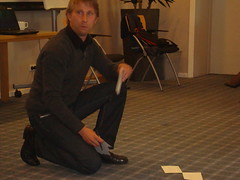
The real threat to traditional libraries is a small robot in the shape of a rabbit named after a Children's fairytale - Kalle Kanin. So we saw at the European Association for Development Institutes Information Management Working Groups meeting hosted by NIAS in Copenhagen last week. Whilst primarily discussing key issues on communicating and managing information on development issues we took time out to hear from Kalle.


This wolf in rabbit's clothing can glance at a book, look up it's ISBN numbers, give you a summary and provide a review. As the latest member to join the EADI Information Management Working Group, the initial reception was welcoming. After all this skilled character, who works at NIAS, can speak over 20 languages,know instinctively when his websites are visited and is more popular on Facebook than most librarians could dream to be in a lifetime.

He was however not a big contributor to the open space sessions which discussed everything from Multiple Knowledge, Open Source, Storytelling, Bias in communication, reaching audiences , Information Managers vs Communication specialists, the use of podcasting to reach politicians and other Open Space discussions. See all the blog entries which summarise some of these discussions.

He missed the Euforic session hearing from members on how they are communicating climate change issues, the key note speech of Lea Santana from NEIM, and the peer assist session.
Neither did he see all the tweets, videos and presentations brought together at imwg2009.blogspot.com.


I hear that Kalle Kanin is staring in a remake of Fritz Lang's Metropolis .... Metropolib.

For the Information Management Working Group we're just planning a meeting next year in Brussels.

The results of the open space sessions helped us identifying the issues that we'll be discussing between now and then:

  • Improving research communication;
  • Making information managers and communicators work together;
  • Information management versus creativity;
  • Building innovation in our work;
  • The importance of low bandwidth;
  • Linking up with researchers?
by Chris Addison

See also Euforic newsfeeds on information, knowledge, communication, and from the IMWG 2009 workshop.

Monday, June 15, 2009

Who are we hearing?

Listening to multiple knowledges, attempts to redress the current bias.

In this open space session during the EADI IMWG 2009 meeting the group discussed what efforts are currently made to ensure that different groups are included in development research activities and that their views can be heard. This is the core concern of an EADI project funded by DGIS, the department for development cooperation at the Dutch Ministry for foreign Affairs.

The conversation was wide ranging around the issue of research information and communication and covered three elements:
  • Providing access to research information from various groups;
  • Bias in the research agendas set in research organisations;
  • Communicating the outcomes of research to the community.
Providing access to research information
In discussing views of and access to research the following portals within the EADI network (which included also NGO research) were mentioned: research4development and search4dev.
Large portals are not the only way to present collections. Using custom search engines like focuss.info organisations have made increased access to views from their networks documents. Good examples are the Sangonet search from South african NGOs and the recently constructed Codesria search. Providing this information is only part of the story. Management need to be convinced of the issue.

There is not only a need to work on mobilising research but also promoting access to and creating demand for other sources of research, in the North as well as in the South. The internet may have provided more access to materials but it also means they can be shared whilst still work in progress. ICCO explained how their materials are shared before the final version is loaded onto Search for dev. ICCO research can be found on their wiki which is part of ComPart, their knowledge sharing platform.

Informing research agendas to make them relevant
How could we be sure that research is relevant and really served development goals?
There was the discussion of how donor agencies have produced a projectisation of research rather than organisations setting their own research agenda. This runs the risk of research agendas no longer being local and set by countries. Examples of these are the EADI Geneva conference last year and the UNRISD 2004 conference (see UNRISD News 27).

In discussing the last EADI conference the issue of action research and studies being more clearly of benefit to communities was raised. This was examined in some depth at the IKM emergent session at the EADI meeting.


Mike Powell introduces the IKMemergent project

Impact and uptake of research has been examined by several donors, one of the largest attempts is the DFID program 'Research Into Use' . This demonstrates a change in how research for development is perceived, with the recognition that participation in research leads to better communication. However, some participants were worried that there are few incentives to work in this way. As we were twittering this discussion we received the recommendation to look at RAAKS as an example of participatory research . In conjunction with discussing new innovative approaches we were encouraged to read Knowledge on the move.

Communicating the outcomes of research to the community
In addition to the difference that participatory research makes to communicating results to the community we heard of different approaches. For example how researchers had worked with the journalist Manuel Torres to write newspaper articles on the results of their research. Other materials were produced to reach the farming community.

A full description of the IKMemergent project and further details on each of these elements and more is available at IKMemergent.net and in previous articles on this blog.

by Chris Addison

See also Euforic newsfeeds on information, knowledge, communication, and from the IMWG 2009 workshop.

Friday, June 12, 2009

Open space on story telling at the IMWG 2009 meeting

Richard Lalleman from the Focuss.Info initiative convened an open space session on story telling.
In Richard's views, when you try to codify your knowledge the context will fall apart. Talking seems to be a better way to share your knowledge. Quoting also knowledge management theories, he stated that "you know more that you can tell, and you tell more that you can write"

Among the different types of story telling techniques, Richard introduced the 'future-backwards'. This approach can increase the number of view points that a group has in understanding their past, and among the range of future possibilities. It can be used to compare and contrast different aspirations on the present situation and the future.

This approach seems particularly appropriate to learn from past experiences.

The discussion went on with participants comparing notes on the different methods used in their organisations to foster knowledge sharing.

See also Euforic newsfeeds on information, knowledge, communication, and from the IMWG 2009 workshop

Thursday, June 11, 2009

Money, power, equity - Whose agendas are we communicating?

This open space session at the EADI IMWG 2009 meeting was convened around the topic: Donors, researchers, politicians, North, South - Whose agenda should be the most important? And how do we, as information workers, recognize and balance these issues in our day to day work?

Several elements were brought up during the group discussion.

Probably it is not possible to be objective. A challenge for the communications and information workers is to be aware of the issues and to respond to them. But there probably isn't a way to always get it right. We are subjective, have to be selective. It's easy to bias Northern organizations research as it is so available, so much more advertised than the harder to find, but more valuable, work being done in smaller, Southern and less powerful organisations.

There is also a language bias as material is dominantly in English. A conscious choice of ELDIS to address this bias is to rather create partnerships with organizations/networks who have material in e.g. Spanish or French. This is a better solution that having this material on ELDIS website, where it is not much read as it's audience is mainly anglophone. This approach fits also into ELDIS mandate which is inclusiveness. ELDIS is trying to globalise and finding partners all over which will help them to address these issues.

Talking about donors' agendas, it was felt that colonial history can be influential for what issues donors see as important. What is considered politically important issues at the time also influences the research presented; the concept of 'good governance' seems to be an interesting example in this sense.

At times, also consideration of project funding changes the focus on the research being done. The temptation is always to 'follow the money'. But this should not have influence on research communication. If we look at small projects as opposed to larger donor supported projects, the importance that we put on communicating the results of a project should not be directly related to the amount of funding.

Lastly, the the question of accountability was tabled, with donors that should be accountable to the recipient. How can we ensure this? Would open repositories be a possible solution

See also Euforic newsfeeds on information, knowledge sharing, communication, and from the IMWG 2009 workshop

What does free mean in "free your information"?

The open space discussion at the EADI IMWG began by asking whether researchers would ever contribute their content for free. In Denmark, negotiations with publishers have led to free access to most journals for the research community. So perhaps the issue is not as clear here to researchers as it is in other parts of the world. The point was made that the whole open access movement derived from librarians who were far more aware of the costs in getting access to journals. This is a big business - it was claimed that Elsevier earns 600 million Euros per year on scientific publications.

The whole discussion on open access may also arise because of the technology issue. In the past, a printed copy of a journal would be bought by a university but then available in a library to a whole range of users. With the change in technology, publishers can now see who reads each article online and give restricted user licenses.

The key issue behind a journal's income was how much this currently relies on the control of copyright and what the future possibilities of creative commons licenses are. It was raised that awareness of copyright issues was still needed - the example video A Fair(y) use tale - was mentioned as a useful resource to raise awareness of fair use.

Initiatives in development talking about opening access rather than open access were mentioned. Here the CIARD initiative was mentioned as an approach to make information not only available but accessible and further to try to ensure it was applicable. Other attempts to improve awareness of open access issues have been undertaken by EADI most notably at last years AGM.

This discussed the costs of making a journal article as open acces as being 2-3000 Euros. If this was the case, shouldn't donors take responsibility for making research outputs open access.

Donors could and do support open access by funding Open Access journals, provide incentives to use OA Journals or fund researchers to publish in standard hybrid journals. At the moment incentives for open access publishing are limited as those journals are ranked too low in Citation index ranking systems such as CERES. Swiss national fund supports open access journals and will pay researchers if they choose to publish in main journals.

Open Access to journals could be a huge cost saving to libraries not just on subscriptions but in saving time at the library to handle links and access to journals and to manage susbcription packages. Information literacy training also becomes far easier as access is straightforward.

Returning to the meaning of 'free', the issue was raised that whilst information may be free on the internet, what about the cost of the pc, connectivity and skills to get there? The idea of "One Laptop Per Researcher" was introduced by Michael Wesseling as a possible initiative to provide access for researchers in developing countries but linked with Internet initiatives working on making bandwidth use more efficient and coping with bad connection, a so-called "internet under the trees" approach.

Finally the discussion concluded with the discussion of the book "Hacking capitalist" published by Routledge which argues that we should consider that information is "free" as in "free beer" as it is the raw material in the new economy.

See also Euforic newsfeeds on climate change; information/knowledge, and from the IMWG 2009 workshop

Peer-assist session at the IMWG 2009 meeting

After the key note speech of Lea Santana (NEIM - see also her blip interview), participants in the IMWG 2009 meeting jumped into the peer assist session, to discuss some of the issues they are facing in their daily work.

The group identified a series of specific questions on which to compare notes and exchange views:

1. How do researchers share knowledge and learn form the knowledge that is produced and exists?

Some participants noted that learning has to be part of the research process. In this process, important is also to share lessons of what did not work so to learn form failures. A fundamental question remain: How do you learn to do things different, especially bringing together people that speak different languages (researchers, NGOs, policy makers)?

A good example comes form DIIS, that hosts staff from Foreign Affairs and DANIDA for a period of time. This way researchers learn how to write in a way that is more immediate to grasp for policy makers: concise, to the point, in a way that can be useful and not just good for academic carrier. It works also the other way around, with researchers outplaced to DANIDA and working there.

2. What's the role of intermediaries?

If you want your research being applied, it has to be communicated, it has to be made known to the target group that needs to use it. The way you write and communicate research findings needs to have the format geared to the audience. You need to to know who you talk to in order to decide your language. In this process, you also choose the appropriate tool(s) to reach your target group.

The role of communication professionals is therefore a key one. Researchers generate very specific outputs; therefore you need 'brokers' that translate these outputs in formats that can be used and applied. There needs to be an expert in between researchers and non-researchers. However it's was underlined that these intermediaries have to work with the researchers and not for the researchers. Therefore the dialogue between researchers and intermediaries needs to start before the research takes places.
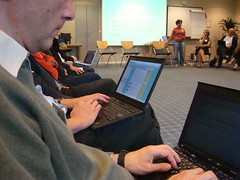
Lastly, it was noted that also other professions have trouble in communicating; what can we learn from experiences in other fields to deal with these issues?

3. Copyright issues

More and more organisations are adopting Creative Commons licenses, what are the pros and cons of this?

Creative Commons allows new distribution ways of information and knowledge produced, making sure that other people can use our work. But as with every deal concerning peoples intellectual property, there's some hesitation around in doing that.

A good example comes form Development in Practice which decided to go for a Creative Commons-Attribution-Noncommericial-No Derivatives license, as it was felt that this protects the interest of the author. However, when you want to apply similar licenses, you need to make it clear to the author from the beginning.

Furthermore, the choice of license very much depends also on where you see that your info is potentially useful.

Plagiarism can happen anyway, regardless of the way of publishing and the license you use; others are the checks and balances which are needed.

One of the participants commented that there need to be more debate on commercial vs. non commercial use of content under CC license.

Useful information on this issue can be found on the web dossiers on open access from EADI, ELDIS and Wellcome Trust. See also the blog post from the open space discussion on the issue during the IMWG 2009 meeting.

Other issues briefly touched upon during these peer assist session included:
- The 'long-tail' of research outputs [Some research outputs are peer reviewed and get increased value and recognition only after the research funds are finished: How do donors go about that?]

- How to compile annual reports [strategy and tools] and how to make them 'live' longer that the time span they cover?

See also Euforic newsfeeds on information, knowledge, communication, and from the IMWG 2009 workshop.

Communication: what for who?

This small group of EADI IMWG 2009 meeting explored differences in communication processes related to research, advocacy and policy. Lea Santana of NEIM, Brazil [see also her blip interview] explained how she tries to package information in ways that serves the purpose of advocacy. Academics can communicate with other academics but for politicians you need to re-package information. You need to "translate" the information.

Mike Powell, IKM Emergent Programme, emphasized that not all research is academic. Research is about recording experiences. Lea agreed, a photographic exhibition can be research. Another participant stressed that whether a publication is actually considered academic research depends on in which journal you publish. There are quality standards, peer reviews etc. These quality standards seem to serve to protect, to legitimize.

The type of communication has very much to do with your audience. In development research you have to realize that there are people involved in such research that do not read academic journals, for example the people in developing countries who's life is being researched one way or another. So what do you do to communicate with them? Is not the basic idea of doing development research that it contributes to development? So you have an obligation to share your research in a accessible way.

Maarten Boers concluded that the differences may not seem fundamental particularly when you try to inform public decision-making.

See also Euforic newsfeeds on information, knowledge, communication, and from the IMWG 2009 workshop

The Art of Open Space at IMWG2009

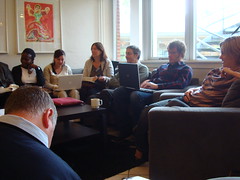
The EADI Information Management Working Group meets in Copenhagen. The group is using - among other modalities - Open Space to discuss their concerns. In brief OST-like sessions over 50 group members discuss during two days the concerns they share. The conference also includes discussion panels, peer-assist sessions and of course lots of informal networking.

The convening question for the OST part is: What are the issues, ideas, possibilities and opportunities etc. around communicating effectively in global research consortia and networks?

Lucie Lamoreux facilitates the initial session and explains the principles of OST which are all about letting go of control and allowing 'chaos' to happen:
1. Whoever comes is the right person, it is open indeed
2. Whenever it starts is the right time
3. Whatever happens is the only thing that could have
4. When it is over is over
5. The law of mobility - once you feel you have made your contribution and heard others you can move on to another group: only the person who reports on the group remains.

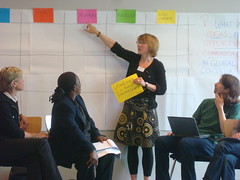
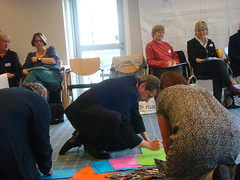
The first step is bringing on topics and engage in some wheeling and dealing to establish the topics for the 5 "spaces" at the venue. This happens at "the wall". Topics cover a different range of issues: using podcast for policy dialogues; what makes communicating about research so different from other forms of communication; storytelling; biases in communication about research; interaction between social movements and research groups; how to actually get researcher to communicate; the difference between information management and research communication; how to reach politicians when communicating research outcomes; webtools, thresholds and inclusiveness of web2.0; one laptop per researcher programme and internet under the tree; whose agenda's we do communicate - money, power and equity - do we really listen or are we using voices from the South to legitimatize ourselves and our donors?

After this inventory three time slots remained but they may be filled later on. At the market place initiators move around subjects in the various time slots, explain what they mean and get people to buy into their sessions. Lucy facilitates the process. IMWG-members are not a loud crowd. A few topics are moved around, some proposals to merge topics but few change proposals make it....

Participants will use old style flip charts and blogs and wikis to report.......to be continued...

by Rosien Herweijer, Euforic

See also Euforic newsfeeds on climate change; information/knowledge, and from the IMWG 2009 workshop

Who's reading this anyway?

Far from being an inclusive, Web 2.0 is at risk of being seen as an elite form of communication which is too often presented as value-free and accepted without judgment. There are a number of assumptions which seem easy to make but (in this space at least) we aren't addressing. These include:

What we have to say is useful and important
People want to hear and need to know what we're saying
That we have access to the technology

For research communication to be effective, we always pose a series of questions to which Web 2.0 should not be exempt from asking. What do we want to say? Who is our audience? How do they engage? What tools do they use? Who are we missing?

Once we have the answers to these we can decide on the most appropriate ways to do this. Sometimes the answer is a workshop, sometimes its podcasts. Sometimes it's participatory video and sometimes it's a very heavy academic paper.

The point is, Web 2.0 is not the only answer but part of the solution. Let's remember that.

By Clare Gorman, IDS

See also Euforic newsfeeds on climate change; information/knowledge, and from the IMWG 2009 workshop

Wednesday, June 10, 2009

Collaboration, Communication and Climate Change

Copenhagen, 10 June 2009. Today's Euforic workshop was convened in view of the forthcoming COP 15 Climate Change meeting in Copenhagen in December 2009. It was hosted by NIAS in Copenhagen.

After Ramesh Jaura, President of Euforic and Director of IPS Europe introduced the theme, we heard from NGOs, research organisations and think-tanks on the issue of 'Collaboration, communication and climate change'.

Ramesh explained that, before the Rio conference on environment and development in June 1992 (UNCED), development was considered in a different way, being funding and project based; the phrase "sustainable development" emerged from the conference. Since then, more and more NGOs and researchers started to explore the implications of climate change. In Bali, organisations like Third World Network took part in the negotiations representing Southern views.

Four Euforic members - IDS, the DiploFoundation, CABI and DIIS presented their work, this was followed by an overview of other Euforic members.

DIIS presented their climate subweb, including their involvement in the Commission on Climate Change and Development, their work on climate adaptation, REDD studies on Forest conservation, and the DIIS reports on low carbon development. They have also produced a thematic issue of the Danish language journal Den Ny Verden. [see presentation]

DiploFoundation shared their work on training and communication towards diplomats and other foreign affairs professionals.


The training begins online, it is followed by an online collaborative policy research case and placement in policy organizations. During this process, participants create a community of practice online. This approach is unique in its combination of online and face to face activities; it empowers people as influencers of change, it merges CoPs that make a difference, and includes those in the south that otherwise wouldn’t have access. Now the question is how this approach could serve the climate change process. As a cross cutting field this has a broad appeal.

Alan Stanley presented IDS knowledge services communicating research on climate change and development.

He highlighted three projects: LCA, Community Based Adaptation Exchange and Africa Adapt. The purpose of these different communications initiatives is to ensure that more decisions are evidence-based. The IDS approach is based on the following elements: expertise, diversity, learning, engagement and partnership. Partnership is the most important, as IDS initiatives are just one of many initiatives; working together instead of duplicating efforts is the take away message [see also this video blip with Alan]

Martin Parr from CABI presented their work on communicating research using the Research4development portal.


First they had built a collective database of all DFID funded research together with links to other websites containing the information. At it’s heart lies 5000 projects and 20000 outputs cross linked by themes, countries and actors. As a second step, they turned the site into a service focused on reaching the desktops individuals. This means for example presenting types of information by audience or presenting thematic pages including feeds from DFID communication partners. The information is made more accessible through the use of RSS. To promote this information, a news service fits on top, using for example blogs to discuss research communications and the launch of the new DFID research strategy.

Lastly, Chris Addison gave an overview of the activities undertaken by Euforic members in the different areas they are working, from advocacy to research, from meetings to communications strategy, from online new services news to training.

See also a previous blog post highlighting some of these issues.

Subscribe to the Euforic AGM 2009 newsfeed.

See also Euforic newsfeeds on climate change; information/knowledge, and from the 2009 annual workshop.

Friday, June 05, 2009

What our members are doing on climate change

Climate change is high on the international agenda these days. During the UN Climate Change Talks in Bonn (1 - 12 June) politicians, experts and activists aim to make progress in the preparation of a Post-2012 Climate Change Agreement. Obviously, the toughest task remains to find a compromise between industrialized countries, emerging economies and the developing world.

Within our diverse Euforic network several of our members are very active in the field of climate change. This is a good opportunity to present an overview of their activities.

Advocacy on climate change aims to influence the ongoing climate change negotiations on the regional and global level. Organisations involved wish to influence policy processes in a strategic way and make sure that the interests of the developing world are heard.


CIDSE is mainly engaged in the campaigning activities towards climate justice and a comprehensive new Climate Change Agreement. During the Bonn Climate Change Talks the network presents its report on the importance of adaptation technology for the Post-2012 Climate Agreement and - amongst other activities - organizes a video conference between Southern experts and conference participants on the issue of disaster risk reduction and adaptation.

APRODEVs Working Group on Climate Change and Concord are focusing on strategically influencing EU policies aiming to ensure that they are coherent with stated poverty eradication and development policies.

Research on climate change focuses on the impact of the phenomenon on the environment and livelihoods as well as on adaptation strategies to cope with these effects.


A research program of IDS is looking at cross-cutting issues between climate change and adaptation, policy, low carbon growth, building of networks and knowledge sharing as well as at training, teaching and mentoring. During the Bonn conference IDS organizes a panel discussion on 'Strengthening knowledge sharing on climate change adaptation in Africa'.

Also the Danish Development Research Network (DDRN) prioritizes climate change in its research. As well as the Danish Institute for International Studies (DIIS) whose research activities focus on the issue of climate change from a number of different perspectives ranging from security and international politics to trade, development, and livelihood.

ISS looks at the effects of climate change on resources, the environment and livelihoods. And ODIs research is trying to identify how increasing knowledge of the science of climate change impacts can be used to understand potential implications for developing countries, particularly in social, economic and political terms. Secondly it looks at how to ensure that emerging climate change mitigation and adaptation policies work for the poor.

Training courses provide services for policy makers to increase their knowledge on climate change and the international policy processes and negotiations.


DIPLO, the training institute for diplomacy, recognizes the importance of climate change negotiations on the global and regional level and developed a training course for diplomats and government officials involved in climate change policy processes.

Latest news, research and policy documents on Climate Change and related topics are provided by several Euforic members:


  • EADI - Information portal on climate change and energy
  • ECDPM - Newsfeed on climate change and development
  • IPS - News alert on climate change
  • ILEIA - Dossier on climate change, rural development and agriculture


Policy perspectives are given by the public institutions among our membership.


FINNIDA focuses on the Clean Development Mechanism and its political dimension as well as on the nexus between gender and climate change.

The Annual General Meeting which Euforic organizes alongside the meeting of EADIs Information Management Working Group takes place in Copenhagen from the 10 - 12 June. The meeting will shed light on the challenges of climate change and communication. See Mike Shanahan (IIED) talk about this issue:


by Martin Behrens

See also Euforic newsfeeds on climate change; information/knowledge, and from the 2009 annual workshop