Google+
Showing posts with label cta. Show all posts

Friday, April 11, 2014

CTA web2.0 and social media trainings - What have we learnt?

Over recent years, CTA web2.0 and social media training programme has become a flagship initiative of the organization, receiving positive feedback from participants and host institutions and being awarded the WSIS Project Prize 2013 in the category e-agriculture.

While we are in the process of finalizing the evaluation of the second phase of the programme (2011-2012), I was recently invited to present and discuss the initial findings of the evaluation with CTA staff and managers.

 
Web 2.0 and social media capacity building initiative - What have we learnt over the period 2011-2012? Results of an impact study from Euforic Services

A few of the headlines emerging from the evaluation are:

  • There is general, high satisfaction of how the training is conducted and its content; 
  • Participants describe the training events as an eye opener and they feel inspired by the potential of social media to support their work;
  • The trainings work for improving participants' social media skills and knowledge;
  • Face-to-face trainings perform better than online trainings in terms of adoption of different social media tools;
  • There is a clear ripple effect, with the training being replicated (in different forms and degrees) by participants in their workplace or with their own partners;
  • Institutional adoption of social media is increasing, but only a few organizations use social media in an advanced way.
  • Resistance to change and lack of management support are the most common challenges to social media adoption.
Some recommendations include:
  • Putting more resources into the documentation and sharing of success (and failure) stories of putting social media to work in the agricultural sector;
  • Investing in a training of trainers programme, to expand the formation of a solid base of trainers across the ACP countries;
  • Sensitize senior and middle managers on the advantages of social media.
The meeting provided a good opportunity for CTA staff to reflect on what has been done so far in the programme, and discuss how to take it forward.

 - 


Wednesday, January 16, 2013

Evaluation of CTA web2.0 and social media trainings 2008-2010


One of the most interesting piece of work we carried out in 2012 was an evaluation for CTA of its web2.0 related capacity building events (2008-2012). The goal of this study was to learn from three years of this web2.0 and social media training programme; to understand which demographic is the most enthusiastic adopters of web2.0 tools, and the impact that digital tools have in terms of personal development and institutional changes.

CTA Web2forDev Training Opportunity - Photo credits: Web2forDev website

Today, a blog post on Web2forDev summarises the main findings of the study:
  • Between 2008 and 2010, CTA delivered 20 web2.0 related capacity building events, reaching a total of 510 trainees from over 20 ACP countries, mainly in Africa
  • Not surprisingly, trainees under 36 are more likely to adopt web2.0 applications, except for online social networking, which interestingly was not affected by age;
  • Female trainees have higher adoption rates than males for almost every web2.0 application;
  • Trainees working for NGOs and national and international organisations are more likely to adopt web2.0 tools than those in educational and research institutions;
  • Nearly 90% of trainees have improved their capacity to search for, access and share information;
  • The use of the iMark module is the preferred way chosen by trainees to introduce colleagues and co-workers to social media;
  • Bringing about systematic adoption of social media in institutions is much more challenging.

The article has generated some interesting comments and discussions, both on the Web2fordev website as well as in Web2forDev community on Dgroups.

A follow up post will soon be published to presents some of the recommendations included in the final report.
 - 

Thursday, December 10, 2009

Organic or Green, agriculture is back on the agenda : CTA briefs on Global Food Crisis and Local Food Insecurity

On 9 December, in its well-known series of Brussels Briefings for policy makers, CTA organized a session on food security entitled From Global Food Crisis to Local Food Insecurity, bringing together a wide range of stakeholders.

Including the most important stakeholders: farmers. After having listened to a number of speakers Mr. Bagna of the Platform of Producers' Organizations in Niger concluded he actually had not heard anything new: food insecurity is a serious problem, we need money, we need research and we need capacity development….. everything has been said already, .... yesterday. But where is the real commitment, asked Mr. Bagna? Maybe policy-makers are not altogether honest with themselves, he felt. Despite all the plans there is no funding, no decent financial credit systems. There is no money for capacity development of people and their organizations. And in the end, farmers do their own research, to survive they have to….. Donors and governments could solve all these problems, Mr. Bagna feels, if they really wanted to…..

The exchange at the CTA briefing was very lively. Not everything may be new but it is useful to contrast different approaches and assessments and reaffirm the need for concerted action.

Presentations and background materials on the Global Food Crisis and Local Food Insecurity compiled by CTA can be accessed at the Brussels Briefings blog, also available in French at Bruxelles Briefings

Dr. Hans Herren co-chair of IAASTD, was the keynote speaker at the 9 December briefing. He presented the key findings of "Agriculture at a Crossroads", the report series of the International Assessment of Agricultural knowledge, Science and Technology for Development. The challenges for food security are quite clear according to Herren: climate change, population- and demand growth, and finally shrinking natural resources. In the past, the green revolution has not been a solution, according to Herren, nor will in the future crop-technology development solve the problem. People have benefitted unevenly from the yield increases generated by the green revolution, and the increases have come at a serious cost in terms of degrading natural resources (soils, water). Across regions, agricultural output is now distributed more uneven than ever.

So while the green revolution is not a solution and there is no simple alternative solution. The organic revolution that Dr. Herren calls for has to deal with “the inescapable connectedness of acgriculture's different roles and function”. Agriculture is not one but two words, Herren argues, “agri” and “culture”. It is not about the production of commodities but rooted in society in culture. Consequently, not crop productivity, but farm productivity has to be the subject of research when 75% of the food is produced by family farms. In his view what is needed is another kind of research based on a participatory, systems approach, working with women, training at agricultural colleges practitioners not people that end up behind desks.

Agricultural economist Steve Wiggins (ODI) emphasized that the 2008/09 food price spike made already high levels of under-nutrition more visible. Also the spike provoked awareness of possible future shocks and the challenges on agriculture agenda.

Agriculture is changing and will have to change according to Wiggins:
- From non-renewables to renewables
- Reducing use of water
- Limiting emission of greenhouse gasses (quite a large contribution (17 – or 32% when including expansion - to 13% from transport)
- From usual to altered climates

Information technology is critical for more efficient use of resources, also pricing of scarce resources and taxing the wastefulness and GHG intensity of food are important strategies. There are win-win scenarios according to Wiggins: climate friendly agriculture = less pollution and land degradation…….

Ndiogou Fall of the Network of Farmers’ and Agricultural Producers’ Organizations of West Africa explained that at micro-level, families and communities develop strategies to address food insecurity. However, so much more can be done in terms of supportive public policies and finance. Fall says support to family agriculture is a priority because they directly suffer food insecurity and there are important multiplier effects of investment in family agriculture. He would like to see that pricing policies favor family agriculture and that support includes various parts in value chain. Also het felt it is very important to support farmers organizations. Maybe not a lot of additional research is needed, said Fall, getting existing knowledge to farming families would already be quite an accomplishment. Finally Fall mentioned that land tenure policies often very negatively affect family farming.

Dr. David Nabarro, Special Representative of UNSG on Food Security, saw with satisfaction that after many years of neglect, agriculture and food security are back on the development agenda. He emphasized that the food crisis is deepening. Food insecurity was already a serious issue before the food price spike of 2008. Now, after the spike, the economic contraction is generating a further negative impact. The crisis is also deepening. Poor people are increasingly susceptible to climate change and systems that do not work.

Global availability of food is not the problem said Mr. Nabarro. The problem is inequitable access and utilization. According to him the question is not “how to feed the world” as the Economist headlined a few weeks ago, but “how to ensure people can exercise their right to the food they need”. Since agriculture is back on the global agenda, Mr. Nabarro is optimistic. He feels major stakeholders are coming together and promising approaches are emerging.

The European Commission, DGDevelopment highlighted aspects of the new EU Framework for support to Food Security and Agriculture. A representative from AIDCO explained how a 3-year funding time frame helps create some continuity in the funding for agricultural research. Several other participants commented on the presentations of the experts.

Rajul Pandya-Lorch - the only women on the panels - of the International Food Policy Research Institute in Washington DC, rose at the crack of dawn to contribute her views, but unfortunately technology failed us. Her slides were available on paper and the first one framed the problem nicely: In the late 1950 there were 1 billion people going hungry every day. In 2009 ……. 1 billion people still go hungry every day.

Visit the Brussels Briefings blogs to see all presentations and summaries of presentations.

For more background information on food security check the Euforic newsfeed.

EC invites to comment on Issues Paper on Agriculture and Food Security

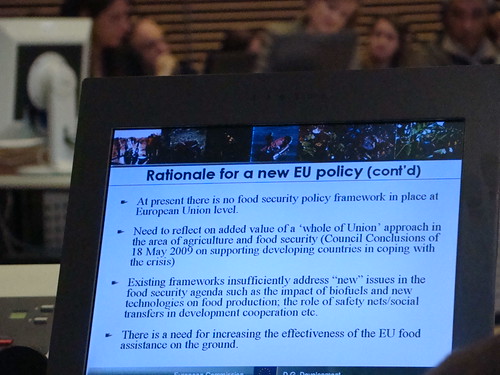
Food Security and Agriculture are very much back on the agenda. Building on its Food Security Thematic Strategy Paper 2007-2010, the European Commission is currently developing a new Policy Framework to assist developing countries addressing agriculture and food security challenges. On 9 december 2009, at the CTA organized Brussels Briefing “From Global Food Crisis to Local Food Insecurity”, the Directorate General for Development elaborated on its Issues Paper on food security.

DSC01913


The new policy framework will build on central elements of the past framework:

• The aim remains not simply to deliver food aid but to achieve Food Security for all
• Maintain a link between relief and protecting sustainable livelihoods and crisis prevention
• Address four pillars: availability (1), access (2), quality and utilization (3), and crisis management and prevention (4)

The Issues Paper was published 16 november 2009 and is part of the consultation and policy development process which has to lead to Council Conclusions – an official statement of the ministers of EU members states – on a Policy Framework on Agriculture and Food Security in May 2010.

Until 9 January 2010 you can voice you opinion about the Issues Paper at www.ec.europa.eu/yourvoice/consultations


Several participants at the Brussels Briefing organised by CTA commented on the presentation by the DG-Development representative. ActionAid welcomes the EC initiative but feels the Commission has no long term approach to investment in agriculture and food security. Also, according to ActionAid, the EC approach lacks attention for women’s access to credit, land and services. For example, compared to an earlier version, the chapter on agriculture has been removed from the current version of the EC Gender Action plan, a document stakeholders may comment on next week. ActionAid also warns about the so-called “whole of union approach” that the Commision wishes to explore in connection with issues of Food Security. This approach suggests that members states – besides official development cooperation - use all kinds of other resources to achieve development objectives. However, ActionAid and Concord are concerned that the "whole of the union" approach is more about “counting all resources” as opposed to really “using all resources”.

Subscribe to the euforic newsfeeds on food security and eu cooperation for more news

Tuesday, December 08, 2009

Brussels Briefings live on the Internet

The Briefing “From Global Food Crisis to Local Food Insecurity” live on the Internet!. This way, you can easily follow the presentations and debates.

WHEN: December, 9 – 8:30 – 13:00 (Brussels Time)

This service (in English and French) is FREE and requires simply the use of a computer connected to the Internet.

To get access, please click on this link: http://scic.ec.europa.eu/str/index.php?sessionno=401 (use of the Internet Explorer browser is recommended)

For the programme, background note and registration form, please check http://brusselsbriefings.net/.

Sign up for the Brussels Briefing newsfeed; see also the Euforic newsfeeds on rural development, food security and the food crisis

Tuesday, December 01, 2009

Next Briefing on food crisis and food insecurity

The next Brussels Development Briefing will be held on 9th December and will discuss “From Global Food Crisis to Local Food Insecurity” in the context of the new EC policy on Food security to be released.

The Briefing will be looking at the domino effects of increased speculation in food markets (How has the global food and financial crisis affected food production and distribution and the food security of the poorest? Is global food production at risk in the medium and long term and will national food security and food sovereignty be the priority over global food availability? Is the small-scale farming more effective and resilient in times of crisis in least-developed countries?) and the on what realistic policy options can secure food supply and availability at global and local levels.

For the programme and registration form, please check http://brusselsbriefings.net/.

Earlier Brussels Briefings looked at 'ACP Agricultural and Rural Development: why Media matters?', 'Upgrading to compete in a globalised world: What opportunities and challenges for SMEs in agriculture in ACP countries?','The Role of Livestock for ACP countries: challenges and opportunities ahead', ' Meeting Food Safety Standards: Implications for ACP agricultural exports', 'Fighting against Illegal, Unreported and Unregulated fishing (IUU): Impacts and challenges for ACP countries', 'Land access and rural development: New challenges, new opportunities', 'How does international migration affect ACP rural development?', 'Rising food prices: an opportunity for change?', 'New drivers, new players in ACP rural development', 'Does Fair Trade contribute to sustainable development?', 'The climate challenge for ACP agriculture', 'Aid for Trade', 'Advancing African Agriculture' and 'Challenges to rural development in ACP countries.'

Sign up for the Brussels Briefing newsfeed; see also the Euforic newsfeeds on rural development, food security and the food crisis

Thursday, November 12, 2009

Brussels Development Briefings: more background information available

The report of the Briefing on “Upgrading to compete in a globalised world: What opportunities and challenges for SMEs in agriculture in ACP countries?” held on 23rd September 2009 is available now. The report presents a detailed account of the presentations and debates, and can be downloaded here.

The reader provides extensive background information on the issue - including online resources - and is also available online.

Sign up for the Brussels Briefing newsfeed; see also the Euforic newsfeeds on rural development and agriculture

Monday, October 26, 2009

European Development Days 2009: the power of networking

Last week Stockholm hosted the European Development Days, a three day event involving a number of heads of State and thousands of development professionals and students from all over Europe, indeed the world. You can read it all on the official EDD-website.

Even though Euforic – as readers of this blog will know – is scaling down its operations, we were present in Stockholm to promote one of the many exciting projects Euforic has been involved in over the last few years: R4D, an information service providing free access to information on DFID (co)financed research for development programs and over 20,000 outputs of these research efforts.

Several Euforic members presented panel discussions at the European Development Days, or the Development D-days as Rajendra Pachauri, Director General of the Energy Resources Insitute in New Delhi and one of the keynote speakers, called them. CTA invited twelve partners from the South to have stands at the Development Village and organized an important event about land acquisition (also known as “land grabbing”). At an event co-organized by AFD, Koos Richelle, head of AIDCO and others examined aid practices. AFD also organized with DFID and DIE a debate about the evolving aid architecture. Concord co-organized an event about development education, sharing ideas and experiences around involving and mobilizing citizens for development. Citizens were also central to the ECDPM-organized event about the EU-Africa Partnership. EADI together with the Development Gateway Foundation looked at the future of European Development Cooperation: Development Beyond 2015 and APRODEV, CIDSE and Concord staged an event on Copenhagen, Climate Justice and the Right to Development. SNV had a session on Accountability and Transparency and cheered us all up with a musical spectacle at the end of the second day.

Most events attracted quite some interest. A crowd of EDD-visitors lined-up outside the forum on Media and Development. In the panel, Ellen Johnson-Sirleaf, President of Liberia, Raile Odinga, Prime Minister of Kenya, blogger and digital activist Ndesanjo Macha and others discussed the role of media in development. Dominique Darmon of SNV was lucky to get in and reported that there was an extensive discussion around the role of new media. Nowadays in Africa over 17 million phones are in use ... or at least, in use when there is electricity, as Ellen Johnson-Sirleaf noted, underlining that energy and infrastructure are critical priorities for investment in this continent. Odinga explained how he used a blog to communicate with the electorate during the recent presidential election campaign in Kenya, but someone in the audience noted that comments from readers of the blog were screened and the comments criticizing Odinga actually never made it to his blog. So new media can promote interaction and participation but they do not eliminate exclusion, whether because of lack of electricity or because of censorship.

Written communication does not reach too many Africans because of the high illiteracy rates, television is important but technically much more demanding than radio which is the number one “old” means of communication in the continent. At the same time, mobile devices are changing the way the good old radio is operating, boosting its use through for example podcast. During the session several other examples of mobile phone use were highlighted for example how they were used to warn people during recent floodings in Burkina Faso. Phones can also be used to hold the government accountable as the HIVOS/SNV project Twaweza demonstrates.

Some participants in the audience felt that new media pose a greater risk of misinformation while others laud their potential to promote democracy. A BBC reporter asked the politicians in the panel what at the end of the day would make them more uncomfortable: a bad news paper story, or a critical blog ... thus showing that the good old newspaper remains critically important.

Having to attend my R4D stand in the Development Village I saw few live presentations. But I made an exception for the “testimonies” on climate change that were given in the morning of the last day, 25 October. Michelle Duvivier Pierre-Louis, Prime Minister of Haiti and former executive of the Soros-sponsored Knowledge and Freedom Foundation told about the seven (7) hurricanes that hit her country over the last few years and asked for fairness and just reparations as part of the strategy to confront the climate change crisis, “The market mechanism is not going to save the planet”, she insisted. Moderator Sackur, known from BBC’s “Hard Talk” highlighted her systematic emphasis on fairness and justice and he asked her whether – when talking with European leaders, she felt they actually “got it”. Very honestly she replied that her gut feeling was not very good, but she also made it clear she will not give up fighting for climate justice.

President Emanual Manny Mori of the Federated States of Micronesia explained how his country has been fighting for climate justice for quite some time already. The small islands state is very much exposed to the potentially disastrous effects of the sea level increase. To anyone who doubts whether this is a serious crisis he urged to reflect “Who are you fooling? Not the oceans and disappearing species”. Mori insisted that all nations will have to bite the bullet: “We will face a different world in our lifetime”

Mary Simon has been an activist for Inuit interests for decades. “My homeland is melting” she stated, “the situation is terrifying, villages just sink in the ground because of melting permafrost”. The changes may very well exceed the traditional capacities op her people to adapt. Simon concludes that previous efforts to reduce carbon emissions have not done the job, public policies have fallen short and emissions have continued to grow. Simon stressed the interrelation between economic and environmental security and calls for massive investments in clean technology. A Climate Change Adaptation Fund of 20 billion euro needs to become operational now, not by 2022 as current proposals suggest. Besides climate change, Simon also warned for what she labeled to be misguided policies that affect the Inuit people like the upgrade in CITES of the polar bear which makes them an endangered species, and the EU ban on seal products. It is climate change that endangers the polar bear, she said, Inuit hunting practices are sustainable. She felt that such policies negatively affect the Inuits capacity to adapt and preserve their livelihoods.

Back at my R4D stand, I listened to Margot Wallström, Vice-President of the European Commission, through a video live-stream. She said that the political realities will force the EU to be more ambitious about reduction of CO2 emission and deliver climate justice. With Michelle Duvivier and the others we continue to hope (but fear her gut feeling).

For more stories on the European Development Days, check the official EDD-site and sites of Euforic member organizations.

by Rosien Herweijer

See also Euforic's newsfeeds on Euforic cooperative life on European Development Days and on Information, knowledge, and communication

Wednesday, October 14, 2009

CTA’s 14th Brussels Briefing: woman bites dog or why media matter for rural development

At the Brussels Briefing # 14, organised by CTA on 12 October, a lively discussion on media and rural development took place. The debate was fed by contributions of a variety of panelists and a large crowd of participants from ACP countries. Why is there so little reporting done on regular media on issues concerning farmers and rural communities? Why do the media treat the food crisis as an urban issue? Can journalists partner with farmers, politicians, policy advocates and researchers in promoting rural development? What is the role of the new media and do ICTs contribute?

To prepare for this session the organiser CTA hosted a 4 weeks e-discussion. Susana Thorp from WREN gave a brief summary of the outcomes. First and foremost, Mrs. Thorp emphasized that participants hope that discussion actually leads to action. The e-debate focused on constraints faced by media on – conflicting - expectations of various stakeholders on new media and ICTs, and on support for enhancing media activities and building capacities. A summary of the e-debate is available here.

It was interesting to observe that at this Brussels Briefing the majority of panelist and quite a number of participants were female. Mrs. Tumi Makgabo, lead discussant and former CNN anchor stressed that in the world of media women have more barriers to overcome than men. But together with Mrs. Violet Otindo of K24TV in Kenya, winner of the CNN African Journalist Award, and all the other women participating in this debate she showed it can be done.

How do women overcome these barriers? Violet Otindo mentioned the importance of mentoring, but she said it should be used with care. For a journalist mentoring involves risks because it exposes you to political and commercial interests. Lack of resources and equipment are the major barrier according to her. She remarked that when you have no resources, everything takes more time. As a journalist you have to work smart and time management skills are essential. She feels that more recognition for the work of local African journalists is important, the big media houses should make more use of local journalists. Also support initiatives involving training and awards can be helpful.

Tumi Makgabo defined herself as a feminist with three-inch heels. You have to counter the way media portray women as a victim by acting like the opposite. She wants women to have a voice and she feels she can contribute more working as an independent journalist from Africa. She also illustrated how women seek to balance professional and private goals by telling how for her living in Africa as opposed to Atlanta serves both. As for the professional goals: Mrs. Makgabo stressed that with the new technologies Africans can tell stories about Africa: “we can tell our stories from any place now”.

In his keynote address CTA’s director Hansjörg Neun observed that media tend to report on the extraordinary – a man biting a dog is news, the reverse is not. Much of the messages on rural development do not seem to qualify as news. The first panel was lead by Tumi Makgabo of South Africa, a former anchor of CNN Inside Africa, now African Broadcasting and Media, and director of the African Women Development Fund. She introduced the panelists: Mr. Jean-Philippe Rapp who founded in 1985 the International North-South Media Forum, Mrs. Brave Nsidale, Ambassador of Malawi, Mr. Ignatius Jean, Representative of IICA and former minister of Agriculture of St. Lucia, Mr. Thozi Gwanya, Director General of the Department of Land Reform in South Africa and Mrs. Krishendaye Rampershad, media consultant based in Trinidad.

Ms. Rampershad emphasized that it is important to differentiate: are we talking high tech corporate media or low tech community based. She felt the latter to be very powerful in serving development objectives. To those wishing to communicate messages to rural populations Ms. Rampershad had a clear advice: talk normal! Extension people have to be communicators and not talk science. Mr. Gwanya felt that media systematically ignored rural people and their interests. Mr. Jean of IICA observed that technical people in agriculture and media may not understand or like each other but they do need each other. In the Carribean Mr. Jean has observed that ICTs and the participatory information sharing they enable, have dismantled monopolies. He also emphasized that new partnerships emerge; in the oral, musical community of the Carribean the power of songs and the influence of musicians can support our communication for agriculture. Jean-Philippe Rapp commented on Hansjörg Neun’s example but he argued that the current food insecurity and plague of hunger is indeed a case of “man bites dog” and considered quite newsworthy. He observed a sincere interest among media for agriculture, but there is also a shift, he noted: media look for testimonies, there is less interest for the stories of the experts.

After the contributions of the panelists Ms. Makgabo opened the debate and the floor. She challenged the panelists: if people continue to buy tabloids that pay no attention to issues and needs of rural people, who are we to question these priorities? Ms. Rampershad emphasized that you may see this disconnection in public and corporate media, but in community driven media agendas are set differently. Mr. Rapp emphasized that agriculture is not a difficult or grateful subject but you need to tell the story with passion and in original, authentic language.

In the ensuing debate the focus was on the relations between the various stakeholders. There is often antagonism between politicians and media but participants also commented on how scientists are suspicious of journalists and vice versa. You can remove that suspicion by talking about the differences and the different roles, looking for common ground. Specific, deliberate and focused education initiatives may help to bridge the gap between what media (thinks it) needs and what the industry needs and what both sides can do.

Ms. Protz, the coordinator of CARIMAC, noted that few agriculture ministries actually do have a communication strategy. She observed that the media coverage of the climate change issue was not lead by journalists but by communities, the corporate and public media enlisted later in the process. Maureen Agena of the Women of Uganda Network questioned the role of (urban) journalists: how do you report on something you are not involved in? WOUGNET works with citizen journalists, women reporting on their own problems. Other participants questioned whether these citizen journalists had the skills and ethics to communicate responsibly.

More information on this briefing and earlier editions are available on the website of the Brussels Development Briefings and - in French - Briefings sur le Développement à Bruxelles

To get regular updates subscribe to the Euforic English language newsfeed for the Brussels Briefings or to the French language newsfeed at Briefings à Bruxelles

More on EU cooperation with ACP countries is available in the corresponding Euforic newsfeed on EU-ACP cooperation. Euforic also has a newsfeed on information, knowledge and communication. Visit the CTA website for more on agriculture and rural development in ACP countries.

Thursday, October 08, 2009

Next Brussels Development Briefing on rural development and the media

The next Brussels Development Briefing will be held on 12th October 2009 (14h30 – 18h30) on the role of the media in rural development.

We will discuss the need to mainstream media in development and increase donor’s attention to media as well as the challenges the journalists and media specialists face when addressing agricultural and rural development issues in their work. We will try to find more on how media can better serve rural communities in ACP countries. This Briefing will be part of the 25th Anniversary events of CTA and we will have with us prominent policy-makers and media specialists sharing with us their experience and views on these issues.

For the programme and registration form, please check http://brusselsbriefings.net/.

Earlier Brussels Briefings looked at
'Upgrading to compete in a globalised world: What opportunities and challenges for SMEs in agriculture in ACP countries?','The Role of Livestock for ACP countries: challenges and opportunities ahead', ' Meeting Food Safety Standards: Implications for ACP agricultural exports', 'Fighting against Illegal, Unreported and Unregulated fishing (IUU): Impacts and challenges for ACP countries', 'Land access and rural development: New challenges, new opportunities', 'How does international migration affect ACP rural development?', 'Rising food prices: an opportunity for change?', 'New drivers, new players in ACP rural development', 'Does Fair Trade contribute to sustainable development?', 'The climate challenge for ACP agriculture', 'Aid for Trade', 'Advancing African Agriculture' and 'Challenges to rural development in ACP countries.'

Sign up for the Brussels Briefing newsfeed; see also the Euforic newsfeed on rural development and media

Wednesday, September 16, 2009

Next Brussels Briefing on agricultural SMEs in ACP countries

The next Brussels Development Briefing will be held in Brussels on 23rd September 2009 from 8h30 to 13h00 on “Upgrading to compete in a globalised world: What opportunities and challenges for SMEs in agriculture in ACP countries?”.

This Briefing will discuss the effects of the financial and food crisis on enterprises in developing countries and also the opportunities this can provide to link local SMEs to global economies. Experts will also discuss investment programmes needed to support SMEs in order to promote growth and investments, upgrade and upscale SMEs to reach regional and exports markets. This session will also share concrete examples of SMEs being successful by boosting innovation and technology, processing, value-addition, infrastructure upgrading.

For the programme and registration form, please check http://brusselsbriefings.net/.

Earlier Brussels Briefings looked at 'The Role of Livestock for ACP countries: challenges and opportunities ahead', ' Meeting Food Safety Standards: Implications for ACP agricultural exports', 'Fighting against Illegal, Unreported and Unregulated fishing (IUU): Impacts and challenges for ACP countries', 'Land access and rural development: New challenges, new opportunities', 'How does international migration affect ACP rural development?', 'Rising food prices: an opportunity for change?', 'New drivers, new players in ACP rural development', 'Does Fair Trade contribute to sustainable development?', 'The climate challenge for ACP agriculture', 'Aid for Trade', 'Advancing African Agriculture' and 'Challenges to rural development in ACP countries.'

Sign up for the Brussels Briefing newsfeed; see also the Euforic newsfeed on agriculture

Thursday, July 16, 2009

New CTA website now live


The new-look CTA website went live on Wednesday July 1, 2009. It will serve as a platform to access relevant, precise and timely information tailored to the end user, on the priorities for agricultural development and rural ACP communities. The new site, featuring a new content management system, will facilitate greater interaction and better information management on the backend of the site. The improvements to the site include a new federated search engine, an improved Google map feature to showcase CTA partners and a new thematic feed from the site.

Also check out Euforic's newsfeeds on CTA, and on agriculture

Friday, June 05, 2009

Next Brussels Briefing on the role of livestock for ACP countries

The next Brussels Development Briefing will be held on 1st July 2009 (8.30 – 13.00) and will deal with 'The Role of Livestock for ACP countries: challenges and opportunities ahead.

This Briefing will discuss key issues on livestock for ACP countries and will review the role of livestock for ACP economies and the drivers of change.

Panel 1 will discuss the key role livestock plays in most of ACP countries in terms of livelihoods, economic development, human nutrition and rural poverty alleviation. It will also identify emerging challenges such as the recent trends on livestock food demand, the accelerated (re)emergence of diseases affecting animals and humans, the climate change impact and the challenges to meet market quality requirements.

Panel 2 will deal with future policy challenges and opportunities for the ACP livestock sector and public and donor’s support to stimulate regional trade in animal products. How can the livestock sector become an effective driving force in strengthening the regional market in animal products? What are the conditions under which ACP exporters can access EU and international markets? How to strengthen the complementarities between commercial and small-scale production?

For the programme and registration form, please check http://brusselsbriefings.net/.

Earlier Brussels Briefings looked at ' Meeting Food Safety Standards: Implications for ACP agricultural exports', 'Fighting against Illegal, Unreported and Unregulated fishing (IUU): Impacts and challenges for ACP countries', 'Land access and rural development: New challenges, new opportunities', 'How does international migration affect ACP rural development?', 'Rising food prices: an opportunity for change?', 'New drivers, new players in ACP rural development', 'Does Fair Trade contribute to sustainable development?', 'The climate challenge for ACP agriculture', 'Aid for Trade', 'Advancing African Agriculture' and 'Challenges to rural development in ACP countries.'

Sign up for the Brussels Briefing newsfeed; see also the Euforic newsfeed on agriculture

Wednesday, May 06, 2009

Next Brussels Development Briefing on food safety standards

The next Brussels Development Briefing will be held on 11th May 2009 (14.00 - 18.30) and will deal with 'Meeting Food Safety Standards: Implications for ACP agricultural exports'.

This Briefing will review the product standards and technical regulations of importance to promoting economic growth and protecting the health and safety of consumers and the challenges posed by rising private and public SPS standards for ACP suppliers. Exchanges will also be held on the lessons we can draw from capacity-building programmes as to better adjust to the needs of the ACP private and public sectors and the need to involve ACP countries in international standard-setting and negotiations over standards and regulations.

For the programme and registration form, please check http://brusselsbriefings.net/.

Earlier Brussels Briefings looked at 'Fighting against Illegal, Unreported and Unregulated fishing (IUU): Impacts and challenges for ACP countries', 'Land access and rural development: New challenges, new opportunities', 'How does international migration affect ACP rural development?', 'Rising food prices: an opportunity for change?', 'New drivers, new players in ACP rural development', 'Does Fair Trade contribute to sustainable development?', 'The climate challenge for ACP agriculture', 'Aid for Trade', 'Advancing African Agriculture' and 'Challenges to rural development in ACP countries.'

Sign up for the Brussels Briefing newsfeed; see also the Euforic newsfeed on agriculture

Monday, April 20, 2009

Next Brussels Development Briefing on IUU fishing and ACP countries

The next Brussels Development Briefing will be held on 29th April 2009 (8h30 - 12h30) and will deal with 'Fighting against Illegal, Unreported and Unregulated fishing (IUU): Impacts and challenges for ACP countries'.

The session will review the main economic, social and environmental challenges that IUU poses at global and regional levels, especially in the ACP context, and the existing global and regional initiatives against IUU. Moreover the 2008 EC regulation which aims to prevent and deter IUU fishing will be discussed, along with the challenges for its implementation in ACP countries and the need for technical assistance to comply with the new requirements.

For the programme and registration form, please check http://brusselsbriefings.net/.

Earlier Brussels Briefings looked at 'Land access and rural development: New challenges, new opportunities', 'How does international migration affect ACP rural development?', 'Rising food prices: an opportunity for change?', 'New drivers, new players in ACP rural development', 'Does Fair Trade contribute to sustainable development?', 'The climate challenge for ACP agriculture', 'Aid for Trade', 'Advancing African Agriculture' and 'Challenges to rural development in ACP countries.'

Sign up for the Brussels Briefing newsfeed; see also the Euforic newsfeed on ACP fisheries

Thursday, February 19, 2009

Ninth Brussels Briefing on land access and rural development

The next Brussels Development Briefing will be held on 25th February 2009 in Brussels (Centre Borschette) on 'Land access and rural development: New challenges, new opportunities' and will discuss the links between property rights, investment and the generation of economic opportunities in rural areas.

It will look at the correlation between inequality in the distribution of land and economic growth. It will also discuss the new challenges of global commercial interest in land and natural resources and the issue of rich countries buying millions of hectares of agricultural land in ACP countries.

For more information please visit the Brussels Briefings website to see the draft programme and to register.

Earlier Brussels Briefings looked at 'How does international migration affect ACP rural development?, 'Rising food prices: an opportunity for change?', 'New drivers, new players in ACP rural development', 'Does Fair Trade contribute to sustainable development?', 'The climate challenge for ACP agriculture', 'Aid for Trade', 'Advancing African Agriculture' and 'Challenges to rural development in ACP countries.'

Sign up for the Brussels Briefings newsfeed; see also the Euforic newsfeeds on rural development, and agriculture

Thursday, December 11, 2008

Eighth Brussels Briefing on migration and rural development

On December 11th, CTA and Euforic - in partnership with the European Commission-DG Development and EuropeAid, the EU Presidency, the ACP Secretariat, Concord and IPS Europe - have organised the eighth in the series of Brussels Development Briefings, entitled 'Does international migration affect ACP rural development?'

This Briefing discussed the benefits and challenges that migration can have on the agricultural and rural development of ACP countries, looking at the effects of remittances in this sector as well as the role of ACP diasporas in the development of their economies.

The programme, the background note, and the presentations are available online.

Earlier Brussels Briefings looked at 'Rising food prices: an opportunity for change?', 'New drivers, new players in ACP rural development', 'Does Fair Trade contribute to sustainable development?', 'The climate challenge for ACP agriculture', 'Aid for Trade', 'Advancing African Agriculture' and 'Challenges to rural development in ACP countries.'

Sign up for the Brussels Briefing newsfeed ; also Euforic newsfeeds on rural development, agriculture and migration

Monday, October 27, 2008

How climate change affects agriculture

This week CTA is holding its annual seminar in Burkina Faso.

It aims to raise the awareness of policy makers and rural communities about the way in which climate change is affecting agricultural and rural development; identify the information and communication needs of decision makers and rural communities so they can protect their livelihood systems against climate change; and identify strategies that will meet the information needs of policy makers and rural communities in ACP countries.

Check out the seminar blog for updates.

Thursday, September 11, 2008

Seventh Brussels Briefing discussed food prices

On October 16th, CTA, Euforic, and other partners organised the seventh in the series of Brussels Development Briefings, entitled 'Rising food prices: an opportunity for change?'

This Briefing addressed the causes and consequences of the rise of the food prices from a development perspective. It looked at the urgent actions that need to be taken, as well as at the best options and political measures on the middle and long term to safeguard the food security situation of the poorest households and market stability of ACP economies.

The programme, presentations, speaker information, video interviews, and further readings are online.

Earlier Brussels Briefings looked at 'New drivers, new players in ACP rural development', 'Does Fair Trade contribute to sustainable development?', 'The climate challenge for ACP agriculture', 'Aid for Trade', 'Advancing African Agriculture' and 'Challenges to rural development in ACP countries.'

The Briefing will be held at the Centre Borschette of the European Commission, rue Froissart 36, Brussels. For registration, please contact Romano Purro or Isolina Boto

Sign up for the Brussels Briefing newsfeed ; also Euforic newsfeeds on rural development, agriculture and food security

Sunday, August 24, 2008

Only connect? Emerging ICT options and opportunities for farmers

At the 2008 IAALD/AFITA World Congress on Agriculture Information and IT, Euforic member CTA organised a special session on 26 August. It provided an opportunity to hear firsthand from those working with ICTs with farmers in rural areas in Africa, the Caribbean and the Pacific.

In recent years technological advances coupled with falling prices in hardware have led to the appearance and increasing availability of low cost mobile computers (such as the XO “$ 100” laptop from OLPC), affordable wireless connectivity together with dozens of free or very low-cost interactive web applications that greatly facilitate the processes of creating, sharing and publishing information, while at the same time profoundly changing the dynamics of collaboration and resource sharing.

Combining insights and perspectives from around the world, this CTA special session aimed to increase awareness and stimulate discussion on the OLPF agenda, so as to develop concrete potential action lines in this area by CTA and its partners.

Read more about the session on the IAALD blog.

The session was facilitated and reported on by Euforic's Chris Addison and Pier Andrea Pirani.

See also our news feed from CTA and on ICTs and information.