Google+
Showing posts with label food_crisis. Show all posts

Thursday, December 10, 2009

Organic or Green, agriculture is back on the agenda : CTA briefs on Global Food Crisis and Local Food Insecurity

On 9 December, in its well-known series of Brussels Briefings for policy makers, CTA organized a session on food security entitled From Global Food Crisis to Local Food Insecurity, bringing together a wide range of stakeholders.

Including the most important stakeholders: farmers. After having listened to a number of speakers Mr. Bagna of the Platform of Producers' Organizations in Niger concluded he actually had not heard anything new: food insecurity is a serious problem, we need money, we need research and we need capacity development….. everything has been said already, .... yesterday. But where is the real commitment, asked Mr. Bagna? Maybe policy-makers are not altogether honest with themselves, he felt. Despite all the plans there is no funding, no decent financial credit systems. There is no money for capacity development of people and their organizations. And in the end, farmers do their own research, to survive they have to….. Donors and governments could solve all these problems, Mr. Bagna feels, if they really wanted to…..

The exchange at the CTA briefing was very lively. Not everything may be new but it is useful to contrast different approaches and assessments and reaffirm the need for concerted action.

Presentations and background materials on the Global Food Crisis and Local Food Insecurity compiled by CTA can be accessed at the Brussels Briefings blog, also available in French at Bruxelles Briefings

Dr. Hans Herren co-chair of IAASTD, was the keynote speaker at the 9 December briefing. He presented the key findings of "Agriculture at a Crossroads", the report series of the International Assessment of Agricultural knowledge, Science and Technology for Development. The challenges for food security are quite clear according to Herren: climate change, population- and demand growth, and finally shrinking natural resources. In the past, the green revolution has not been a solution, according to Herren, nor will in the future crop-technology development solve the problem. People have benefitted unevenly from the yield increases generated by the green revolution, and the increases have come at a serious cost in terms of degrading natural resources (soils, water). Across regions, agricultural output is now distributed more uneven than ever.

So while the green revolution is not a solution and there is no simple alternative solution. The organic revolution that Dr. Herren calls for has to deal with “the inescapable connectedness of acgriculture's different roles and function”. Agriculture is not one but two words, Herren argues, “agri” and “culture”. It is not about the production of commodities but rooted in society in culture. Consequently, not crop productivity, but farm productivity has to be the subject of research when 75% of the food is produced by family farms. In his view what is needed is another kind of research based on a participatory, systems approach, working with women, training at agricultural colleges practitioners not people that end up behind desks.

Agricultural economist Steve Wiggins (ODI) emphasized that the 2008/09 food price spike made already high levels of under-nutrition more visible. Also the spike provoked awareness of possible future shocks and the challenges on agriculture agenda.

Agriculture is changing and will have to change according to Wiggins:
- From non-renewables to renewables
- Reducing use of water
- Limiting emission of greenhouse gasses (quite a large contribution (17 – or 32% when including expansion - to 13% from transport)
- From usual to altered climates

Information technology is critical for more efficient use of resources, also pricing of scarce resources and taxing the wastefulness and GHG intensity of food are important strategies. There are win-win scenarios according to Wiggins: climate friendly agriculture = less pollution and land degradation…….

Ndiogou Fall of the Network of Farmers’ and Agricultural Producers’ Organizations of West Africa explained that at micro-level, families and communities develop strategies to address food insecurity. However, so much more can be done in terms of supportive public policies and finance. Fall says support to family agriculture is a priority because they directly suffer food insecurity and there are important multiplier effects of investment in family agriculture. He would like to see that pricing policies favor family agriculture and that support includes various parts in value chain. Also het felt it is very important to support farmers organizations. Maybe not a lot of additional research is needed, said Fall, getting existing knowledge to farming families would already be quite an accomplishment. Finally Fall mentioned that land tenure policies often very negatively affect family farming.

Dr. David Nabarro, Special Representative of UNSG on Food Security, saw with satisfaction that after many years of neglect, agriculture and food security are back on the development agenda. He emphasized that the food crisis is deepening. Food insecurity was already a serious issue before the food price spike of 2008. Now, after the spike, the economic contraction is generating a further negative impact. The crisis is also deepening. Poor people are increasingly susceptible to climate change and systems that do not work.

Global availability of food is not the problem said Mr. Nabarro. The problem is inequitable access and utilization. According to him the question is not “how to feed the world” as the Economist headlined a few weeks ago, but “how to ensure people can exercise their right to the food they need”. Since agriculture is back on the global agenda, Mr. Nabarro is optimistic. He feels major stakeholders are coming together and promising approaches are emerging.

The European Commission, DGDevelopment highlighted aspects of the new EU Framework for support to Food Security and Agriculture. A representative from AIDCO explained how a 3-year funding time frame helps create some continuity in the funding for agricultural research. Several other participants commented on the presentations of the experts.

Rajul Pandya-Lorch - the only women on the panels - of the International Food Policy Research Institute in Washington DC, rose at the crack of dawn to contribute her views, but unfortunately technology failed us. Her slides were available on paper and the first one framed the problem nicely: In the late 1950 there were 1 billion people going hungry every day. In 2009 ……. 1 billion people still go hungry every day.

Visit the Brussels Briefings blogs to see all presentations and summaries of presentations.

For more background information on food security check the Euforic newsfeed.
EC invites to comment on Issues Paper on Agriculture and Food Security

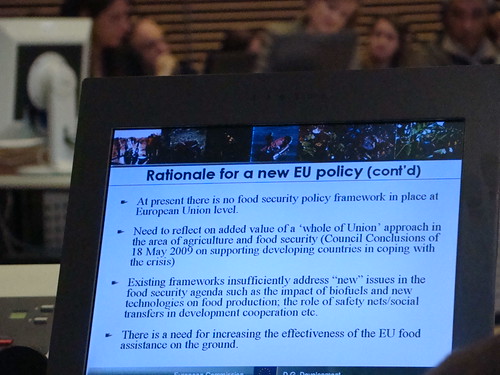
Food Security and Agriculture are very much back on the agenda. Building on its Food Security Thematic Strategy Paper 2007-2010, the European Commission is currently developing a new Policy Framework to assist developing countries addressing agriculture and food security challenges. On 9 december 2009, at the CTA organized Brussels Briefing “From Global Food Crisis to Local Food Insecurity”, the Directorate General for Development elaborated on its Issues Paper on food security.

DSC01913


The new policy framework will build on central elements of the past framework:

• The aim remains not simply to deliver food aid but to achieve Food Security for all
• Maintain a link between relief and protecting sustainable livelihoods and crisis prevention
• Address four pillars: availability (1), access (2), quality and utilization (3), and crisis management and prevention (4)

The Issues Paper was published 16 november 2009 and is part of the consultation and policy development process which has to lead to Council Conclusions – an official statement of the ministers of EU members states – on a Policy Framework on Agriculture and Food Security in May 2010.

Until 9 January 2010 you can voice you opinion about the Issues Paper at www.ec.europa.eu/yourvoice/consultations


Several participants at the Brussels Briefing organised by CTA commented on the presentation by the DG-Development representative. ActionAid welcomes the EC initiative but feels the Commission has no long term approach to investment in agriculture and food security. Also, according to ActionAid, the EC approach lacks attention for women’s access to credit, land and services. For example, compared to an earlier version, the chapter on agriculture has been removed from the current version of the EC Gender Action plan, a document stakeholders may comment on next week. ActionAid also warns about the so-called “whole of union approach” that the Commision wishes to explore in connection with issues of Food Security. This approach suggests that members states – besides official development cooperation - use all kinds of other resources to achieve development objectives. However, ActionAid and Concord are concerned that the "whole of the union" approach is more about “counting all resources” as opposed to really “using all resources”.

Subscribe to the euforic newsfeeds on food security and eu cooperation for more news

Tuesday, December 08, 2009

Brussels Briefings live on the Internet

The Briefing “From Global Food Crisis to Local Food Insecurity” live on the Internet!. This way, you can easily follow the presentations and debates.

WHEN: December, 9 – 8:30 – 13:00 (Brussels Time)

This service (in English and French) is FREE and requires simply the use of a computer connected to the Internet.

To get access, please click on this link: http://scic.ec.europa.eu/str/index.php?sessionno=401 (use of the Internet Explorer browser is recommended)

For the programme, background note and registration form, please check http://brusselsbriefings.net/.

Sign up for the Brussels Briefing newsfeed; see also the Euforic newsfeeds on rural development, food security and the food crisis

Tuesday, December 01, 2009

Next Briefing on food crisis and food insecurity

The next Brussels Development Briefing will be held on 9th December and will discuss “From Global Food Crisis to Local Food Insecurity” in the context of the new EC policy on Food security to be released.

The Briefing will be looking at the domino effects of increased speculation in food markets (How has the global food and financial crisis affected food production and distribution and the food security of the poorest? Is global food production at risk in the medium and long term and will national food security and food sovereignty be the priority over global food availability? Is the small-scale farming more effective and resilient in times of crisis in least-developed countries?) and the on what realistic policy options can secure food supply and availability at global and local levels.

For the programme and registration form, please check http://brusselsbriefings.net/.

Earlier Brussels Briefings looked at 'ACP Agricultural and Rural Development: why Media matters?', 'Upgrading to compete in a globalised world: What opportunities and challenges for SMEs in agriculture in ACP countries?','The Role of Livestock for ACP countries: challenges and opportunities ahead', ' Meeting Food Safety Standards: Implications for ACP agricultural exports', 'Fighting against Illegal, Unreported and Unregulated fishing (IUU): Impacts and challenges for ACP countries', 'Land access and rural development: New challenges, new opportunities', 'How does international migration affect ACP rural development?', 'Rising food prices: an opportunity for change?', 'New drivers, new players in ACP rural development', 'Does Fair Trade contribute to sustainable development?', 'The climate challenge for ACP agriculture', 'Aid for Trade', 'Advancing African Agriculture' and 'Challenges to rural development in ACP countries.'

Sign up for the Brussels Briefing newsfeed; see also the Euforic newsfeeds on rural development, food security and the food crisis

Tuesday, February 10, 2009

Food crisis: the high level Madrid conference on Food Security for All

Source: EU News, Issue 1, February 2008

The EU Council approved the EU's contribution to a high-level meeting on "Food Security for All" that is due to take place in Madrid on 26 and 27 January.

The EU wishes the Madrid conference to urge the donor community to engage in a joint, coordinated and coherent response to the challenge of food security in developing countries. It further calls on the conference to launch a consultation process between all stakeholders of the global food system - developing countries, donor countries, international organisations, private sector, NGOs and civil societies - which would lead to the formation of a "global partnership for agriculture and food security". The global partnership would allow all stakeholders to renew their commitment to achieve a comprehensive and coherent long-term response to hunger and malnutrition.

The Ecumenical Advocacy Alliance (EAA) and faith-based organizations and leaders around the world hailed the recognition, at the High Level Meeting on Food Security for All, of the essential role of the Right to Food in combating hunger.

In his closing remarks in Madrid, UN Secretary-General Ban Ki-moon challenged the international community to add a third track to the food aid and safety response:”the right to food - as a basis for analysis, action and accountability."

"We welcome this outcome and look forward to the concrete elaboration of how the Right to Food will be linked to the actions proposed by the UN High Level Task Force; it is essential that this statement is much more than lip service, but will be made operational and guide actions at country level," said Rudolf Buntzel, chair of the APRODEV working group on Trade and Food security, one of the three e faith-based delegates to the Madrid meeting advocating for more just policies to benefit the poorest and most vulnerable.

In Madrid, together with the EU, some participants were promoting a new Global Partnership for Agriculture and Food Security (GPAFS). However, the relevance of a new global partnership for the people that suffer hunger was highly criticized by many civil society organizations and some governments. The establishment of the partnership was not formalized during the meeting and will undergo further discussion.

APRODEV representatives questioned whether the complex process proposed during the conference (GPAFS) will lead to a more efficient structure rather than only improving the functioning of the international organizations that currently have the lead in tackling hunger such as FAO, IFAD and WFP.

The UN Secretary-General called for urgent commitment and action. "The way forward must link actions to reduce hunger, improve food and nutrition security, broaden social protection for the vulnerable, improve agricultural production, and make trading systems work for the world's poorest," he said. "We must raise the political profile of actions in all of these areas, advocating for finance, action and results."

The Ecumenical Advocacy Alliance (EAA), the broad international network of churches and Christian organizations cooperating in advocacy recently launched a broad campaign on Food. For more information and for the EAA press release on Madrid Conference, see the EAA website.

See also Euforic's newsfeeds on the food crisis, CIDSE and APRODEV